
In a clash of credentials that has captivated the state, a five-person panel of alleged experts, the Tasmanian Planning Commission, has dared to challenge the singular, unassailable wisdom of David O’Byrne, President of the Southern Football League.
While the panel’s CVs read like a dusty encyclopedia of public service; “longstanding and extensive involvement in planning,” “Senior Counsel since 1981,” “former Secretary of the Tasmania Department of Treasury and Finance,” “35 years’ experience encompassing architectural practice”, O’Byrne’s statement on the Macquarie Point stadium has made it clear that their so-called expertise is merely a niche hobby.
After all, what is a “biannual Sidney Luker Medal” for urban and regional planning compared to the crucial responsibility of organising fixtures for the Brighton Robins?
What is the experience of a former Mayor of Flinders Council and chair of Metro Tasmania when stacked against the weighty decisions of a SFL President, whose very job it is to ensure the heart of the community, local footy, is alive and well?
And let us not even speak of the panel’s most glaring weakness – their lack of any significant professional history with the Southern Cats.
O’Byrne’s statement, a work of philosophical genius, reveals the TPC’s fatal flaw – they think with their heads.
They’ve relied on things like “data sets,” “economic analysis,” and “existing planning schemes written in the 1990s” to reach a conclusion. How quaint.
O’Byrne, on the other hand, operates on a higher plane.
He understands the profound truth that a future AFL team, one that does not yet exist, is a far more reliable source of economic projections than all the bean counters in the world. He understands that a subjective feeling about a stadium’s “ugliness” is just as valid as the objective analysis of a seasoned urbanist.
The TPC, in their naivety, “routinely disregarded experts for their own contrary views.” O’Byrne, however, knows that the only view that matters is one’s own. The panel is a collection of parts whereas O’Byrne is a unified, harmonious whole.
They are a committee – he is a force of nature.
The TPC’s recommendation to refuse the stadium is a sad and predictable outcome from a group whose collective experience is limited to running governments, managing economies, and designing cities. It is indeed a relief that Tasmania has people like O’Byrne at the helm, a man whose skills in navigating the treacherous waters of grassroots football administration have prepared him for this far more complex challenge.
He has done the difficult thing after all.
He has made up his mind, and now it is up to Parliament to follow suit, regardless of what a bunch of planning nerds and lawyers have to say about it.
 The Southern Football League Board last night (28 February 2023) appointed Mr David O’Byrne as President of the Southern Football League.
O’Byrne fills the vacant Presidents position after Russell Young announced that he would be stepping down from the role on the 1st of March 2023. O’Byrne will occupy the position until the 2024 SFL Annual General Meeting.
O’Byrne has been involved in Australian Rules Football in numerous roles including previously playing for South Launceston, Sandy Bay and the Southern Cats in the former Statewide League and also with University in the Old Scholars league. He has also played football interstate and is currently a member for Franklin in the House of Assembly.
David O’Byrne, Independent for Franklin, 18 September 2025
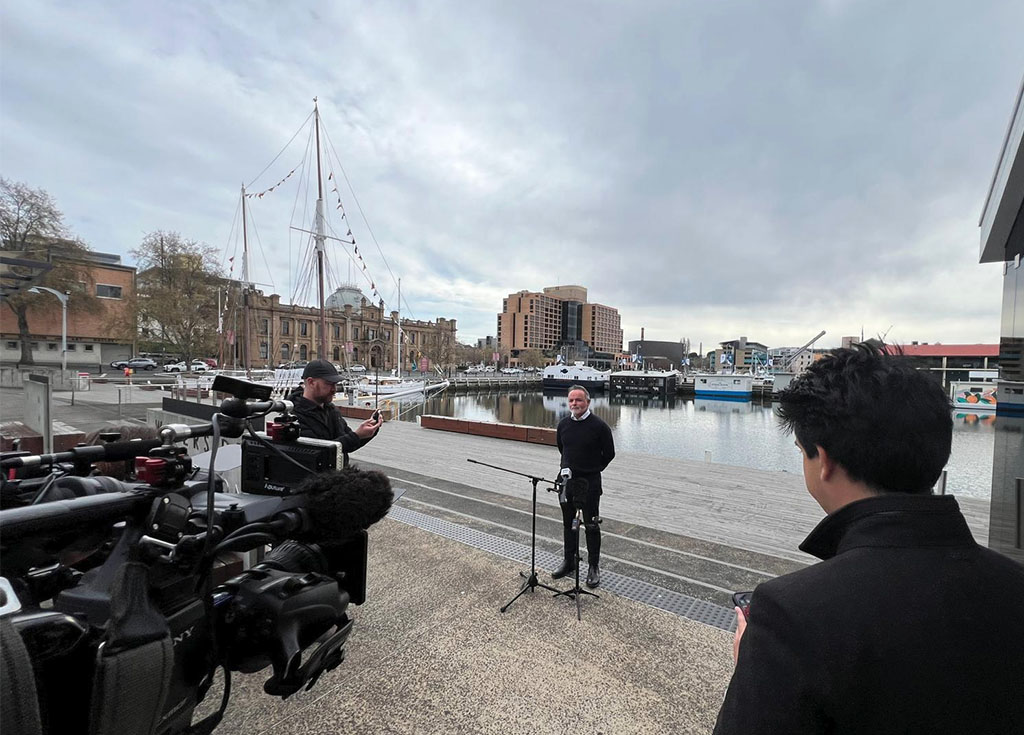
I spoke to the media a short time ago about the TPC report into the Macquarie Point stadium. Here is my full statement as posted into his Facebook page.
Statement on the Macquarie Point stadium report
The report by the Tasmanian Planning Commission on the Macquarie Point Multi Stadium provides Tasmanians with important information on the project.
Firstly, the POSS process is one of a number of planning processes that are open to Governments and planning authorities.
This is the first assessment under this element of planning legislation since 2010. Only six projects have been proposed under this legislation since the late 1990s, with only Basslink being successful.
It should be noted it was the demand in 2023 of former Liberals turned independents John Tucker and Lara Alexander that dictated Government adopt the POSS process and abandon the favoured process.
It is a fact that the POSS process is rarely used and considered by many as cumbersome and problematic.
It is important to note that even the Panel had to seek external legal advice on what it could or could not consider in this process.
Whilst the panel members all have levels of experience in their chosen fields it is not a standing expert panel but rather a newly formed panel comprised of individuals tasked with compiling evidence as best they are able.
This is the first time all of them have been asked to do something of this type in this context under this act.
Having said that, much information has been learned from the process and we should accept that it has assisted the public with a greater level of detail about the proposal.
I acknowledge the panel for their work and commitment to undertake this task.
What is pleasing from the report is that the vast majority of concerns raised in the interim report from earlier this year have been accepted as matters that are not fatal to the project.
Objectively the stadium can be built, the site can accommodate the proposal, the traffic and pedestrian impact can be managed, the noise and environmental impacts can be mitigated.
The report however recommends the project should be refused.
At the core of the recommendation are subjective issues raised which, whilst not being insignificant, are matters that are a matter of opinion and argument.
It is clear that the panel throughout the report routinely disregarded experts for their own contrary views without providing any explanation as to why.
As an example with the discounting of the benefit cost ratio (BCR), the panel has assumed interstate visitation to football games by using a data set relating to games played at Bellerive by North Melbourne between 2021 and 2024.
The panel have also stated that the facility will not add to the overall convention and conference market but would simply result in a redistribution of existing events between already established facilities.
On both these matters the panel has applied manifestly flawed logic.
The panel also does not take into account that the Tassie Devils will not exist without the development of a facility that underpins the club’s business case. They fail to appreciate the cost to Tasmania of not proceeding with the project.
The impact on Tasmania’s social and human capital should not be underestimated.
I can’t accept that thousands of direct construction jobs, an AFL team, other sporting and arts events, a 1500 seat convention centre, $360m investment from the AFL and a $240m investment from the federal government – all dependent on this stadium – does not represent a compelling case to mitigate concerns around public investment.
The report also fails to adequately acknowledge the construction activity that will occur across greater Hobart to take advantage of the economic opportunity created by the stadium build.
The panel also apply an assessment of the management of the cost of the project in a way that ignores how all infrastructure projects are managed by state governments.
In terms of the budget, this is simply about the government deciding how infrastructure funding is spent over the coming years in the context of a $1bn per year infrastructure budget.
This report is based on a planning scheme that was written in the 1990s. It is clear that all major projects of this type across the country have required special planning legislation as existing schemes fail to adequality assess or manage them.
The panel report provides extensive explanation on their view of the size, design and impact of the stadium on Hobart. Of course there will be some people who will not like the building and think it’s ugly and disagree with the location, that is the case for all developments and all buildings. But that’s not a uniform, factual view the panel can espouse.
Overall, this report does not change my view that the stadium should proceed.
The recommendation for refusal is just that – a subjective recommendation that is not beyond critique – it is now up to members of parliament to decide.
The easy thing is to say no.
The difficult thing is to work hard and make it happen.
Tasmanian Times (TT) is a community-based news and current affairs service covering the island state of Tasmania. It exists to provide a diverse presentation of Tasmanian issues. TT creates and supports independent media content utilising the best of modern technologies and tried-and-true practices of public-interest journalism.
Support us in expanding our coverage and developing new content by and for Tasmanians.
New initiatives on the way include … what our contributors and readers suggest! Please get in touch with your suggestions.