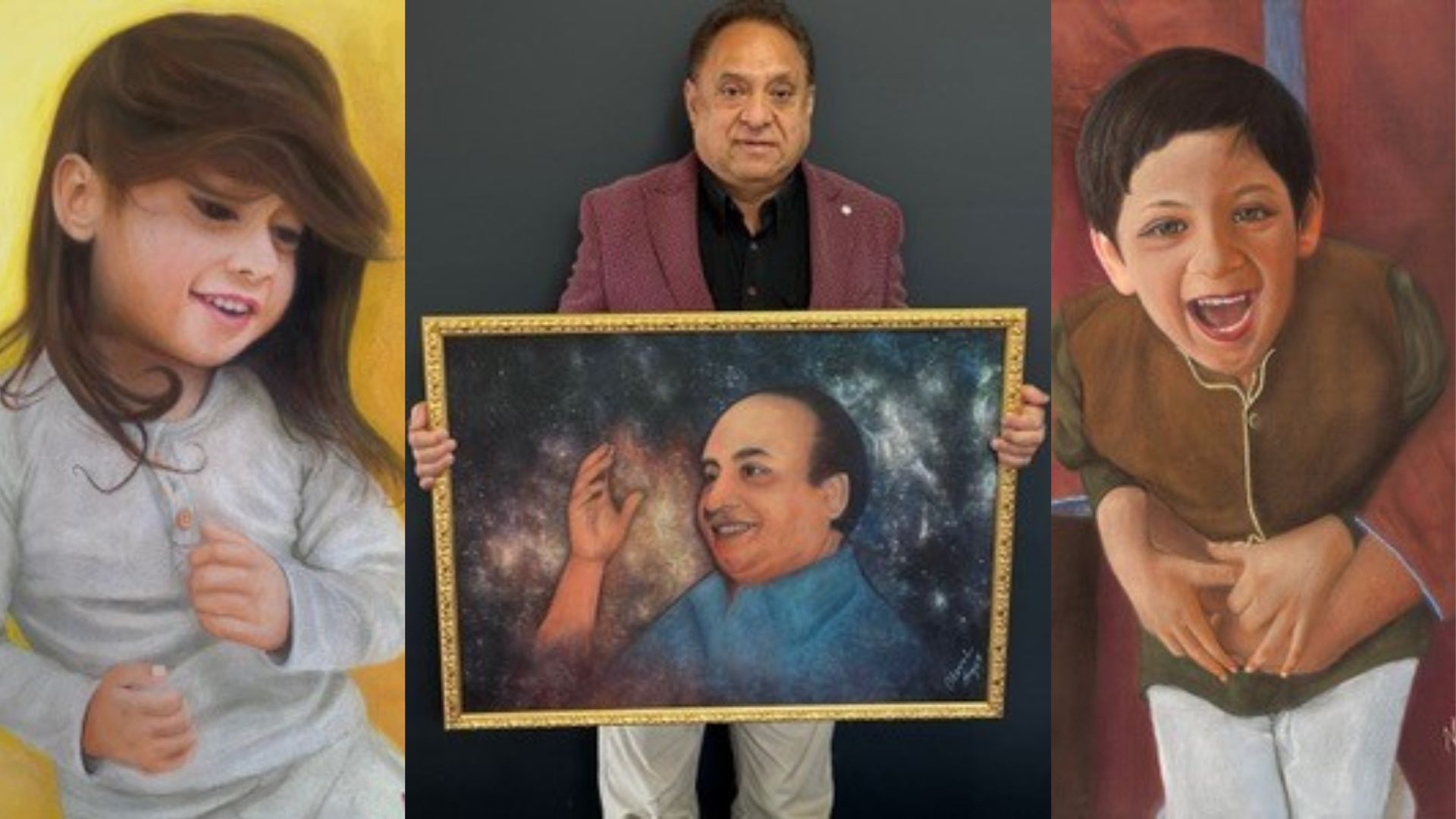
Dr Gajinder Oberoi, a Hobart-based doctor who led the development of specialist pain services at the Hobart Hospital, is now donating the proceeds from his artwork to the Royal Hobart Hospital Research Foundation (RHHRF) to support local medical research and patient care.
“I have been helping people around the world manage their pain for the past four decades […] and I want to keep giving back to my community that has given me so much,” Dr Oberoi said in a media release on Friday 4 July.
RHHRF CEO Steph Furler said it was an honour that Dr Oberoi chose to donate the proceeds of his artwork to the foundation.
“Dr Oberoi’s generosity is extraordinary,” she said.
“He has already left a lasting legacy through his work as a doctor, and now he’s supporting future health improvements for Tasmanians in such a thoughtful, creative way.”
Dr Oberoi was born and raised in India, moved to Papua New Guinea in the late 1980s, and later settled in Tasmania, where he established the state’s first accredited training program in pain medicine.
During his career, Dr Oberoi often sketched anatomical diagrams to help patients visualise their pain.
“For example, I once had a patient who was having pain problems with his hand,” he told Tasmanian Times.
“He dissociated from that by not looking after it. He stopped washing it; he stopped using it. It was swollen and there was a lot of pus. When he came to me, I thought that he had rejected that hand as not being a part of his body. So I drew his [whole body], and I could see the change in his emotions, because he was not expecting that. He thought I would just show that hand. I was trying to tell him that his hand was part of his body and by not using it, all these joints were being affected. It was educational for him and I could see his acceptance that ‘This is something which belongs to me’.”
The practice of sketching anatomical diagrams strongly informed Dr Oberoi’s artistic journey.
Two Images, One Message
Around 10 years ago, Dr Oberoi was invited to speak at the annual emergency medicine conference that was sponsored by MONA and held at the Hobart Grand Chancellor.
“MONA said, ‘Whatever talk you give, you have to do it with some diagrams or paintings’,” he told Tasmanian Times.
The message of his conference talk was that pain is relative – what’s painful for one person might not be for another – so he made two sketches to illustrate this.
One of the sketches was an Indian man “sitting on thorns and worshipping, doing some sort of meditation, and was not in pain”.
“The second image was myself [a self-portrait], which I did very poorly, but it was of me looking at myself in the mirror,” Dr Oberoi said. “The picture was of the mirror, and the mirror had cracks.”
He said the self-portrait was confusing for the people at the conference.
“They asked me this question, ‘What do you mean by that?’
I said, ‘Listen, when you have chronic pain, your image is distorted or has got cracks, so you have to repair the image’. That’s a very big answer and they loved it, actually.”
He told the audience that repairing a patient’s body image cannot be done with just emergency medicine.
“Basic things should be taught to those patients by providing primary help and then sending them to a proper physician who can look after [their body image problem],” he said.
The Patient Who Wanted Justice
While living and working in Papua New Guinea, Dr. Oberoi once treated a local tribesman who had been shot in the chest with an arrow.
“He was not worried about death,” Dr Oberi told Tasmanian Times.
“He was also not worried about his body image because their body image is [different to ours]. He was more worried about what he could do to make sure the fellow who shot him with the arrow was punished.”
Dr Oberoi added that the tribal man only lived a few days after being treated “mainly because of infection”.
Callum J. Jones studied English, History, and Journalism at the University of Tasmania and lived in Western Sydney from 2022 to 2024 while working as a journalist for Professional Planner, a leading online publication for financial planners. He has written for Tasmanian Times since 2018 and has also been published in a range of other outlets, including Quadrant and the BAD Western Sydney anthologies.
Tasmanian Times (TT) is a community-based news and current affairs service covering the island state of Tasmania. It exists to provide a diverse view of Tasmanian issues. TT creates and supports independent media content utilising the best of modern technologies and tried-and-true practices of public-interest journalism.
Support us in expanding our coverage and developing new content by and for Tasmanians.
New initiatives on the way include:
- a weekly podcast covering current affairs
- a revamped website
- a monthly cartoon competition
- a user-friendly app for both Android and Apple devices
- a weekly roundup of key stories