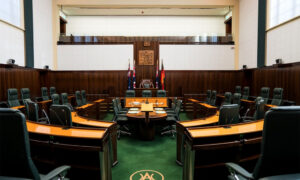
When the Tasmanian Charter of Budget Honesty was introduced in 2007, it was intended to promote transparency in election campaigns, and to promote fiscal discipline.
Under the Charter, Treasury is required to prepare a pre-election Financial Outlook Report. As in previous reports, it painted a particularly gloomy outlook for the budget, pointing out the importance of significant and early re-adjustment in fiscal settings.
Treasury did its part but as far as the major parties interact with the Charter, ‘budget honesty’ is an oxymoron on a par with ‘military intelligence’. Transparency takes a back seat.
The problem lies with the repeated claim that election promises will be ‘submitted to Treasury for costing’. Presumably this is intended to reassure voters that promises have been carefully developed and that costs are realistic. If it were complete, it would also provide a checklist as to which promises have been kept.
The Charter fails on both counts.
Here’s a few numbers to start with. Until election day, the three parties had submitted 153 policies for costing. Treasury was unable to cost a third of these (seven from the Greens and 35 from the Liberals) either because they were submitted too late, or because insufficient information was provided. The Labour party doesn’t appear on this list. It’s not because they were particularly diligent. Quite the reverse –it was because only a few of their promises were actually submitted.

TasInsure was unable to be costed as the concept was inadequately defined.
To illustrate the problems, consider a few significant examples from each of the three parties.
The Liberals’ proposal to expand the Motor Accident Insurance Board to be a comprehensive insurance company – TasInsure – was submitted for costing. This is a major change, and its impact on the budget is likely to be significant. But Treasury was unable to analyse it because “There is limited detail available on the structure, governance, legislative and financing requirements that will apply to the new entity”.
Did the ‘submitted for costing’ claim give voters the impression that TasInsure had been subject to careful policy development? I hope not.
Then there are the dozens of proposals which weren’t submitted at all. The signature announcement from the Labor party, for example, was TassieDoc. It was proposed to establish ten new bulk-billed doctors’ clinics. TassieDoc comes with a hefty bill, as the commitment is to provide clinic space and cover administrative and overhead expenses for the clinics, including nursing and support staff.
Was it a credible announcement? Ironically, although TassieDoc wasn’t submitted, Labor promised to save $1.25m per annum by cutting the number of spin doctors in the Communications Office!
The Greens’ plan to impose a royalty on the salmon industry exposes a different issue. The policy is to introduce a royalty on salmonid aquaculture as a prescribed dollar per tonne calculated as 10 per cent of the average farmgate value of the previous year.
Treasury confirmed that the four-year estimate of royalty revenue of over $400m was plausible, given the assumptions. But it didn’t address the issue of whether the proposed fee is, in fact, a royalty or an excise. This is important because, under the Australian constitution, the states are permitted to levy royalties but not excises. Earlier High Court rulings on these cases suggest that the Greens’ proposal is a state-based excise. An alternative mechanism for taxing the salmon companies needs to be found.
As this example illustrates, the Charter doesn’t require Treasury to analyse proposals in great detail – whether there are hidden complexities in the required legislation, for example.
Having a proposal costed by Treasury doesn’t necessarily mean that it’s a good idea, or even a high priority.
There are important differences between Tasmania’s Charter and the federal requirements. In Canberra, submissions require detailed information on the data sources used, sensitivity of outcomes to different assumptions, and the four-year effects on fiscal aggregates. Costs should also include the administrative burden on the relevant government agencies.
The Parliamentary Budget Office receives separate funding to analyse costings, assesses their plausibility and, after the election, publishes a report on the overall impact of election promises.
Outside the election period, the PBO is also available to provide detailed analyses of policy proposals. While not all of these are released publicly, they give access to analytical grunt not normally available to the smaller parties or independents.
One of the reasons often cited for a growing shift away from the major parties is that they can’t or won’t deliver on election promises.
The Charter was introduced as a mechanism to deliver transparency. In terms of costing election promises it has failed to meet this objective.
Things need to change.
We can’t afford a full-blown Parliamentary Budget Office as in Canberra. But we should look to other jurisdictions – in Canberra or New Zealand, for example – to find ways to finds ways to require politicians to take the costing process seriously, and to provide the voters with a modicum of confidence in the promises they make.
Dr Graeme Wells is an independent economist, having previously had an academic career in New Zealand, North America and, more recently, as Associate Professor at ANU and UTAS. Since returning to lutruwita/Tasmania he has been a consultant and adviser to a range of private sector and government agencies.
Tasmanian Times (TT) is a community-based news and current affairs service covering the island state of Tasmania. It exists to provide a diverse view of Tasmanian issues. TT creates and supports independent media content utilising the best of modern technologies and tried-and-true practices of public-interest journalism.
Support us in expanding our coverage and developing new content by and for Tasmanians.
New initiatives on the way include:
- a weekly podcast covering current affairs
- a revamped website
- a monthly cartoon competition
- a user-friendly app for both Android and Apple devices
- a weekly roundup of key stories