Article
Constantine Asquith – Convict Fraudster and Mustachioed Master Mariner

Not all convicts sent to Tasmania were from British territories. The British National Archives report that there were 1,321 convicts from ‘other parts of the Empire’, and this does not even include men and women from non-British foreign countries.
However, in this case Constantine Asquith was rather vague about his birthplace, plus he had several aliases, one being Schaeffer. His Tasmanian conduct record reads: ‘Native Place; Boundaries of Russia and Prussia’, but no hometown is given, although he later claimed considerable property there.
Nevertheless, a witness at Asquith’s Old Bailey trial described himself as Peter Henry Schaeffer’s countryman, and this man was from Memel [now Klaipeda], Lithuania. And at one time he was reported to have spoken with an accent, probably German/Slavic. Either way, compounding this uncertainty, when sentenced Constantine, aged 31 years, went by Asquith [Asqueth in court documents]. In fact, trial transcripts suggest that he also used over four aliases including Brandt and Schmidt.
Asquith’s story has elements worth recording, not least his commonly held perception of his status. In common with many other convicts he misinterpreted the level of freedom granted by a ticket-of-leave and especially by conditional pardons. His crime, occurring in April 1849, was for forging 1,200 quarters of wheat which, using the name Captain Brandt, was said to be worth ‘400 golden dollars in his writing’, albeit under the name Moxila or Molia. Golden dollars were minted during USA’s goldrush, and at that time a grain ‘quarter’ equalled ¼ ton. This wheat was, according to Brandt, stored onboard his ‘brand new’ ship Russia.
The vessel’s cargo was detailed on a German language manifest, which when translated helped Asquith/Brandt successfully obtain an advance of 25 sovereigns. Gaining this subterfuge was aided by another document from a man named Cruzinski, who also endorsed the existence of the wheat. But checking revealed no such vessel was berthed at Gravesend, and Cruzinski’s hand-writing was found to match Asquith’s. Besides Cruzinski’s firm had folded in 1828!
Another witness at Asquith’s trial, held on 2 July 1849, reported Constantine, using the name Captain Schmidt of the Frien, claimed that his ship had lost its anchor and that he ‘needed £65 to refit myself’. Schmidt also said that he was going back to Bristol to marry a girl there and so needed money, producing yet another letter to support his claim. It was from a ‘rich merchant in Bremen’ Germany, warranted by a banking house in Amsterdam, and so Schmidt was advanced the money. Yet another letter confirmed that £60 due to Schmidt was coming from a Liverpool-based agent of a company called Moella & Co. However, the lender, a marine businessman, explained in court that the ‘letter came, and we opened it, we found we could not get the money’. And when he queried this letter his was returned via the dead letter office because no such business existed.
However, what brought Asquith undone was a return to a dwelling house in Clifford’s Passage, London that he had used before. While there he claimed that he had to go to Holbeach, Lincolnshire where had ‘made proposals’ to marry the daughter of a spirit merchant on 25 May. But this was not where he had earlier claimed he was going, plus this merchant said at trial ‘I have never lived at Bristol’.
Also before leaving London Asquith asked the landlord to cash a letter for ‘1,000 silver roubles’ from a reputable firm in Riga, Latvia. But, ‘having heard something about him’ the landlord reported the matter to the police. The letter was soon identified as a fraud because it was missing the signature of a clerk in the relevant firm. It was also mistakenly signed Asqueth!
All of which brought the wheat cargo matter to the fore. Faced with this mass of evidence, Asquith pleaded guilty and was sentenced to ten years transportation—it could have been life. Nevertheless, under the prevailing probation system he spent his first years in a British prison, supposedly being reformed via hard labour, some education and occupational training.
With Asquith onboard, the Oriental Queen left Plymouth on 23 September 1852 and after 149 days at sea it reached Hobart on 19 February 1853. Once docked, when asked Asquith ‘stated this offence’; ‘Forging a bill of lading, was Captain of the Lyra’. Adding that he had a brother in London and was single, and that his religion was Lutheran, which matches his origins. Able to both read and write, his trade— no doubt from his own lips— was noted as a Master Mariner.
His physical details were documented; height 5’ 9¼’’, aged 35, with dark complexion, a large head and a large mouth. With light blue eyes, his nose was dubbed ‘aquiline’, and dark brown hair and whiskers. In addition to being hirsute, albeit with a ‘retreating hairline’, he had a ‘defective nail on right forefinger and small scar on upper lip, right side’. All this being necessary in the pre-photographic era, should he abscond. This extract from the ship’s indent includes ‘B’ for both read and write.
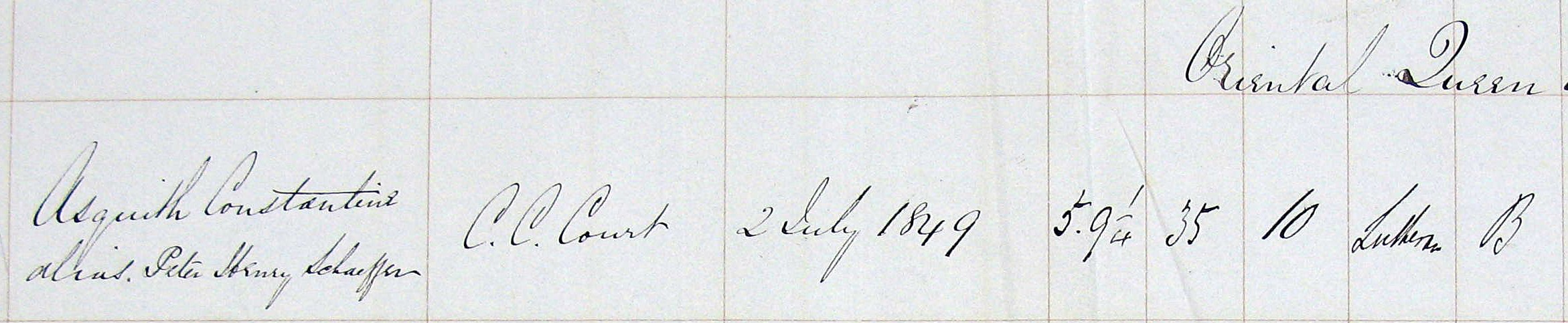

A brief aside in connection to the Oriental Queen. Captain Samuel Radford Thomas appears to have been a harsh taskmaster, possibly even starving his crewmen—they claimed. True or not, on 4 March 1853 the men refused to return to the vessel, claiming that Thomas intended to renege on a promise to pay them off at Sydney. Captain Thomas duly charged them with mutiny, and so 13 crew members faced Hobart court on 7 March. The result was that each man gained one month’s jail at hard labour —likely on the treadmill.
But with so few crewmen available to him the magistrate advised Thomas that if he needed these men he must apply for remission of their sentences. It is unclear what transpired on this, but on the 9th Thomas charged another two sailors with desertion, and they gained even longer sentences! Finally, the Hobart Town Advertiser report hints that the crewmen had ‘gold mania’ and were prepared to face their punishment in Tasmania and afterwards go to the gold-fields.
Returning to Asquith, because of his ten-year sentence he was to serve two further years of probation [less five months] in Tasmania. Given his sea-faring background he was soon employed by Olaf Hilmer Hedberg, Argyle Street, Hobart, himself then a mariner, and later a fireman and merchant [whose building now houses part of the Theatre Royal and UTAS]. Hedberg’s employee record is of interest because probation pass holders could earn between £7-10pa. Several of Asquith’s predecessors did earn similar sums, but in March 1853 he earned £12pa, suggesting that Hedberg utilised his skills. Also, after Asquith moved on, two other men earned just £9 or £10pa, but for the record, three female employees earned between £7-8pa, which lower rate was standard for females…
After leaving Hedberg, Asquith was appointed as a constable in August 1853. He was still only a pass-holder until three months later he gained the next level of indulgence. His ticket of leave was issued in November 1853, but on 17 January 1854 he resigned from the police. However, shortly afterwards he breached convict regulations in a way that deserves some attention. Thankfully, several local newspapers inserted his story, which adds to Asquith’s physical description. It also mentions that the magistrate criticised the presence of a moustache —as part of a goatee beard?—which may have been considered too dashing for a convict as perceived by the ruling classes.
Asquith’s ‘pompous’ demeanour is also mentioned by Colonial Times under this bold headline:
AN ARISTOCRATIC TICKET-OF-LEAVE HOLDER
Constantine Asquith, aged 35, a ticket-of-leave holder, was apprehended a few days ago, and charged before the police magistrate with misconduct, in ‘falsely representing himself to be free’. The defendant was tall, pompous, and rather good looking; attired in black, his chin bearded, and his upper lip adorned with a moustache. It turned out that he had fallen into company in town, and while enjoying the luxury of a carriage-airing, a constable who had some knowledge of him, walked up and asked him who he was. He replied, ‘I am a free man, who are you sir?’
The constable there and then walked him to the watch-house. It was mentioned in court that the détendant had been passing throughout the town by the counterfeit distinction of a ‘Captain’, either of the army or the navy.
The police magistrate said it was very unbecoming of defendant, simply a ticket-of-leave man, to wear a moustache, and be decked out in the guise in which he was; and, seeing the deception he had been practising upon the credulity of free persons, he should order him to be imprisoned in the House of Correction [Penitentiary], there to remain and be kept on hard labor for the space of one calendar month, and recommended not to reside in the district of Launceston. Defendant opened his eyes rather wider than usual on the sentence being pronounced.
Shortly after his release Asquith tried what many convicts attempted, an escape. On 20 April 1854 he was discovered as a stowaway onboard the Tasmania. When reporting this the newspaper mentions his accent, and underlines the reality of his status; probation pass and ticket holders remained under convict regulation. Even after convict transportation to Tasmania ceased in 1853 they still had to report their residence to police, and not relocate without a pass. The Tasmanian Colonist wrote:
Constantine Asquith, a Prussian, and a pass-holder, was charged by… the Water Police, with ‘absenting himself from his authorised place of residence, and with being concealed on board the Iron Steamer Tasmania with intent to leave the colony’. The prisoner, a very intelligent man, pleaded guilty, and, in a foreign accent, stated that he had nothing to say to the charge, except that he had some considerable property in his own country, which he was anxious to enjoy; and where he would have better prospects than he could hope for here, where he was annoyed from all quarters, so that he became actually tired of his life; he had been working a craft [ship], and gaining an honest living; before he came to this colony he was the master and owner of an East Indiaman [vessel] of 600 tons; and he further stated, that if he had wished to leave the colony ho could have done so a hundred times; he could not tell, however, how this circumstance had occurred, as he thought he must have lost his senses.
Their Worships consulted together for a few minutes, …[and] the decision of the Bench,… imposed a sentence of twenty days solitary confinement, for which the poor delinquent seemed very grateful. It was really heart-rending to see a person of this description charged, with such an offence. The man’s demeanour was so respectful and obedient, that, as far as we could ascertain, their worships felt much for his situation, being, as he is, a prisoner of the Crown.
Being grateful sounds unlikely, although for such ‘passing off’ magistrates regularly handed down many months of hard labour. Nonetheless, almost a year later, on 13 March 1855, Asquith was listed in the Gazette as AWOL, and so his ticket of leave was revoked. But a fortnight later another entry amongst ‘Apprehended’ convicts listed his name, but added in brackets ‘(did not abscond)’. His ticket was duly returned to him on 10 April. Even before this hiccup the last entries made on Asquith’s conduct record lists the recommendation for his Conditional Pardon—7 November 1854— followed by the formal return of approval from England on 14 August 1855.
Between these dates convicts were effectively treated as ‘free’, merely awaiting Her Majesty’s pleasure, eg. they no longer needed government permission to marry. Therefore, they generally believed that they were already free, hence Asquith’s response to the Water Police. In addition conditional or partial pardons had been amended in 1844-45. Thereafter convicts were no longer restricted to remaining in the colony of their transportation. An endorsement was made on existing and new pardons that the individual could live in any Australian or NZ colony, but not UK or Ireland, nor the country from which they were transported. Therefore, many convicts relocated, often changing their names to erase their past. Asquith, perhaps using one of his aliases [Schaeffer/Brandt/Schmidt/or three starting Mo…] left Tasmania, and after his sentence expired he almost certainly returned to Europe to, as he put it, enjoy his properties there.
Tasmanian Times (TT) is a community-based news and current affairs service covering the island state of Tasmania. It exists to provide a diverse view of Tasmanian issues. TT creates and supports independent media content utilising the best of modern technologies and tried-and-true practices of public-interest journalism.
Support us in expanding our coverage and developing new content by and for Tasmanians.
New initiatives on the way include:
- a weekly podcast covering current affairs
- a revamped website
- a monthly cartoon competition
- a user-friendly app for both Android and Apple devices
- a weekly roundup of key stories