If the state of Tasmania was my patient and they told me that they had taken out a second credit card to borrow money to pay the interest on the first, I would immediately send them to Anglicare for urgent financial counselling. Clearly, they would need help to get out of such a self-defeating spiral of doom.
It is in this exact context that both Tasmanian old parties, Labor and Liberal, have agreed that what this state needs is an AFL stadium with a price tag of $1.86 billion – rather more red cents than the $375 million cap promised by the Liberal Government.
No-one will die if we don’t have a third stadium. But people will surely suffer and even die because of the cuts the government of the day will have to make to pay for this act of irresponsible borrowing.
Serious and extensive cuts to all kinds of services – health, housing, education, police, transport – you name it, jobs and services will have to go.
Already, the message from government is clear – there is no money. No money for any new initiatives in education, housing, tourism, heritage, parks, climate change adaptation and the rest, even when the need and the benefits are clear.

Catastrophic
Tasmania has no spare cash. The Treasury predicts that we are already facing a catastrophic level of debt, forecast to reach $13 billion by 2028-29. The interest bill alone amounts to $1,200 per person per year.
In a cost-of-living crisis, how is it that our leaders ever contemplated investing in such a bad bet?
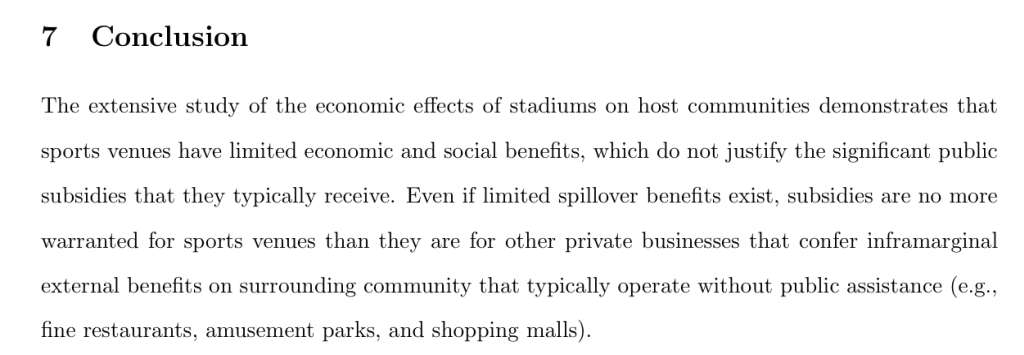
Stadiums lose money. This is a proven fact. The benefits touted before construction never eventuate. Academic peer reviewed research all around the world demonstrates (see conclusion below) that the promises made in the planning stage are not fulfilled.
But it gets worse. Where stadiums are constructed, it is usual for the private sector to carry some of the risk. In the USA, for example, public funding for stadium construction varies between 40 and 70 percent.
Tasmanian taxpayers are going to be asked to pay 99.2 percent of the costs of the Tasmanian roofed stadium – the $15 million contribution from the AFL amounts to only 0.8 percent. The lack of private investment confirms the reality that there is no prospect of profit.
In a recent review of 130 studies on economic outcomes of sports stadiums, the findings were unequivocal: “The level of venue subsidies typically provided far exceeds any observed economic benefits.”
The authors conclude there is “deep agreement in research findings” that “sports venues are not an appropriate channel for local development policy”.
Other research suggests that perceived local benefits merely reflect a shift in the destination of disposable income that would have been spent anyway. In this case it’s mainly from the north and north-west to the south of Tasmania.
Big economies can absorb these costs, like loss leaders in a supermarket. Tasmania is not a big economy, nor a particularly robust one. Our widely dispersed population is only 575,000.
Sometimes there are other perceived benefits to projects like these. These may be intangible, like an increase in civic pride.
Given the levels of anti-stadium sentiment, it is hard to believe that this will prove to be a unifying project. If anything, it is likely to cause on-going resentment, reinforcing Tasmania’s existing regional divisions.

Lack of accountability
My trawl through the published research (none of it positive) did throw up one great idea.
Again, I quote: “As a potential institutional reform, communities should assess all stadium proposals through referendums and initiatives, a once-common practice which has declined over the last few decades.
“Public votes ensure that subsidies are congruent with voter preferences and allow time for careful consideration of all relevant costs and benefits, so that voters can make informed decisions.”
To date the history of this project has been the absolute opposite. The Macquarie Point stadium is a sordid tale of deals made behind closed doors, without discussion in Cabinet or with the state Treasury, and unrepentant resistance to all cries for meaningful public scrutiny.
Questions need to be asked.
Why have Labor and Liberal party leaders capitulated to the unreasonable demands of the AFL? Why are they willing to bypass our few opportunities for review like the Tasmanian Planning Commission process to force this disaster on our collective pockets without proper accountability?
If they – one or both – went back to the AFL, with an experienced negotiator, and pointed out the huge desire for a team, and the massive backlash against the condition of a costly roofed stadium in the second driest state capital, we should have teams based in the stadiums we have.
Make the AFL explain why they will not back a fair go for Tasmania despite the outstanding contribution that Tasmanians have made to Australian Rules Football over the years.
Focus on what matters
While our leaders are fiddling with football as the world burns, our most serious challenges are mounting up. Once more it would be good if we had a government that could read and digest the research.
It is ironic that climate science is the one area where Tasmania can be said to be a world leader – look at the recent university rankings – and yet our Government continues to attempt to bedazzle us with bread and circuses, deflecting attention from the realities we face.
Unpredictability of so many kinds is already with us. It is certainly our future – from the weather to geopolitical complexities.
Why aren’t we focusing all our energy and resources on preparing ourselves, like going on a war footing? We know that we, and even more our children and grandchildren, are in for a tough and unstable future. Why aren’t we taking this seriously? It breaks my heart, knowing a stadium is an anti-solution.
So, faced with unresponsive leadership, do we just give up?
Not me – my grandchildren will know I did everything I possibly could, on climate change and on this stadium. I have changed my bank, changed my super, changed my diet and I am practically a pen-pal of the Minister for the Environment in Canberra.
I will do my best to call out our decision makers’ stupid choices like this stadium when we have other more pressing needs coupled with a debt disaster.
Anxiety can be turned into action, and in this case, it was participating in the preparation of the Open Letter from Tassie doctors expressing our concern that we must spend more wisely than a stadium we don’t need and can’t afford.
Retired GP Dr Clare Smith was one of more than 100 Tasmanian doctors who have signed an open letter opposing the proposed Macquarie Point AFL stadium.
This article is republished with the kind permission of Croakey Health Media.
Tasmanian Times (TT) is a community-based news and current affairs service covering the island state of Tasmania. It exists to provide a diverse view of Tasmanian issues. TT creates and supports independent media content utilising the best of modern technologies and tried-and-true practices of public-interest journalism.
Support us in expanding our coverage and developing new content by and for Tasmanians.
New initiatives on the way include:
- a weekly podcast covering current affairs
- a revamped website
- a monthly cartoon competition
- a user-friendly app for both Android and Apple devices
- a weekly roundup of key stories