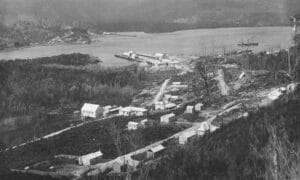
A change of plan regarding the old Bridgewater Bridge could cost Tasmanians up to $50 million as well as further fragment the state’s rail network.
Despite previously indicating that it planned to leave the lifting mechanism raised in place, the Department of State Growth (DSG) now wants to remove it.
As the project is currently out to tender DSG is tight-lipped about the expected cost, however Tasmanian Times understands that it is likely to be in the range of $40M to $50M.
The tender notice states: “The Old Bridgwater Bridge has now reached the end of its economic life and will be demolished following the construction completion of the new bridge expected in mid-2025.”
Independent Clark MHA, Kristie Johnston, argues that there is no actual need to remove it.
“It would only cost $200,000 a year to maintain, and would preserve both heritage engineering and the integrity of the rail link to Hobart,” she told TT.
Removing the old bridge – the causeway at the southern end of the link will remain – will mean that rail tracks from Macquarie Point to Granton will be cut off from the rest of the rail network.
The new Bridgewater Bridge has two traffic lanes in each direction plus a walking and cycling path, but no capacity for rail tracks.
“The Tasmanian Transport Museum wants access to the network to run excursions on heritage trains, but now they’ll be limited to a very short section of track,” said Johnston.
Removal of the bridge appears to be driven by private yacht owners wanting access between Hobart and New Norfolk. Although the new bridge is high enough to pass under, as is the old one, the two openings to do not align particularly well.
It is not known if this issue was identified during the design stage of the new bridge. A reliable source told TT that approximately 60 yacht movements per year would benefit from the demolition.
David Marriner’s Boyer Capital, recent purchasers of the Norske Skog paper mill at Boyer, are another potential beneficiary. The Norske Skog sale statement noted that: “the site has a total area of 565 hectares, offering significant opportunities for future developments, and good access to raw materials and logistics infrastructure.”
Johnston said that in her discussions with State Growth, they had indicated that the heritage values of the old bridge would be enshrined in ‘on-site interpretation and a public artwork’.
The causeway – constructed by convict labour in the early 1800s – is built on the shallower southern side of the river. Construction of a bridge to span the deeper northern side of the Derwent commenced in 1939 and was completed in 1946.
The lifting section is one of only a few remaining in the Southern Hemisphere, and is the largest of its kind remaining in Australia. In 2018 the bridge has received an Engineering Heritage Marker from Engineering Australia.
Transport
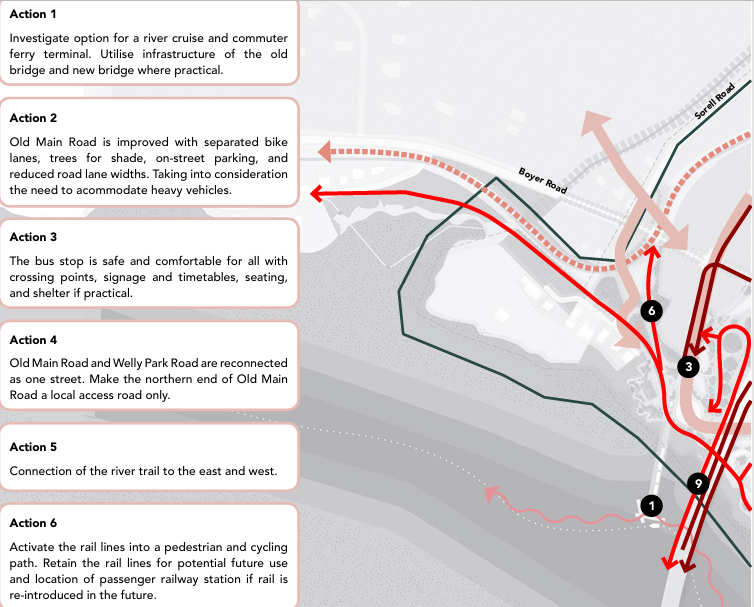 Brighton Council’s Bridgewater Waterfront Master Plan, dated November 2023, foreshadows a ferry terminal at the site of the old bridge.
Kristie Johnston said it was shortsighted to effectively rule out either light or heavy rail by dismantling the rail bridge.
“This government has no serious plan for public transport,” she stated.
“The public transport section of State Growth is just a contract manager with Metro and other service providers, that’s it.”
Johnston was also skeptical about whether a ferry would ever happen or even whether it would be a good option.
“It’s all very well to talk about ferries but they are most effective for short, straight trips. A rail link to the CBD from Bridgewater would be much faster than a ferry.”
The plan also seeks to encourage new residential development in the area and to revitalise the Old Main Rd hub of Bridgewater.
Page 42 of the plan acknowledges that: “We have heard how the community loves the old bridge structure. It is an iconic symbol of Bridgewater’s industrial heritage.”
Options discussed include moving the southern tower caisson for use as part of a pedestrian overpass, using the northern one as a lookout and pier, or demolition.
As it seems it’s this third option that is progressing, the documents notes that this could facilitate the posssibility to: “creatively re-use the material to create elements such as large scale public artworks, park furniture, structures, way finding and signage.”