Media release – National Shelter / SGS Economics & Planning, 22 November 2024
Rental affordability plunges to record lows across Australia
Rental affordability has plunged to record lows in almost every capital city and region, with low income renters bearing the harshest brunt of the crisis, according to the tenth annual National Shelter-SGS Economics and Planning Rental Affordability Index released today.
The Index highlights an increasingly dire situation. For single JobSeekers and part-time workers receiving a parenting payment, every city and rest of state area is now classed as severely unaffordable or worse. There is also nowhere affordable for pensioners and only regional South Australia is affordable for a single hospitality worker.
Sydney, Melbourne, Brisbane, Perth and Adelaide all recorded their worst affordability scores since the index began in 2014. The rest of NSW, VIC, QLD and SA also hit record lows. Rental affordability improved slightly in the ACT and Tasmania.
National Shelter spokesperson John Engeler said: “Renters across the entire country are under severe pressure as rent rises continue to outpace income growth amid historically low vacancy rates.
“The situation is especially serious for low-income renters who are increasingly forced to rent privately due to the declining availability of social and affordable housing.
“A single pensioner would have to spend 86 per cent of their income to rent a median one-bedroom apartment in Sydney. This is clearly unacceptable. Governments must urgently act to reverse this affordability crisis including by building more social and affordable homes and better regulating rental markets.”
In the past 12 months, rental affordability has declined 13 per cent in Perth, eight per cent in Adelaide, six per cent in Melbourne, five per cent in Sydney, and four per cent in Brisbane.
Perth is now the least affordable capital city, with median weekly rent of $629 taking up 31 per cent of median income, closely followed by Sydney where median rent of $720 is 30 per cent of median income, meeting the threshold for rental stress.
Ellen Witte Principal at SGS Economics & Planning said: “Deteriorating affordability across the country has been driven by a number of factors, including increasing material costs, the increased cost of construction, rising interest rates, a return to pre-pandemic rates of population growth, and strong rent price increases.
“Not only are rent rises hurting households, they are also exacerbating inflation. The ACT introduced rent increase limits in 2019, and rental affordability has improved there since. This suggests that guide rails that prevent excessive rent increases could serve a dual purpose of improving rental affordability and lowering inflation.
“Huge swathes of Australia are now unaffordable to even median income renters. With rental affordability deteriorating this rapidly, rents are now “critically unaffordable” for pensioners, JobSeekers and some single parents. We added the “critically unaffordable” category this year to highlight households that would now have to pay 75% of their income or more on rent.”
The Index was developed in partnership with the Beyond Bank Australia Foundation. Peter Rutter, Chief Community & Strategy Officer, said: “We believe everybody has the right to safe, secure and affordable housing, which includes rental accommodation. Through the Beyond Bank Australia Foundation, we invest in projects and initiatives that aim to make this a reality. We are proud to again partner in this important work so that we can continue to understand the cost of living pressures that people are facing and think about how we can work together to overcome them.”
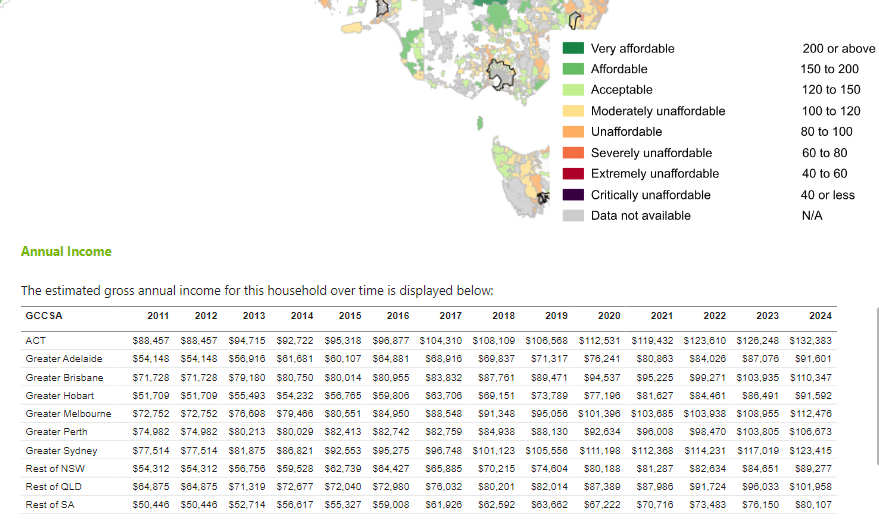
Editor’s note: The rental affordability index scores areas based on median rental prices and average income of rental households within the capital city or rest of state area. A score of 100 indicates households spend 30 per cent of income on rent, the critical threshold level for housing stress. This year’s release saw the category of ‘critically unaffordable added, highlighting households paying 75% of their income or more on rent. A lower score is worse.
Regional data available here.

Media release – ShelterTas, 22 November 2024
Low-income earners hit hardest in Tasmania’s rental crisis
Low-income earners across Tasmania are bearing the brunt of the state’s rental crisis, according to the tenth annual National Shelter-SGS Economics and Planning Rental Affordability Index (RAI).
The landmark annual study, released today, cross references incomes against rents and shows Tasmania’s most vulnerable households – those on pensions, JobSeeker or low-wage work – face a dire rental crisis with Unaffordable rents across the entire state.
Rents in Hobart remained stable in the past year, rising just 2.1 percent, but this does not offset the rapid rise in costs over the past several years. Since 2016, the median rental rate in Hobart has grown by more than 60 percent, with rents in the city just 10 percent lower than the Melbourne median, despite the average rental household income being more than 18 percent lower.
With a RAI score of 108, households across Hobart are paying up to 28 percent of their gross income of $91,592, which is considered Moderately Unaffordable. It’s even worse for people on low incomes, with single people on Jobseeker and single part-time workers on parent benefits facing Extremely Unaffordable rents.
The situation in regional Tasmania mirrors Hobart. Rents in the regions increased by just 2.6 percent over the past year, but with a rental score of 111 it is classified as Moderately Unaffordable. Renters in the regions are spending about 27 percent of their income on rent if renting at the median rate.
Regional centres such as Launceston are especially unaffordable with low-income earners and pensioners facing limited options. For those seeking Acceptable or Affordable rents, the only viable options are in the state’s north-west or central Tasmania, where essential services are often limited or difficult to access.
Acting Shelter Tas CEO, Kim Bomford, said: “Tasmania’s rental crisis is at breaking point, with low-income earners facing serious financial stress. Despite some improvement, the affordability crisis has deepened for those who can least afford it. Many are on the edge of homelessness and we need urgent reforms to stop the escalating financial stress that is plaguing the most vulnerable communities.
“The housing sector is in urgent need of intervention. Even households earning the average income can’t avoid rental stress, paying nearly 28 percent of their income to keep a roof over their heads. This combined with more general cost of living pressures exacerbates the situation for those on low incomes.”
Shelter Tas is calling on the state government to take immediate and decisive action to reverse the housing crisis by committing to an increase in social housing to at least 10 percent of all dwellings, strengthening renters’ rights by modernising the Residential Tenancy Act 1997, increasing funding for homelessness services and regulating short-stay accommodation.
“We welcome the commitments in the 20-year Tasmanian Housing Strategy (2023-43), but as the Action Plan (2023-27) is implemented, the top priority must be to house Tasmanians at risk of or experiencing homelessness, with the ultimate goal of ending homelessness in Tasmania for good,” Ms Bomford said.
“With rent increases outpacing income growth, the current housing crisis isn’t just a blip – it’s the result of long-standing underinvestment in social and affordable housing. We need at least 10 percent of all dwellings in Tasmania to be social housing if we are going to stop the crisis from spiralling further.”
| Household | Affordability | Rent as share of income | RAI score |
| Single person on JobSeeker | Extremely unaffordable | 71 per cent | 43 |
| Single pensioner | Severely unaffordable | 44 per cent | 68 |
| Pensioner couple | Severely unaffordable | 37 per cent | 80 |
| Single part-time worker on parent benefits | Extremely unaffordable | 56 per cent | 53 |
| Single full-time working parent | Acceptable | 23 per cent | 131 |
| Single income couple with children | Moderately unaffordable | 27 per cent | 111 |
| Dual income couple with children | Very affordable | 14 per cent | 222 |
| Student share house (three bedroom) | Moderately unaffordable | 28 per cent | 108 |
| Minimum wage couple | Acceptable | 25 per cent | 122 |
| Hospitality worker | Moderately unaffordable | 25 per cent | 119 |
* Table comparing each household in Hobart and their rent as a share of income, as well as RAI score and affordability.

Vica Bayley MP, Greens Housing Spokesperson, 22 November 2024
Liberal Government must act on rent unaffordability crisis
Rents in greater nipaluna/Hobart are the second highest of any capital city in Australia, the latest Rental Affordability Index report by SGS Economics and Planning has shown. Rents across regional lutruwita/Tasmania have been assessed as “moderately unaffordable”, and getting worse.
A safe and affordable home is a human right. But trying to find an affordable place to live across lutruwita/Tasmania is becoming impossible. Tasmanians are really struggling in this rental crisis.
The Liberals have consistently failed to build enough public houses and sat on their hands as the price of rents have been jacked up across the state. For years, the Greens have been trying to stop unreasonable rent increases, but every time we’ve been blocked by Labor and the Liberals. The major parties seem quite happy with a system that favours profits over renters’ rights.
The Liberal Government needs to act now to help Tasmanians struggling in this housing crisis. We need investment in public housing instead of a billion-dollar stadium that Tasmanians don’t want or need. Short-stay accommodation must be reined in to secure more homes for Tasmanians.
Renters need real rights.
It’s time to stop massive rent hikes and introduce minimum standards in rental properties. The Liberals must stop stalling with their promise to Tasmanians to ensure they can stay in their rental with their beloved pets.