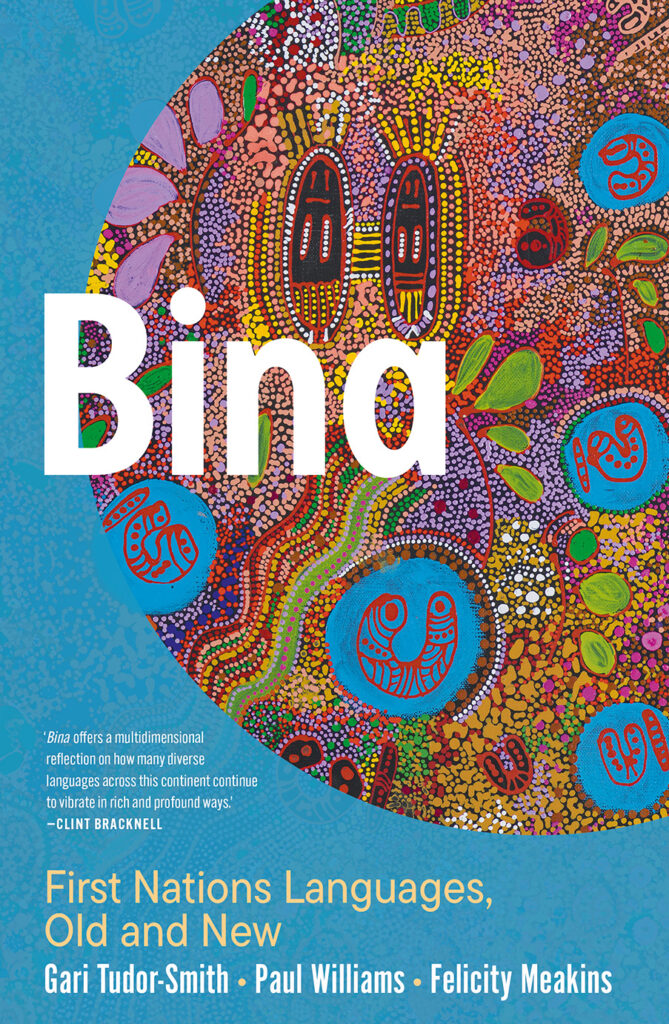
Bina – First Nations Languages, Old and New is the exciting work of three young Indigenous linguists, who travelled the length and breadth of Australia to meet with language practitioners across fifty-six language groups, and consulted and collaborated with many more academics, performers, writers, teachers and community. It was a series of epic travels, and has resulted in a book with an epic story – that First Nations languages can survive colonisation into the distant future.
.

Colonial invaders and settlers assumed that First Nations cultures carried no knowledge they needed, or hadn’t already experienced in their distant ‘primitive’ past. The Anglo-Irish (my heritage) assumed nothing valuable was lost with the cultural genocide of over 400 language groups. Whitefellas assumed First Nations were a homogeneous group, existing in a ‘simple’ hunter-gatherer lifestyle, without the dynamic complexities of our ‘advanced’ cultures from Europe, Asia and the Middle East.
And so…[looks around]…here we are today.
We whitefellas got it wrong. We didn’t understand that First Nations languages are every bit as diverse as those found across Asia or Europe.
We didn’t understand the sophistication of these languages, which encode worldviews, provide the means to safely navigate vast distances, incorporate complex social systems and family architectures, connect the encyclopaedic diversity of the natural world to the psychological and physical health of the individual – all in ways that are often very different from language structures found outside this continent.
We also didn’t understand that sign languages are intrinsic to indigenous languages, and can be used at a distance, encoding information and critical emotional cues. There are whole grammars based around kin structures, which serve to navigate the individual safely in any place, and with any other language group.
Bina means ‘ear’, or to listen. While my whitefella culture links knowledge to seeing (“I see what you mean”), blakfella cultures associate knowledge with bina, the ear – meaning active listening done to provide understanding.
palawa kani, the contemporary collective term given for Tasmanian languages, is an intriguing, and grim, outlier. Australia’s first languages are broadly grouped into Pama-Nyungan (the larger grouping from north-eastern to south-western Australia), and is around 6000 years old, ‘relatively young given the continent’s 50,000-year history of human occupation’, and non-Pama-Nyungan across our Top End, which probably pre-date the others. Research is ongoing, but suggests there were around five distinct Tasmanian languages, but the links between them and Mainland languages are unknown. ‘Due to extensive massacres and other colonial atrocities, all that remained of the languages were small word lists.’ The languages themselves were separated, like the peoples, 12,000 years ago as the seas rose, and would’ve developed their own characters, fully independently of Mainland mobs.
Invasion, colonisation, dispossession, oppression, exploitation, and deliberate policies of cultural genocide has left many legacies. But while we rightly mourn loss of languages, new languages have evolved to fill critical gaps. Various forms of kriol (‘Creole’), yumplatok, pidgin and Aboriginal English have and are developing to support, retain and relearn culture and language.
These kriol aren’t, as assumed by many, necessarily lesser forms of language. They’re primarily functional in times of forced colonisation, yes, but they’re being formed from and informed by indigenous languages, by and for First Nations mobs. It’s a uniting force between many nations, one that is much needed when our post-colonial governments still deny Voice, Treaty and Truth-telling.
“We can reclaim and speak language that was denied our Old People, and make the statement that our languages are complex and alive.” Anita Heiss – Wiradyuri writer
Bina speaks to ‘the beauty of these languages’, hoping ‘to inspire fellow language activists, educators, researchers, rangers and artists’ across the many First Nations, and ‘inform policy makers, educators, healthcare providers and environmentalists about the important scientific and cultural contributions First Nations languages can make.’ Above all, Bina is part of the ‘mission of Truth-telling and affirming sovereignty of First Nations.”
Language is a human right, and studies indicate health and well-being is intrinsically linked to command of language and the culture that derives from it.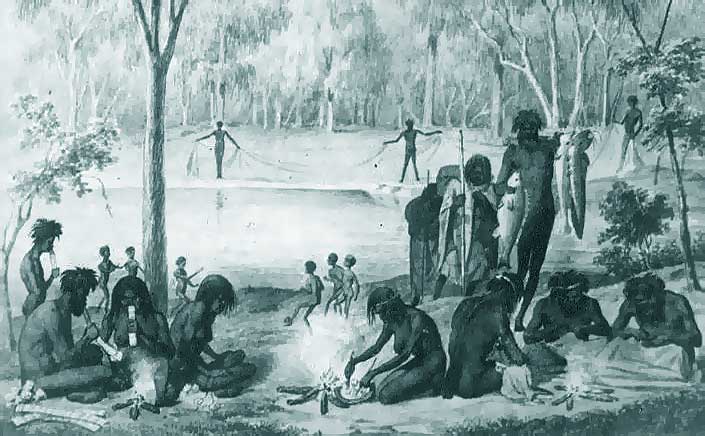
Language carries knowledge and Culture, and all three are necessary to carry us forward. There is need for inclusion of Language in law, education, government and wider society as a practical path to improvements in all aspects of Indigenous life.
From the suppression of language to its reclamation, Bina points to the pathways forward. Mob who need to learn more about their Culture need the support of Language, and we can all benefit from their current and recovered knowledge of land management practices, ecological understandings, and natural sciences.
Bina is written by academics, and would’ve been a tough edit to cover all the bases without being too dry, but the story it tells is hugely important and relevant to our world. Gari Tudor-Smith, Paul Williams and Felicity Meakins are, with their colleagues and collaborators, to be congratulated on their work, and I can only hope a documentary film of their journeys is in the wings.
Bina – First Nations Languages, Old and New, by Gari Tudor-Smith, Paul Williams, Felicity Meakins, La Trobe University Press 2024, RRP $37.99, 327 pp, ISBN: 9781760644987
B.P. Marshall is a scriptwriter and author who, in an earlier career, worked with and for mob on country as a remote area nurse.