
The Tasmanian political stunt of the week was undoubtedly the dead cat thrown by Russell Hanson with his ‘report’ on Wednesday.
On this same day, the Public Affairs Committee (PAC) found multiple shortcomings with the process to date of the proposed stadium, and amended its terms of reference to ensure the matters would receive appropriate scrutiny.
Hanson’s contribution – claimed to be a reconsideration of the business case, ‘correcting’ the assumptions of the MI Global Partners and Price Waterhouse Cooper reports – was indeed breathlessly reported by some sectors of the Tasmanian media.
The Mercury had a front page splash, then double-dipped with a follow up the next day. Sports reporter Brent Costelloe likewise fell for the ploy as he gushed on Twitter a preview of 7’s news report:
“Even when a worst-case scenario is looked at, with direct benefits substantially discounted, the new stadium is no ‘dud’. A quote from Russell Hanson’s Macquarie Stadium report. He has the backing of high profile economist Saul Eslake.”
We think such interventions require proper scrutiny. So in the cold light of day, ungulled by the distraction, here is a point by point response to the ‘Hanson Report’; the original is available here in its entireity.
The Big 4 Points
His four key points all dial up the revenue projections.
Point 1 is “The jobs and activity generated by the construction of the stadium precinct and the economic benefit of the permanent ongoing jobs.”
The ‘jobs and activity from construction’ is irrelevant unless it is assessed against what the returns would be from other types of investment of that money in the same location, such as for example realisation of the Our Place plan. That’s why it wasn’t included in the MI Global report.
It needs to be noted that the average construction time for a stadium of this size is three years. That means that the imported workers will be occupying Hobart hotel rooms for at least three whole tourist seasons. How much damage does that do to Tasmanian tourism revenue, given that construction workers will be less likely to visit local tourist attractions than actual tourists?
Also, given that a stadium is mostly concrete and steel, and the key engineering expertise will come from interstate, how much of $1B plus construction cost will remain as ‘economic benefit’ in Tasmania. How much will simply be siphoned offshore by Hansen Yuncken et al?
Point 2 is “The activity generated by the establishment and operation of the new Tasmania Football Club. This represents $10.62 million per annum in real terms before NPV discounting.”
This one is quite funny, given that the Tasmanian government has promised to donate $15M for 10 years for the operational side of the football club.
In other words, the ‘economic activity’ is -$4.38 million per year for 10 years, total -$43.8M, then possibly $10.62M per year for the next 10 years, minus any further government subsidies. Sounds like, at best, a break even.
Point 3 is “Intrastate incremental expenditure that would occur from Tasmanians utilising hospitality, tourism, goods and services associated with their attendance and use of the stadium precinct with a wide range of new events that previously required travel to the mainland to achieve their objectives. This represents $4.76 million per annum …”
We suggest generously that there might be 10 events per year at the stadium that Tasmanians might have travelled for, and that each of those might have attracted 500 Tasmanians. That gives us a total 5,000 avoided interstate visits.
How much will they spend in Tasmania instead? If a couple in Moonah take a taxi to the stadium, buy a few drinks at the venue, and take a taxi home, their spend – net of revenue already accounted for elsewhere – is simply the two taxi fares, possibly $40.
If we postulate an average spend of $100 for those ‘Tasmanians utilising hospitality, tourism, goods and services’ to attend an event in their backyard, then we arrive at a figure of $0.5M per annum. It’s an insignificant amount.
Hanson’s point 4 is “The ‘Flow-on’ spend which MI Global agrees will happen but does not include. This represents $29.8 million per annum…”. He does not explain why he thinks it should be included, whereas MI Global thought it was so trivial it was not worth including.
He then uses 86% as the flow on, based on “Tourism Research Australia for 2021-22: for every dollar spent in the tourism industry, an additional 86 cents of additional expenditure was generated and spent elsewhere in the economy”. TRA don’t provide a methodology, but let’s run with it.
Even if we accept this rationale, it’s still based on MI Global’s daffy projection of 44 events a year and total spectator numbers of 575,000. More on that later.
But once we rein in those projections to a more reasonable level, say about two-thirds, even the tourism spend plus flow on will only come to about $20M per annum. That’s less than $4M a year more than MI Global’s projection of $16,275,000 without flow on.
All in all, Hanson’s revisions have found about $100M over 20 years, an amount which does not significantly change the benefit-cost-ratio. It will still be negative.
In fact if we use a proper estimate of the stadium cost, at least $1B, the BCR is likely to come in at around just 30 cents in the dollar for the base case.
And it gets worse
Aside from Hanson’s much vaunted big four points being largely chaff, there are numerous other flaws in his document.
– FLUFF: There is no ‘New Stadium’ project; new stadium, yes. The capitalisation is a trick to attribute importance.
– HYPE: He has not ‘analysed’ the previous reports, just lifted their figures and replaced them with his own, without showing actual workings. Read the document yourself and you will find no workings. He also doesn’t appear to have had any look at the cost assumptions.
– ERROR: Hanson repeatedly quotes $375M as the construction cost to Tasmania. The $240M in federal funds is for the precinct, not the stadium. Labor Shadow Minister for Sport Josh Willie is on the record as stating he had clarified this with the federal ministers who made the announcement.
Regardless of the stadium, Tasmania gets $240M for urban renewal. It does not reduce the $615M cost to Tasmania that was part of the now very outdated ‘ballpark’ figure of $750 million. By the time a design sees the light of day, let alone tenders awarded, the cost will be well over $1B.
– ERROR: Hanson claims the York Park upgrade money is at risk if no team. This is incorrect as Prime Minister Anthony Albanese has clarified that that funding is not conditional on an AFL licence. Indeed, it was announced in January well before the licence agreement which came in March.
– RED HERRING: The ‘football club activity’ revenue and jobs is irrelevant to the stadium issue, as it can happen without a new stadium being built. Other new clubs have entered the league without a new stadium, in fact all new franchises since the VFL->AFL transformation have entered without a new build stadium, save GWS Giants. The only calculation that would be relevant would be a comparison between projected revenue at a new stadium as compared to an upgraded Bellerive Oval.
– OMISSION: No evidence is presented that the claimed football economy benefits could not be achieved at an upgraded Bellerive.
– ERROR: The ‘Hawthorn model’ used in estimating economic benefit is flawed. Currently if for example Hawthorn play Western Bulldogs in Launceston, or North Melbourne play St Kilda in Hobart, two sets of visiting supporters travel, plus locals attend. If Tasmania were to play Footscray in Launceston (or Hobart), only one set of visiting supporters travel, plus locals attend. Even fewer travelling supporters attend from far-lying states due to the additional flight time and cost.
Clearly the ‘tourism effect’ is lower for Tasmania Vs Anybody as locals will spend far less on hotels, hire cars and taxis, entertainment, etc.
– OMISSION: No evidence is presented that a new stadium is essential. Even the AFL have not presented evidence. They have not even argued the case. It’s an ambit claim, admittedly an important one.
But allow me to ask this question:
If a new stadium is so essential, why have the AFL never put forward a single reason for it? Why won’t the AFL put any funding into it beyond a token $15M?
Is there any Hobart-sized city anywhere in the world that has two 20,000+ stadia for the same sport? I can’t find any; the smallest would be about 800,000, not even including wider catchment areas. On current trends Hobart’s population is hundreds of years from that.
– ERROR: Hanson states that the roof is an ‘absolute requirement’ of the AFL in respect of a licence. Again, this is incorrect. The roof concept was added in by the Tasmanian government, according to evidence given to the PAC Inquiry.
– ERROR & OMISSION: Hanson claims that Bellerive cannot be upgraded to the ‘required capacity’ of 23,000 seats but he does not provide any evidence for his reasoning. However spatial analysis shows there is room at Bellerive for another 10,000 seats, assuming the small existing building behind the northern goal (media facilities, snack bar) is replaced by a wraparound new grandstand that joins the existing members stand to the existing David Boon stand along the northern and eastern side of the ground.
– ERROR: Hanson ‘discounts’ the supposed 44 events (from the MI Global Partners Capacity Optimisation Assessment), down to 28 or and then their revenue by 25% as his worst case. That is still way over.
For example MI postulate three A-league (football) games per year with average crowds of 7,500. For a start no A-league team is coming here unless the Tasmanian government throws a bucket of money at them, which also needs to be factored in. But we have good recent data. Western United played Sydney United at North Hobart Oval in January this year on a pleasant day, crowd 5,100. That’s about half the capacity of that venue. Why would those games be played at a 23,000 capacity stadium that costs more to hire? They won’t be … unless the bucket of money includes a condition forcing them to, ie. a hidden stadium subsidy.
I have analysed stadium usage elsewhere – workings are here – and I think about 300,000 spectator visits would be a hard upper limit. Well over half would be from AFL. In other words the facility will be empty and unused most of the time.
This is quite normal for stadia. It is very likely for a relatively small city halfway to Antarctica that has no proven history of stadium events. Apart from AFL football, there is very little happening at Docklands stadium for example, and that is supposedly the model – inner city, redeveloped on waterfront industrial land, compact, etc. – model for the proposed Hobart stadium.
– NONSENSE: His suggestions for other events that could be held at the stadium are creative, but ludicrous. State of origin rugby? At best 1 match every 10 years given that Tasmania would be competing with Melbourne, Adelaide, Perth, Canberra plus regional QLD and NSW cities. AFL finals? There is no guarantee of finals, and no club is able to rely on finals revenue. Car display? Cars can be displayed on any field, you don’t need the expensive hire of a 23,000 seat stadium for that. Markets? Cocktail parties? I almost can’t stop laughing. 2034 World Cup? Soccer World Cup matches must be played on rectangular fields, with a certain minimum capacity, this is a requirement of FIFA; the MCG for example did not host any games at the recent Women’s World Cup.
Some of the kinds of things he suggests, like wine shows, dinners, etc. will be better suited to smaller and less expensive venues. And in that respect, there’s an OMISSION: if events are simply moved from elsewhere in Hobart to the new stadium, there is little or no net benefit to the economy. I find it quite cheeky for Hanson to suggest that “the imagination and positive thinking of others would no doubt unearth many more events.”
Quite. How about stag parties, Papal masses every other Sunday with His Holiness flown in on the regular Hobart-Rome direct flight, B&S balls, Easter egg hunts, state funerals, homeless sleepovers, UN meetings and so on?
Perhaps even a landing site for alien spacecraft as they descend from the heavens and tentatively announce with their wobbly triangular heads: “We come to meet your state leader, Gill McLachlan.”
Actually a genuine multi-purpose community space, as proposed in the Our Place plan, would unearth more events of the type that are likely to emerge in Hobart and whose realisation is feasible.
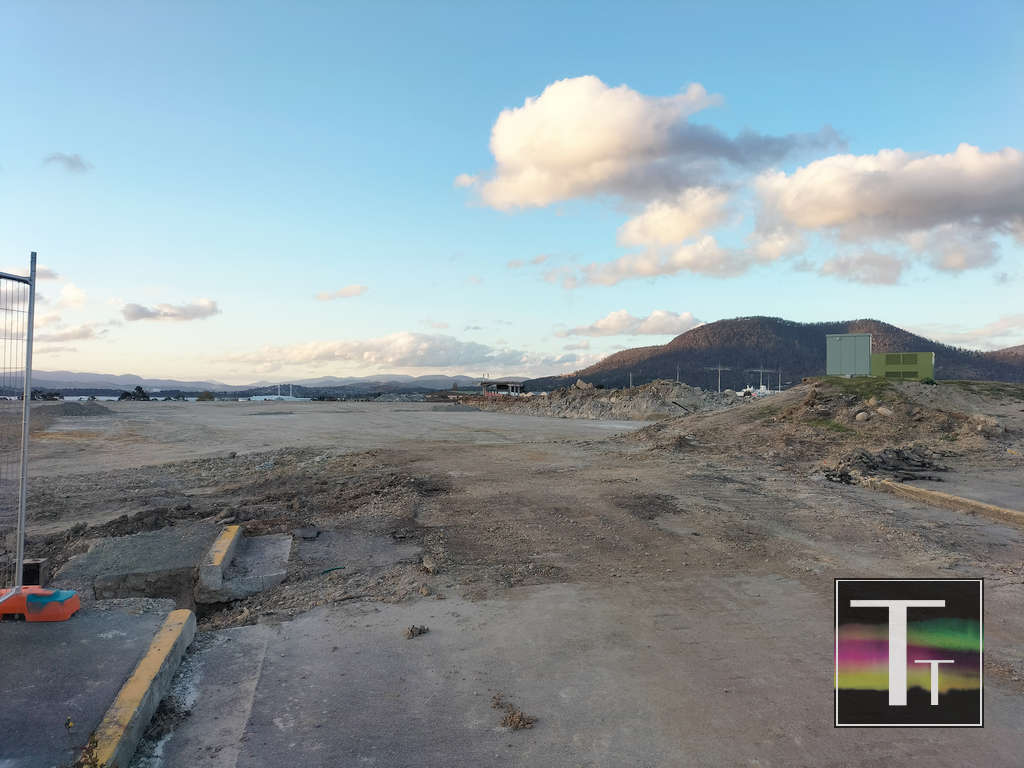
Showgrounds redevelopment site, September 2023.
Remember also that the stadium will be competing against the redeveloped Hobart Showgrounds. That one at least is definitely happening: funding has been secured, the development application has been approved, and the site is being prepared for construction. According to the blurb the precinct will feature “new facilities for community, business, sporting, tourism and commercial uses, and be designed for high levels of utilisation with events, activities, shows, trade shows, markets, music, conferences and commercial activities.”
Expected to open in 2025, this venue will have a good four- or five-year head start on the new stadium in building a portfolio of clients and events.
– OMISSION: Hanson is very silent about running costs. A lot of these – wages, insurance, maintenance, groundskeeping, marketing, event acquisition costs, etc. – will also be subject to inflation, currently running at 6% according to the Reserve Bank and at a 30-year high. What are his assumptions about inflation? Will revenue rise at the same rate as costs?
What about major costs like remodelling to keep up with technology and crowd expectations? What about climate mitigations likely to be required due to location beside a tidal river? It’s as if Hanson doesn’t even want to consider the issue of costs with any seriousness at all; this is either ineptitude or wilful ignorance.
– OMISSION: There is no accounting for the opportunity cost of stealing events from Bellerive Oval like Hobart Hurricanes games; they are not ‘new money’ in the economy. Or for the fact that it might cost more to mount an AFLW game (average crowd 5,000 according to MI Global Partners) at the new stadium as compared to Bellerive Oval.
 – OMISSION: There is no accounting for the possibility of making Bellerive Oval a stranded asset that has insufficient events and event revenue to remain viable. This accounting would need to include complete write-offs of the existing infrastructure – some of which has been recently upgraded, such as the David Boon stand with new seats, toilets and concession stands – running possibly into hundreds of millions of dollars.
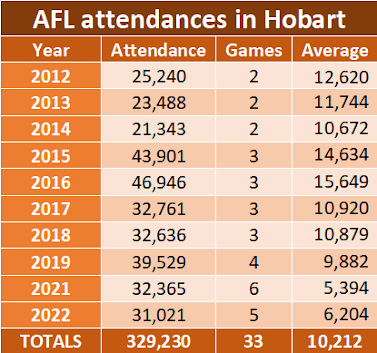
– HEAD IN SAND: There is no addressing, in crowd projections, that Australian rules attendances in Tasmania have been in decline for decades. This includes AFL games in Hobart and Launceston, both in decline and with their highest attendances a long time ago. Martyn Goddard has more detail in this impressive piece That Silly Stadium in Hobart.
– OMISSION: What is the cost of the risk associated with poor stadium management? The stadium is to be entrusted to a newly-formed body, Stadiums Tasmania. They have no track record. What if ST becomes a place where (incompetent) old maates are parked for a cushy job swilling bubbly at big events? What if the government business enterprise is simply poorly run? Either scenario is easy enough to envisage if you have ever spent much time in Tasmania.
– LIE: The statement ‘without the stadium there is no team’ is not correct. It reflects the status quo, but things change. Indeed, the iron law of the universe is that everything changes.
‘Giving the team the best chance of success’, stated elsewhere as a rationale for a new stadium, would be proceeding along a path that unites Tasmanians; it is not compatible with forcing an unpopular and divisive project on Tasmania generally and Hobart specifically.
Sadly for our society, the Rockliff government and the pro-stadium cult have taken every opportunity to propagate this lie, in order to provide a fig-leaf for the poor deal agreed with the AFL. The state of Tasmania can and has renegotiated all kinds of deals, including for example the Marinus Link funding arrangements with the Commonwealth.
The Tasmanian government would be perfectly justified in writing to the AFL to say: “The deal we reached is deeply unpopular in Tasmania. We cannot wave a magic wand and change that. Given that both parties failed to negotiate with the people of the state prior to announcing it, the grave mistake was made jointly. Together we can fix it. Together we will sit down and renegotiate the deal in the best interests of our state and the sport.”
– OMISSION: Hanson makes no attempt to account for the fact that the secretive, ham-fisted and corrupt process by which the Tasmania-AFL deal was hatched has set the fledgling team back. How many people are so disgusted by the obfuscation that they will never become members? How many potential sponsors have been scared off? What is the financial cost of the significant reputational damage to the Tasmania Devils before they have even kicked a ball? What is the naming rights write-down when the stadium becomes the most hated structure in Tasmania?
– OMISSION: The AFL licence is only for 12 years, with no guarantee of extension; it is wholly subject to the whim of the AFL.
What is the cost of the risk associated with the state of Tasmania ending up with an Australian Rules football stadium without an anchor tenant, after having only been used for 8 or 9 years?
– OMISSION: Even under the current plan, the new team will play at Bellerive Oval for several years while the new stadium is being built. Presumably Bellerive Oval will still require some modifications and upgrades to maximise matchday revenue and facilitate the team’s presence. What is the cost of these, and the further cost of transition arrangements to the new stadium if/when built?
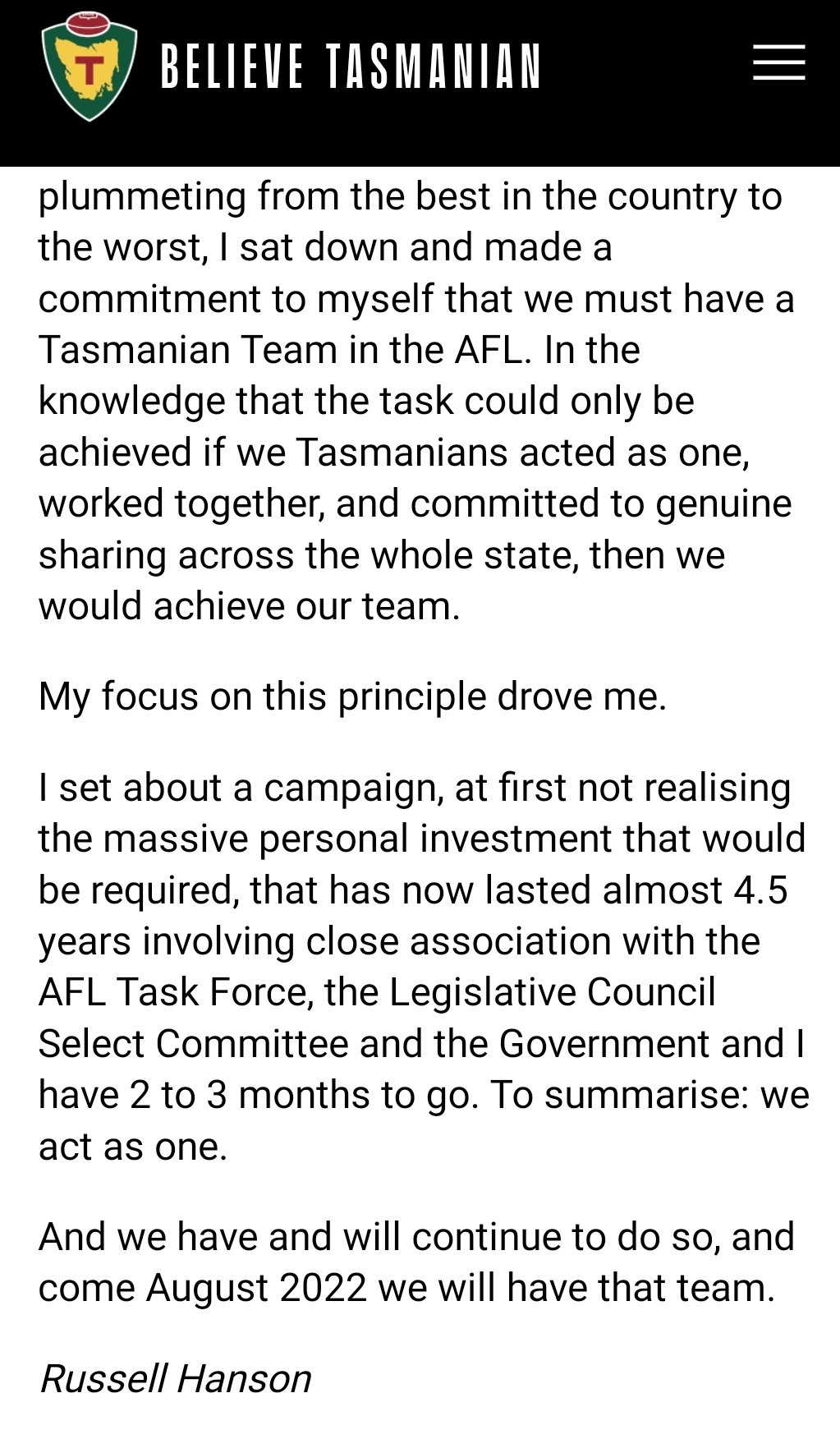
– VERDICT: overall the ‘report’ is amateurish, lacks detail, and is provided by a person with neither independence nor specialist expertise in this area. Indeed, Hanson describes his involvement in the Tasmanian team effort as ‘a campaign’ (see screenhot below taken from pro-team lobby site believetasmanian.com this week).
His ‘economic reasoning’ is therefore nothing but campaign material. It is highly flawed, mostly unreferenced, blinkered and limited in scope, and despite carrying the laudable conviction of an earnest believer it is simply lacking the depth and rigour necessary of a credible economic analysis.
It can be disregarded in its entireity.
Alan Whykes is Chief Editor of Tasmanian Times and a keen observer of many sports.