
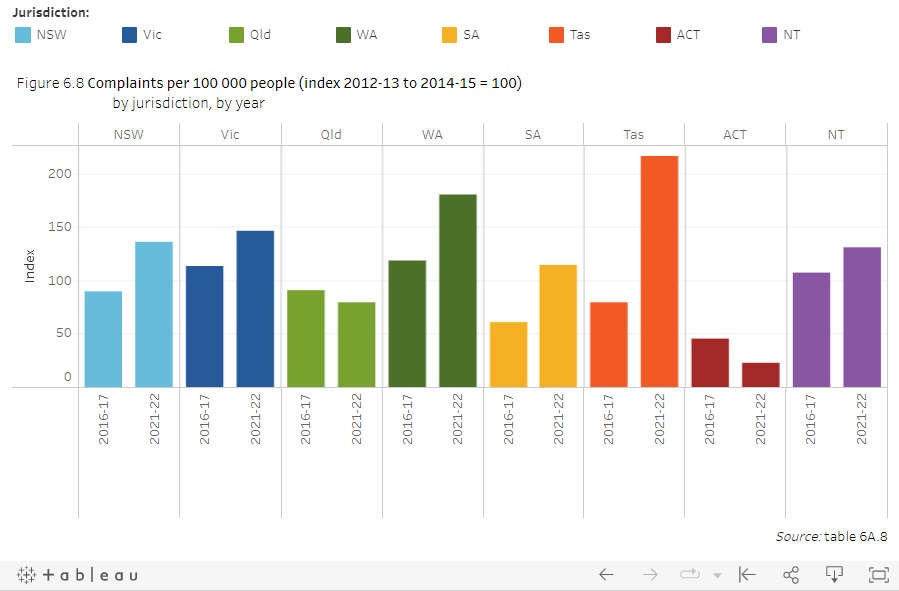
More complaints (pro rata) are made about made about Tasmania Police than any other police force in Australia, new figures show.
The volume of complaints is 10 times the pro rata number in the ACT, and more than double that in SA and Queensland. The statistics were released in the latest Report on Government Services update, published on 6 June 2023.
Another troubling indicators was the ratio of non-operational to operational staff, where Tasmania had the highest (worst). Tasmania was also second-worst in the nation on the indicators roads deaths and guilty decisions in magistrates’ courts.
Complaints
The rate of complaints against police in Tasmania now stands at 215.5 per 100,000 people in the most recent year of reporting (2021-22, see chart above).
That number has skyrocketed in five years from the 2016-17 figure of 78.9 complaints.
A spokesperson for the Civil Liberties Association said that the complaints figure reflects ‘massive problems’ for the Tasmanian Police Service in how it deals with the state’s citizens, and equally alarming problems in how it operates.
“The Commonwealth Ombudsman has said for years that Tasmania Police lacks a compliance culture,” wrote the CLA in their newsletter. “The contrast in the bar chart above is enormous, when you consider ACT and Tasmania have roughly similar populations: ACT about 461,000, Tasmania 571,000.”
“Whis police force failure is a rumbling warning before a general election possibly two years out – or maybe even less, given the current government is in minority – Tasmania is also a disaster area in how and in what facilities it jails young people, with double existing facilities needed.”
The CLA noted that Risdon Prison is coming under huge criticism in the current Commission of Inquiry, which bodes ill given the effect of the Don Dale exposé on the fate of the Country Liberal government in the Northern Territory at the subsequent election.
“State governments always kowtow to police forces, partly because they represent a sizeable voting bloc,” wrote the CLA. “But the Tasmanian government could well be advised to hold a Commission of Inquiry into Tasmania Police, with particular emphasis on citizen complaints, forensic issues, failure to disclose mandatory evidence, surveillance practices and record-keeping, the Sue Neill-Fraser and Jeff Thompson cases and the abysmal compliance culture in Tasmanian Police as officially reported by the Commonwealth Ombudsman.”
Tasmania Police were contacted for comment and their response is reproduced in full further down the page.
The service did however rate 83% ‘satisfied’ or ‘very satisfied’ from the public for their performance in general, and 80.9% in regard to recent contact with the police.
Guilty Outcomes in Court – Second Worst
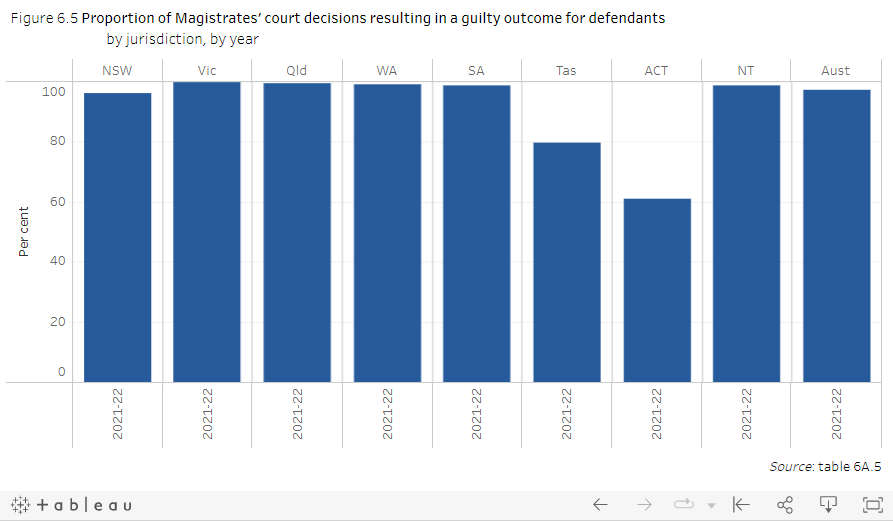
Tasmania Police were also second worst in the nation for in the statistical category ‘Magistrates’ court decisions resulting in a guilty outcome for defendants’.
Tasmania achieved just 79.7% of guilty outcomes, bettered by all other states and territories except the ACT. The statistical notes explain that: “A high or increasing proportion of Magistrates’ court decisions where the outcome for the defendant is guilty is desirable. This can indicate police were effective in gathering evidence and only bringing to court charges with sufficient evidence to ensure a guilty outcome.”
Road Deaths
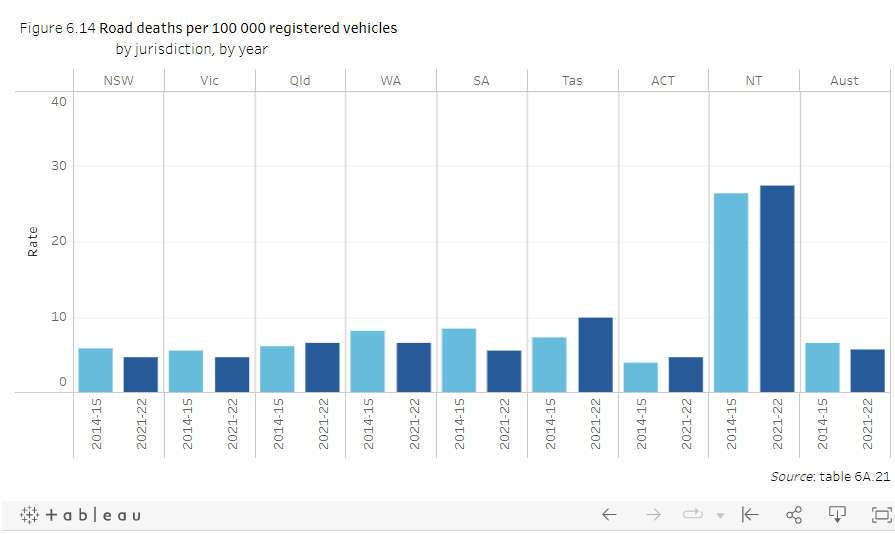
Tasmania also has the second worst rate in the country of road deaths, pro rata.
Tasmania suffered 10 deaths per 100,000 registered vehicles, second only to the Northern Territory.
The rate has risen since the Liberal government came to power in Tasmania in 2014, with the figure for the 2014-15 year being 7.3
A force of pencil pushers?
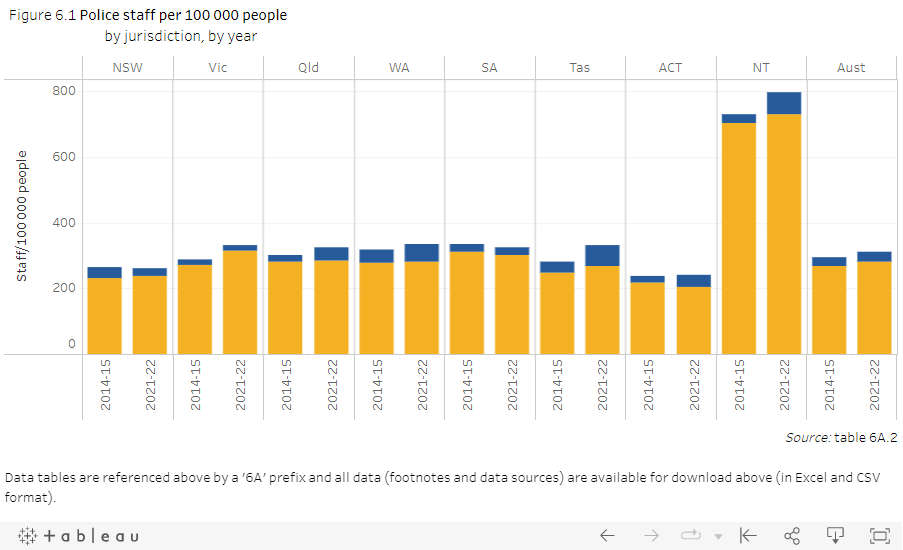
Tasmania was almost worst in the nation for the number of ‘non-operational staff’.
The statistics captured show that in 2021-22 Tasmania had 66 non-operational staff per 100,000 people, fractionally behind the Northern Territory’s 67.
It was however the highest proportion of non-operational to operational staff. Tasmania had 267 operational staff per 100,000 as compared to the NT’s 730.
The ratio therefore of 66:267 or 24.7% was easily higher than the NT’s 67:730 or 9.2%.
Tasmania’s ratio was the only state/territory above one in five, with the next highest being Western Australia with 19.1 %.
This proportion has also worsened over the Liberal terms, almost doubling from 12.9%.
Statement – Tasmania Police, 6 July 2023 – 2:55 pm
Report on Government Services
Tasmania Police acknowledges the importance of our community having trust and confidence in our organisation.
Tasmania Police is subject to a high degree of scrutiny – and rightly so. Our frontline officers wear Body Worn Cameras which record interactions with members of the public, our staff have high levels of supervision, and we encourage members of the public who are dissatisfied with an outcome to make complaints through formal channels, which includes the Integrity Commission.
A review of Tasmania Police’s conduct management system, Abacus, conducted by the Integrity Commission found that our system was one of the most advanced police conduct management systems in Australia.
Tasmania has a unique process for recording complaints and therefore cannot be compared to other jurisdictions.
These statistics do not account for upgrades to Tasmania’s complaint recording processes in 2017-18, which improved the level or recording and accountability.
Tasmania’s system includes complaints not only from members of the public – it includes internally raised matters which includes lower level incidents such as not completing a file on time.
This means that more complaints have been reported since the time of the introduction of the new system.
Tasmania’s absolute (i.e. non-indexed) rate of complaints per 100,000 people is actually the fourth lowest in the country for 2021-22.
In 2021-22, Tasmania had 44 complaints against police by the public per 100,000 people, compared to 35 in 2020-21.
Commencing in 2013, the Integrity Commission has conducted annual audits of all Tasmania Police complaint files, with the last three of these tabled in Parliament.
No systemic issues involving integrity and ethics have been identified in any of the audits.
More information is available on the Integrity Commission website:
Under our new Commissioner, Tasmania Police has recently developed our new organisational values – accountability, integrity, respect, and support.
Our values will guide us in developing a culture of agreed behaviours in our workplace and in our interactions with the community.
Our people strive to make a difference every day and Tasmania Police welcomes any opportunity to ensure the transparency and accountability of our organisation.
Police Satisfaction
Tasmanians continue to rate general satisfaction with police services highly. Tasmania’s rate of satisfaction decreased from 82.5 ± 2.6% in 2020-21 to 79.9 ± 2.4% in 2021-22 but remained above the national average of 76.8 ± 1.0%.
Police Integrity
Tasmanians’ perceptions of police integrity, defined by the following three separate measures, continued to remain high in 2021-22:
- 85.2 ± 2.2 per cent of Tasmanians surveyed ‘agreed’ or ‘strongly agreed’ that police perform their job professionally, which was above the national average of 82.0 ± 1.0 per cent,
- 73.8 ± 2.7 per cent of Tasmanians ‘agreed’ or ‘strongly agreed’ that police treat people fairly and equally, which was above the national average of 66.3 ± 1.2 per cent, and
- 72.4 ± 2.6 per cent of Tasmanians ‘agreed’ or ‘strongly agreed’ that police are honest, which was also above the national average of 68.6 ± 1.1 per cent.
Public Safety
Tasmanians’ perceptions of safety when alone in their homes and in public places was greater than or comparable to the national average in 2021-22:
- 89.8 ± 1.9 per cent of Tasmanians surveyed felt ‘safe’ or ‘very safe’ at home alone during the night, which was comparable to the national average of 89.0 ± 0.7 per cent,
- 93.2 ± 1.5 per cent of Tasmanians felt ‘safe’ or ‘very safe’ walking or jogging locally during the day which was similar to the national average of 91.5 ± 0.6 per cent, and
- 57.9 ± 2.8 per cent of Tasmanians felt ‘safe’ or ‘very safe’ walking or jogging locally during the night, which was greater than the national average of 53.8 ± 1.2 per cent.
Road Safety
The number of road fatalities recorded in Tasmania for 2021-22 was 52, a significant increase from the 32 recorded in 2020-21. The 2021-22 result was the highest number since 2006-07.
The number of road fatalities so far in 2023 is significantly reduced from last year – 17 compared with 31 the previous year.
It should be noted that road fatalities are a relatively low volume, volatile indicator for Tasmania and can fluctuate substantially from year to year.
Tasmania Police has restructured its former Road and Public Order policing model and formed the new Road Policing Services, resulting in 68 police officers solely dedicated to road policing across Tasmania. As a result, Tasmania now has one of the highest ratios of traffic police in Australia.
Tasmania Police has created a new senior position – the State Road Safety Coordinator – who is an Inspector responsible for closer liaison and coordination with our other road safety partners, including the Department of State Growth, the Road Safety Advisory Council and the Motor Accident Insurance Board.
Tasmania Police has introduced new highway patrol vehicles on our major roads and highways seven days a week, 365 days a year.
Along with our partners in State Growth and the Road Safety Advisory Council, we have launched, and continue to support and expand upon, the mobile speed camera program.
Female staff
Tasmania Police is committed to creating a workplace that is gender diverse with a culture that values and embraces the contribution of employees from diverse backgrounds, experiences, knowledge, skills and perspectives.
Tasmania’s percentage of female police staff (sworn and unsworn) was 41.2% in 2021-22. Tasmania ranks the highest nationally. The national average was 34.5%.
– Assistant Commissioner, Glenn Keating