At the risk of losing my Tasmanian citizenship, I have to say I haven’t been a big fan of Dark Mofo. Not my thing. Then again, I haven’t seen David Walsh down at our Gaelic football social league so perhaps we’re even?
This year I decided to put my toes back in the water. Suffice to say that the new AFL stadium controversy, and some of the outlandish claims attached to it, have had me thinking about what makes a city.
What makes it a fulfilling place to live in? What makes it a destination? How does it build and maintain an identity? Under what circumstances does that identity change?
It’s fair to say that Dark Mofo, like many MONA projects, started modestly and has since grown bit by bit. It has even had a recovery from its COVID-related cancellations. Heavens to Abetzy, the printed program this year when unfolded was larger than a Senate ballot paper.
Undeniably it’s now ‘a thing’. I have Airbnb guests who have come just for it (and appear to be indulging it in the full, returning home at 4am to the tut-tutting of the front lawn pademelons). The Tasmanian Bridge lit blood red makes for a stunning night-time tableau. Despite it not being my thing, I’m kind of glad it’s on.
I think some of the blazing animosity toward the proposal for an AFL stadium at Macquarie Point is that it feels like a foreign body sledgehammered into position. AFL already exists in its niche at Bellerive Oval, with North Melbourne playing four games at the venue this season.
A giant eyesore stadium right beside the main road into the city centre of Hobart feels like too much, too quickly, without an up-swell of public support. If only the AFL had granted a team without a stadium condition (supposedly), the Tasmanian AFL team once playing could have developed that support until a new stadium actually seemed organically like a good idea.
One of the charms of MONA festival programming is that they have been absolute guns at rediscovering, re-envisioning and re-activating lots of forgotten spaces around Hobart. Instead of wanting a build a shiny corporate coliseum at public expense for their show, they have shoehorned events into warehouses, motels, underground vaults, little-used churches and all manner of buildings and spaces.
While I understand that an AFL game cannot be played on a decrepit barge landing, the point is this: integrating yourself into the existing framework of a city does not raise anyone’s hackles. No, the Dark Mofo naysayers have been limited to daft posturing about upside-crosses, airport billboards and the like. AFL naysayers – and they may have various reasons for being so – have a very easy bullseye to hit.
Borderlands II
It was with all this in mind that I crept into the second week of Dark Mofo, having being laid low by illness for the first, at the Hanging Garden. Borderlands II was described on the blurb as ‘avant-garde electronics, sampling, and percussion unveil a new musical language’, featuring Carl Stone (USA/JPN), Rama Parwata (AUS/IDN) and Lydian Dunbar (AUS).
The darkness of the venue lived up to the festival’s moniker, with most of the audience area lighting adequately achieved by gas flame heaters. Meanwhile the stage was crisscrossed by silvery beams cutting through the smoke.
Electronic music played by humans is one of those areas where it seems that the technology is an extension of a soul, and rightly so. In an era of chatbots badly answering your service enquiries, it’s comforting to remember that flesh and blood can co-exist, even co-create, with the machines.
Standing at the back of the auditorium for Stone’s piece reminded me of the time tunnel sequence toward the end of 2001: A Space Odyssey. Perhaps not so much for the audio of the film, more for the visual journey. As my Italian music lecturer used to say, if you can’t see the music you aren’t listening closely enough.
So I was delighted, frankly, for Stone to take me on his journey. And what a trip it was, gliding along a deep valley of acid tripping cactus, yoga meditation rooms, hoarse ghosts of Dire Straits’ heyday, hover-boards with wonky jets, one-eyed condors riding thermals for free, robots tipping marbles down electronic waterfalls, dung beetles rolling discarded synth riffs into fat scoobs and smoking them.
In the end I found myself, like the protagonist at the end of 2001, existing in a state where even the tiniest of my movements somehow irrevocably changes a complex, multi-dimensional scene I don’t understand, but understand I am an essential part of.
Magnificent.
Unfortunately a severe coughing fit while waiting for the next act had me heading home for an early one.
The Divine Comedy
Riding my bike down Howard Road toward this event (at Derwent Entertainment Centre) I was loudly abused by some yobbo in a ‘hot’ car. The pretext was something like me being in the bike lane that approaches the intersection somehow delayed his journey by a millisecond, therefore it was necessary for the driver to hang out of the window and yell “Are you trying to get yourself killed?! Get the f__k off the road!”
I blew him a kiss and a few moments later arrived at the venue, resplendent in more blood red lighting and the Welcome to Hell illuminated sign during the performance. “You can’t scare me,” I thought to myself, “I live in Hobart’s northern suburbs.”
Now I may be indulging in an assumption here but I’m guessing not many of the 2,000 odd spectators at this show had studied Dante in Italian at university in Italy.
I can tell you that this work is incredibly revered in Italy. Every student studies it at school. Most people can recite part of it, usually the opening verses which are iconic and dare I say it one of the pinnacles of Italian literature.
Imagine Christmas Eve: everyone has gone home, packed up their troubles, and is sitting with family and a hot toddy in a European winter. Enter into this – the first year I was living there – the great character actor Roberto Benigni reading the 9th Canto live on national television, the equivalent of our carols by candlelight. People were in tears at the time, and then talking about it for months afterwards.
Not that all this really gave me much of an advantage in trying to make sense of Florentina Holzinger’s work, seen in Australia for the first time here.
This is a very loose interpretation, more in the ‘inspired by’ rather than ‘based on’ category. The plot device of poet Dante, lost in his middle age, being led by fellow poet Virgil through Hell, Purgatory and finally Paradise to meet his great love Beatrice, is reworked as an ‘audience member’ being hypnotised to act as Dante.
Thereafter, chased by cranky portaloos, Dante descends into Hell and then the fun begins.
A lot of the original Divine Comedy is taken up with descriptions of the various levels of Hell and Purgatory, the kind of people within them, and their various punishments. These punishments variously consist of living in filth, degradation, having to do menial and endless tasks and labour, being forced to eat disgusting things, and physical punishment.
Under the aural punishment of a largely metallic and heavy soundtrack, the denizens of Hell in this stage version run and rerun hurdle races only to be beaten by a motorcyclist who appears out of nowhere, roll down and fall off staircases, chop wood, shit on wooden platters presumably for their own sustenance and so on.
Probably the yuck highlight is blood being drawn from one of the performers and then squirted onto a canvas as art, which the performers then enhance with other paints and by body-slamming themselves against the evolving image, before collapsing in a writhing and tangled heap of broken bodies.
Whilst there are certainly sexual connotations most of the nude, all-female cast seems to disappear into the skeletons they carry on their backs. In fact the skeleton functions a kind of exoskeleton, the shell we see and relate to more than the creature inside.
Rather than the full journey of Dante this interpretation melds the three realms more or less into one. I am not a fuddy traditionalist and appreciated this throbbing, fluid, (blood-)lusty version of the Divine Comedy. And, as two ominous black cars descended onto stage, in my heart of hearts I fully concurred that motor vehicles are creatures from Hell.
Hell … after the Derwent Entertainment Centre, I hear Hell is going to reinvent itself on the city skyline as a giant stadium-eyesore Tasmania doesn’t want or need. Stay tuned.
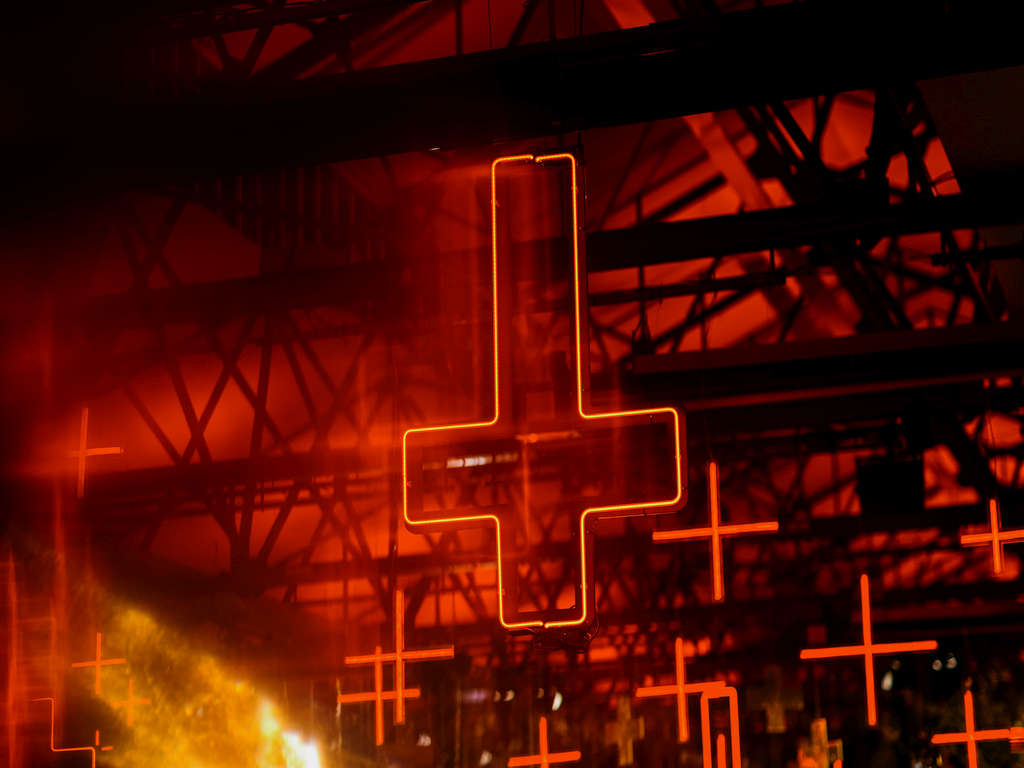
Featured image above by Jesse Hunniford. Image courtesy of Dark Mofo 2023. Editor’s note: The festival did not provide any images of the events I attended, and photography even by accredited media was not permitted.