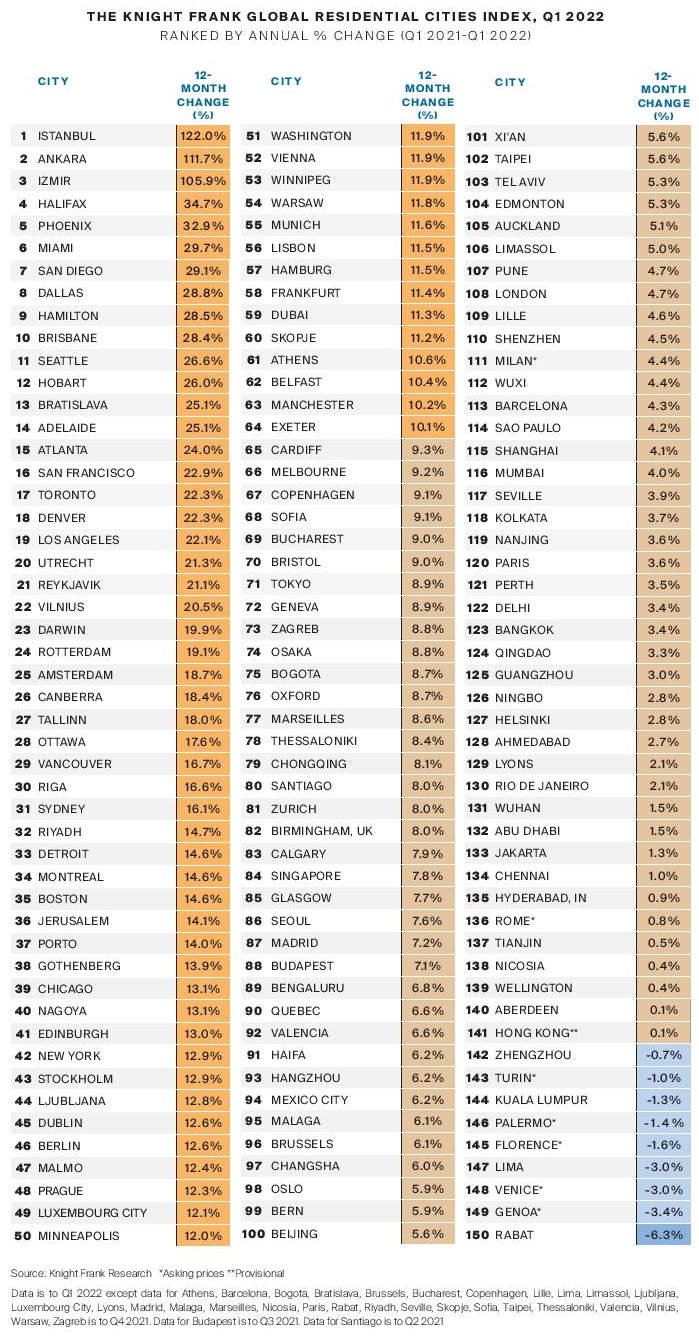
Hobart property prices rose an average of 26% in the year to April 2022, according to the Global Residential Cities Index.
That puts the Tasmanian capital as the twelfth-fastest growing of the 150 cities assessed worldwide by Knight Frank.
The assessment is based on residential property prices from the end of the first quarter of 2021 to the equivalent point in 2022.
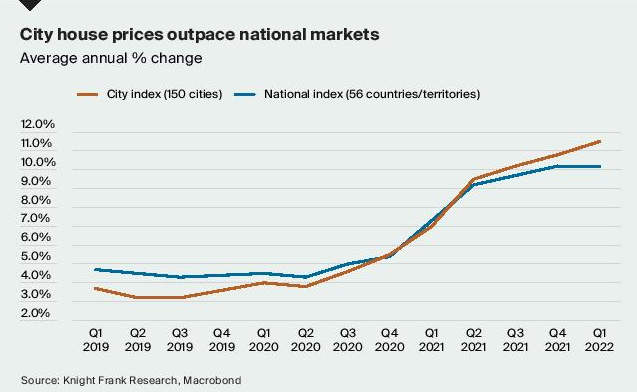
City house prices are rising on average by 11.5% per annum, the fastest rate since Q3 2004. 94% of cities assessed saw prices increase over the latest 12-month period, up from 85% a year ago.
City house prices are outpacing their national markets which registered growth of 10.3% over the same period. Much maligned during the pandemic as the ‘race for space’ story took hold, the dynamism of cities is reasserting itself.
Report authors said the market cycle is shifting as large parts of the world move from a pandemic to ‘post-pandemic’ landscape. Inflationary pressures are surging, and the cost of debt is increasing as interest rates track higher.
“Set against this backdrop of heightened uncertainty, rising taxes and more property market regulations (e.g. a ban on foreign buyers in Canada), we expect the rate of price growth to slow in most markets but we think a sudden shift to negative price growth is unlikely for most cities in 2022,” they said.
“Along with key fundamentals such as economic growth, supply levels and employment, the speed and scale by which interest rates rise will determine the extent of the slowdown.”
Among the Australian cities, Hobart was eclipsed by Brisbane where there was 28.4% growth in prices over the period. The problem was widespread, however, with Australian cities averaging 18.3% growth.
Italian cities were the leaders in price decline on the index, with Turino, Palermo, Florence, Genoa and Venice all registering negative numbers.
Housing and rental affordability continue to fall: REIA
Meanwhile the latest Real Estate Institute of Australia (REIA) Housing Affordability Report has confirmed that housing and rental affordability have declined across Australia.
The key factors have been limited stock levels, inflation and interest rates rises continue to create trepidation in the market.
REIA President Hayden Groves said housing affordability has declined over the March quarter of 2022, with the proportion of income required to meet loan repayments increasing to 37.3%, an increase of 0.2 percentage points.
“Housing affordability improved in New South Wales and the Northern Territory, remained stable in the Australian Capital Territory but declined in all other states,” said Groves.
“Rental affordability declined more than housing affordability with the proportion of income required to meet median rent increasing by 0.5 percentage points to 23.5%. Rental affordability declined in all states and territories except the Northern Territory.”
“Tasmania remains the most unaffordable state to rent with income to rent needed sitting at a huge 30.8%.”
Groves said the number of first home buyers decreased to 29,093, a drop of 22.5% during the quarter and a fall of 33.9% over the past 12 months.
“First home buyers now make up 31.6% of owner occupier dwelling commitments, a decrease of 2.7 percentage points over the quarter and 8.7 percentage points over the year. The number of first home buyers fell over the March quarter in all states and territories.
“Declines ranged from 10.5 percent in Western Australia to 40.2 percent in the Northern Territory,” he said.
Groves said that RBA’s announcement of further interest rate hikes is likely to see further declines in housing affordability but added that they remain historically low and will hopefully help slow rising inflation.
According to Groves, the average loan size to first home buyers increased to $475,544. This was a rise of 0.9% over the quarter and an increase of 11.7% over the past twelve months.
“The average loan size to first home buyers increased in all states and territories, ranging from 0.1% in New South Wales to a whopping 9.8% in Tasmania,” he said.
“The total number of owner-occupied dwelling loans decreased to 91,922, a decrease of 16.1% over the March quarter and a fall of 15.9% over the past 12 months. The total number of loans for owner occupied dwellings decreased in all states and territories over the March quarter. Decreases ranged from 8.2% in Western Australia to 21.3% in New South Wales.
“Over the March quarter, the average loan size rose to $603,395, an increase of 2.1% over the quarter and an increase of 19.2% over the past 12 months. This is the largest annual increase since the current ABS series began in 2002.
“Over the quarter, the average loan size grew in all states and territories except the Northern Territory which had a marginal decline of 1.1%. Increases ranged from 1.0% in the Australian Capital Territory to 6.1% in South Australia. Over the past 12 months, the average loan size increased in all states and territories with New South Wales recording the highest annual growth rate of 21.6%,” Groves concluded.
“With the federal election 2022 now behind us, it is time to get to work on the fundamentals of housing supply and affordability for Australia’s renters, first time buyers and home owners.”

Jo Siejka MLC, Shadow Minister for Disability, 8 June 2022
Palmer reveals shocking extent of waiting lists for Tasmanians living with disability
Disability Services Minister Jo Palmer has shed new light on the shocking state of the housing crisis, showing the Rockliff-Ferguson Government needs to be doing much more Tasmanians living with a disability.
Ms Palmer confirmed to Estimates Hearings today that of the 4,382 Tasmanian families languishing on the Liberal’s housing wait list, 334 are NDIS recipients and 229 of those Tasmanians are classified as priority.
Additionally, 411 Tasmanians are waiting for support at St Giles and over 600 are on the waiting list for the Tasmanian Autism Diagnostic Service.
This is a government that specialises in waiting lists and has not prioritised the delivery of services – including housing – for our state’s most vulnerable.
It beggars belief that the Rockliff-Ferguson Government thinks it’s OK that even priority applicants for housing will now wait a minimum of 90 weeks.
It’s not good enough that the Premier and his Ministers who are responsible for delivering understand the extent of multiple waiting lists yet are prepared to do the bare minimum.
Ms Palmer has been installed as the new Disability Services Minister and, unlike her predecessors, needs to finally act and show that this is a government that cares about delivering results – not just weasel words – for Tasmanians.