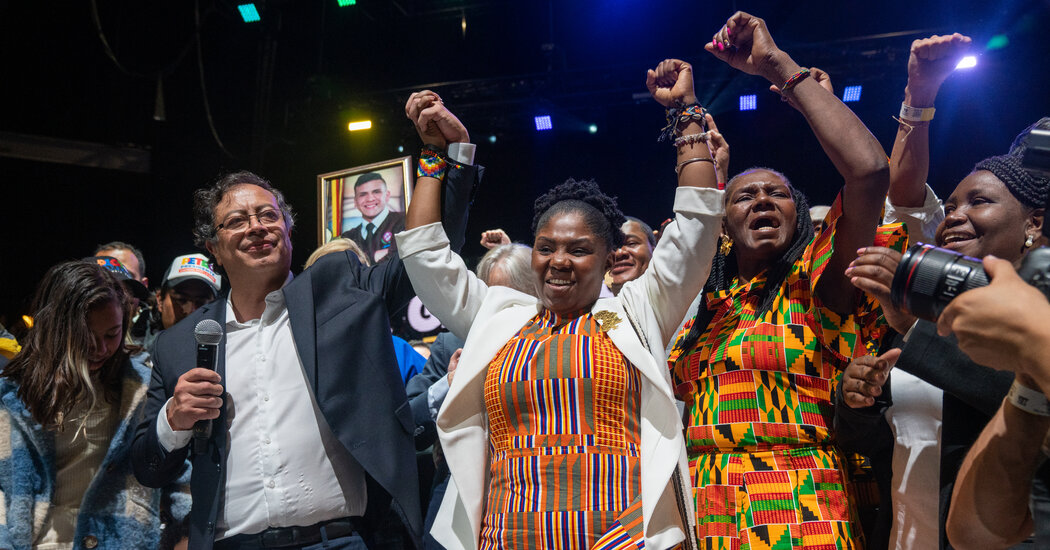
Dawn, and we saw the first left-wing President of Colombia, Gustavo Petro, elected in my country of birth.
It is a historical event that marks a major change for the country in a number of different ways: a left-wing and ex-guerilla fighter in power, the first black woman as Vice-President, a presidential election with a record voting turnout, all at once in a country which for decades has been led by conservatives.
Petro, a former Mayor of national capital Bogota, is an ex-rebel of the M-19 guerilla group, an economist and current senator.
His election partner was an Afro-Colombian, Francia Marquez, a single mother and former housekeeper. She is a lawyer and recipient of the Goldman Award, a major environmental prize for her struggle in the community of La Toma. Marquez campaigned to stop the illegal gold mining on her ancestral land that was polluting with mercury the Ovejas River, a significant water source for her community.
Never before has a couple of politicians with these peculiar characteristics, and distinctly different campaigning style for public politics, been elected. Before them, many had tried for decades and several of them – five candidates – were assassinated for their trouble.
In Colombia it has never been easy to talk and debate about the left-wing side of politics and parties. After various guerilla groups appeared in the country since 1964, when the FARC and ELN were created, all left ideas have been attributed to Cuba and communism.
And Petro does not disown this. For some it is one of the ‘black points’ in his political career and one of the main reasons why millions of Colombians don’t like him and are scared of him in power.
However, Petro had prepared himself all his life as a guerrillero, parliamentarian and economist. I attended some of his speeches and read some of his research on issues such as indigenous problems, hydroelectric dams, the electricity monopoly, human rights, defending high-altitude paramo habitat as natural water reserves, and so on.
His debates in the Colombian congress about the relation between para-militarism and politics and about extrajudicial executions by the Colombian Army showed him to be a brave man and politician at a time nobody else in the congress – apart other left wing congressmen – wanted to talk about it.
In a country where peace is more urgent than ever and where the peace agreements signed in 2016 haven’t been fully implemented, it was really important that someone who knows the background to the war and the politics of exchanging weapons for votes became president.
Gustavo Petro and Francia Marquez defeated the right-wing construction magnate Rodolfo Hernández, who represented the dangerous populism that has been growing exponentially in the Americas. Even so, we can’t forget that he got 10 million votes, which means that the new president will not have an easy government and will receive a divided country plus with difficult problems to solve such as health system, education, poverty, high crime rates, etc.
With their election Petro and Marquez have managed to raise the visibility of black people in Colombia and provide opportunities for them to feel represented and involved in a country where the black, indigenous and rural/poor people have been looked down upon.
Marquez represented the hope for a change but also the provided proof that Colombia had made some progress to bring equal opportunities for all. I hope she can manage this historical opportunity not just for black people but for all the excluded.
The election of Petro and Marquez is the symbol of Colombian people wanting change and voting to achieve it. It is the first time in Colombia’s history that a president has been elected with 11 million votes, coming from 22 million votes in total. In the past, abstentionism was very high. Voting is not compulsory.
Today, I write with the hope for a good change. Like millions of Colombians abroad we still have our hopes, heart and thoughts there.
I hope that his experience, acknowledgement of the country’s issues, social conscience and intelligence, translate into a united country and bring a better life for all. I hope the new leadership team can show that left wing politics can do well for their people, despite some arguably poor examples in neighbouring countries.
It sounds like the easy part was to be elected. The hard part starts now.
A new dawn, and we will see how the day unfolds.
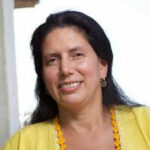
Sonia Parra, originally from Colombia and now resident in Tasmania, is the presenter of the Spanish language radio program on Hobart FM and the founder of Hobart Language Day.