Media release – Prime Minister Scott Morrison, Minister for Foreign Affairs and Minister for Women Marise Payne, Minister for the Environment Sussan Ley, 22 February 2022
$800 million to strengthen our leadership in Antarctica
The Morrison government will send a clear international signal of Australia’s world-leading Antarctic leadership with an $804.4 million investment over the next ten years to strengthen our strategic and scientific capabilities in the region.
Prime Minister Scott Morrison said the package would both strengthen Australia’s national interests in Antarctica and be a jobs boost for Australians through local procurement.
“The money we are investing in drone fleets, helicopters and other vehicles will enable us to explore areas of East Antarctica’s inland that no country has ever been able to reach before,” the Prime Minister said.
“My government will continue to back our world-class scientists and expeditioners with the necessary funding and resources, because their research on the frozen continent and in the southern ocean is critically important to Australia’s future.
“Our ongoing investment in Antarctica will directly support jobs at home, with Australian businesses, contractors, medical suppliers and providores reaping the benefits of local procurement.
“Our $800 million commitment supports the next decade of Australia’s operations in Antarctica and provides more opportunities for local businesses across Australia that support this work, especially in Tasmania.”
The new measures include:
- $136.6 million to support Australia’s inland traverse capability, critical charting activities, mobile stations, environmental protection and other core activities
- $109 million to increase aerial and inland capability:
- $60.6 million for drone fleets and other autonomous vehicles able to map inaccessible and fragile areas of East Antarctic, establishing an ‘Antarctic eye’ with integrated censors and cameras feeding real-time information
- $35 million for four new medium lift helicopters with a range of 550 kilometres that when launched from the Nuyina can access parts of the continent we could never reach previously
- $13.6 million for capability development to further enhance Australia’s reach inland including investigations into modern intracontinental aeroplanes
- $44.2 million in additional shipping support to enable the RSV Nuyina to focus on extended science voyages
- $17.4 million for marine science in the Southern Ocean and a new state-of-the-art krill aquarium in Hobart
- $14.3 million for environmental management including a ‘Cleaner Antarctica Strategy’ to remove legacy waste and to establish new ‘geographic information system’ technology to support environmental management
- $7.4 million for research focused on Antarctic ice sheet science to build global understanding of climate change impacts – improving our ability to support Pacific partners to monitor information about climate and oceans, including sea level rise
- $3.4 million to enhance Australia’s international engagement to support the rules and norms of the Antarctic Treaty system and promote Australia’s leadership in Antarctic affairs
The new funding package also includes $92.2 million a year from 2026-27 to further support Antarctic activities.
Minister for Foreign Affairs and Minister for Women Marise Payne said the package would reinforce Australia’s commitment to the Antarctic Treaty system, and to promoting Tasmania as the gateway to East Antarctica.
“Our investments are a clear marker of our enduring commitment to the Antarctic Treaty system, its scientific foundations, and Australia’s leadership within it,” Minister Payne said.
“The investment will also strengthen Tasmania’s status as an international science hub and pave the way for more opportunities in the years ahead as we continue to work on further projects such as the Antarctic Science and Research Precinct under the Hobart City Deal.”
Minister for the Environment Sussan Ley said the package will significantly enhance our scientific capability which is at the heart of our leadership within the Treaty system.
“When I sit down with world leaders to discuss the Antarctic and the Southern Ocean in the face of increasing pressures, the strategic importance of our scientific leadership is clear,” Minister Ley said.
“We need to ensure that the Antarctic remains a place of science and conservation, one that is free from conflict and which is protected from exploitation.
“Science is the key to that future. This investment, together with the window of discovery that is already being opened through RSV Nuyina, will reflect Australia’s commitment to our sovereignty in the Australian Antarctic Territory and its leading voice in the region.”

Media release – Bob Brown Foundation, 22 February 2022
Scott Morrison’s big spend fails to protect Antarctica
Today’s announcement from Prime Minister Scott Morrison to spend $800 million dollars on a fleet of drones is nothing more than strategic posturing and does nothing to protect the Antarctic environment. At a time when scientists are clear that Antarctica is melting faster than ever before, Morrison and his government of climate criminals have decided to make a flashy announcement with very little substance.
“Just weeks ago, scientists announced that the Thwaites Glacier, which was previously expected to melt and fall into the ocean in the next 100 to 150 years, may do so in as shockingly little as 10 years. If this happens, it will result in a global sea-level rise with massive consequences. While the Morrison government approved $600 million for new gas projects that directly contribute to Antarctica melting, it seems they are happy to spend another $800 million so we can watch it happen via drones,” said Alistair Allan, Antarctic campaigner at the Bob Brown Foundation.
“As usual, the Australian government’s interest in Antarctica is sadly misplaced. Rather than spending $800 million on drones, that further invite the militarisation of Antarctica through dual-use activities, the $800 million could go towards removing the abandoned Wilkes station, with its leeching fuel and chemical dumps, and restoring that area. It could go towards suggesting and creating an Antarctic Specially Managed Area in the Vestfold Hills outside of Davis station, an area that Australia almost destroyed with a proposal to build a concrete airport.”
“How Prime Minister Scott Morrison can boldly declare these drones will help with climate research, while he and his industry mates recklessly plough on with climate-destroying projects, is beyond comprehension. The biggest threat to Antarctica is a heating Antarctica. From sea-level rise to krill populations and the penguins we love, all of us face dire consequences if we don’t address climate change. The prime minister should use this $800 million to help transition out of fossil fuels right now. Not fly a bunch of cameras over Antarctica to show us what we are about to lose.”
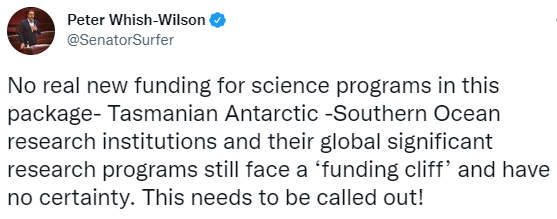
Today’s Antarctic announcement from the Morrison government is a political ploy that provides no certainty for Tasmania’s globally significant science community and is a distraction from the real threat facing the Antarctic: climate change.
This Liberal government has a penchant for big announcements and cutting ribbons but not for investing in people and critical science programs.
The Coalition has spent the last decade ignoring numerous strategic reviews and gutting Tasmania’s contribution to Australian Antarctic science.
In this parliament, the Liberals have been called out for their lack of coordination and strategic approach in funding Antarctic science programs, causing uncertainty in the Tasmanian science community and fragmenting globally significant Antarctic research.
In 2016 the Coalition tried to sack 300 scientists, many of them globally significant researchers in the Southern Ocean and Antarctic science based in Tasmania.
All the runways, machines, boats, and buildings amount to nothing unless you invest in the people utilising them, and the scientific programs they are needed for.
Science is the currency of the Antarctic Treaty and if Scott Morrison wants to secure Australia’s leadership role in the region he should properly fund Tasmanian scientific efforts.
If you want to act on security and on protecting Antarctica then act on the biggest threat this region faces: climate change. Take real action to stop warming oceans and unstable ice sheets, and act on the loss of krill and biodiversity.
The government’s dismal track record speaks for itself. Don’t be conned by yet another big election promise from a government facing defeat at the polls.

Media release – Roger Jaensch, Minister for State Growth, 23 February 2022
Antarctic funding welcomed
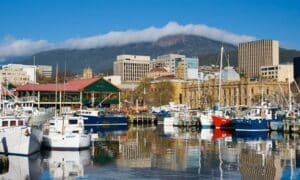
The announcement of an additional $800 million in funding from the Australian Government is welcomed by Tasmania as home to one of the world’s most significant Antarctic gateways.
As the base for Australia’s Antarctic and Southern Ocean operations, the new $528 million icebreaker Nuyina and a range of national Antarctic missions from around the world, we are well placed to increase our scientific and support services to the sector.
Already the sector employs almost 950 Tasmanians and injects almost $160 million into Tasmania’s economy each year.
With this investment coupled with an increased focus on inland-Antarctic science, upgrading of facilities in Antarctica and Macquarie Island and the much-anticipated new Antarctic and Science Precinct at Macquarie Point we are already moving to increase the capacity and capability of Antarctic operations available in Hobart.
We expect this funding boost will have significant flow-on effects for both local jobs and our economy and we will continue to work with and support our local network of specialist businesses servicing and supplying the Antarctic program to ensure our strategically important Antarctic sector continues to grow.

Media release – Greater Hobart Mayors, 23 February 2022
Greater Hobart Mayors welcome Antarctic commitment
An $800 million funding commitment by the federal government to support and enhance Australia’s Antarctic research sector demonstrates confidence in Hobart’s ongoing role as an international Antarctic Gateway City, say the mayors of the Greater Hobart region. Lord Mayor of Hobart Cr Anna Reynolds, Mayor of Clarence Ald Doug Chipman, Mayor of Glenorchy Ald Bec Thomas, and Mayor of Kingborough Cr Paula Wriedt have jointly welcomed the funding announced yesterday by Prime Minister Scott Morrison.
“Every investment in our Antarctic sector is an investment in Greater Hobart and Tasmania,” Lord Mayor Anna Reynolds said. “We now have the RSV Nuyina calling our city home, and the capabilities of the vessel and its crew will be enhanced through the purchase of new equipment that will greatly expand the reach of our research programs.”
Kingborough Mayor Paula Wriedt said Kingborough had long supported Australia’s efforts in Antarctica through the presence of the Australian Antarctic Division in Kingborough, which houses hundreds of scientists and expeditioners. “We fully support enhancing Tasmania’s Antarctic focus and welcome this funding commitment which would benefit all Tasmanians,” Cr Wriedt said. “Our Antarctic sector is worth $160 million a year to our state’s economy and employs nearly 1000 Tasmanians.”
“This 10-year investment contributes to the value of the sector to our local economy and community,” Glenorchy Mayor Bec Thomas added. “It drives opportunities to further Greater Hobart’s identity as a globally significant base for world-leading Antarctic and Southern Ocean research and education.”
Clarence Mayor Doug Chipman said the importance of the Antarctic sector to Greater Hobart’s economy and identity had been recognised in the Hobart City Deal. “A survey by the Antarctic Cities Project found that more than 72 per cent of Greater Hobart residents feel Antarctica is important to the city’s identity,” Ald Chipman said. “This is a reflection of our city’s special connection with the icy continent and the influence it has on our community. The City Deal identifies investment in Antarctic science infrastructure as a key driver of Greater Hobart’s economic growth and future success.”
The Greater Hobart Strategic Partnership supports the work of the Australian and the Tasmanian Governments in achieving a world class Antarctic and Science Precinct for Macquarie Point, as identified in the Hobart City Deal.
The project is expected to expand Hobart’s capacity as a premier gateway to the Antarctic and Southern Ocean, and further consolidate the collective Hobart-based science and research capability in the sector.
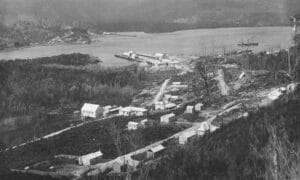
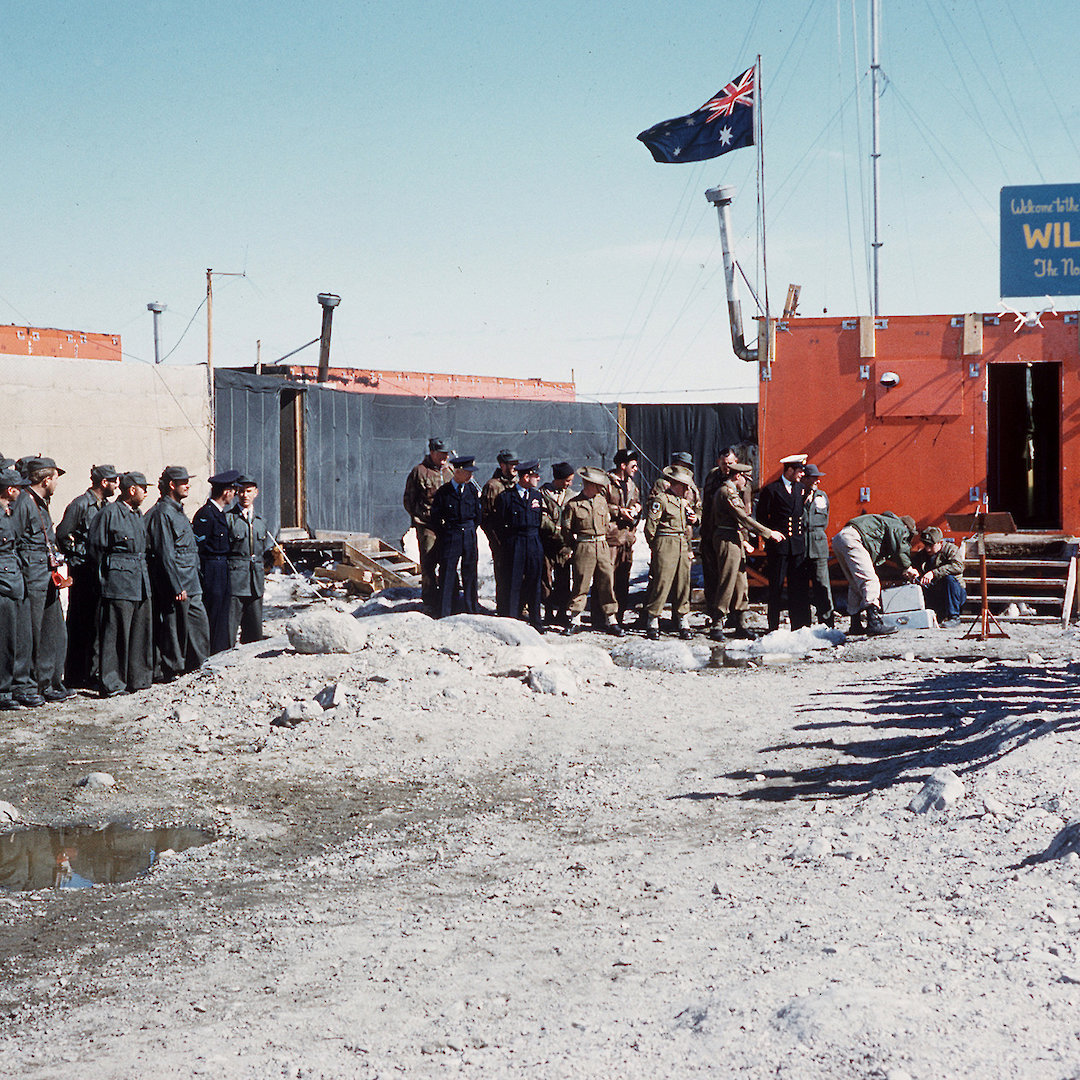
Featured image: Wilkes Station, courtesy Steve Scalise.