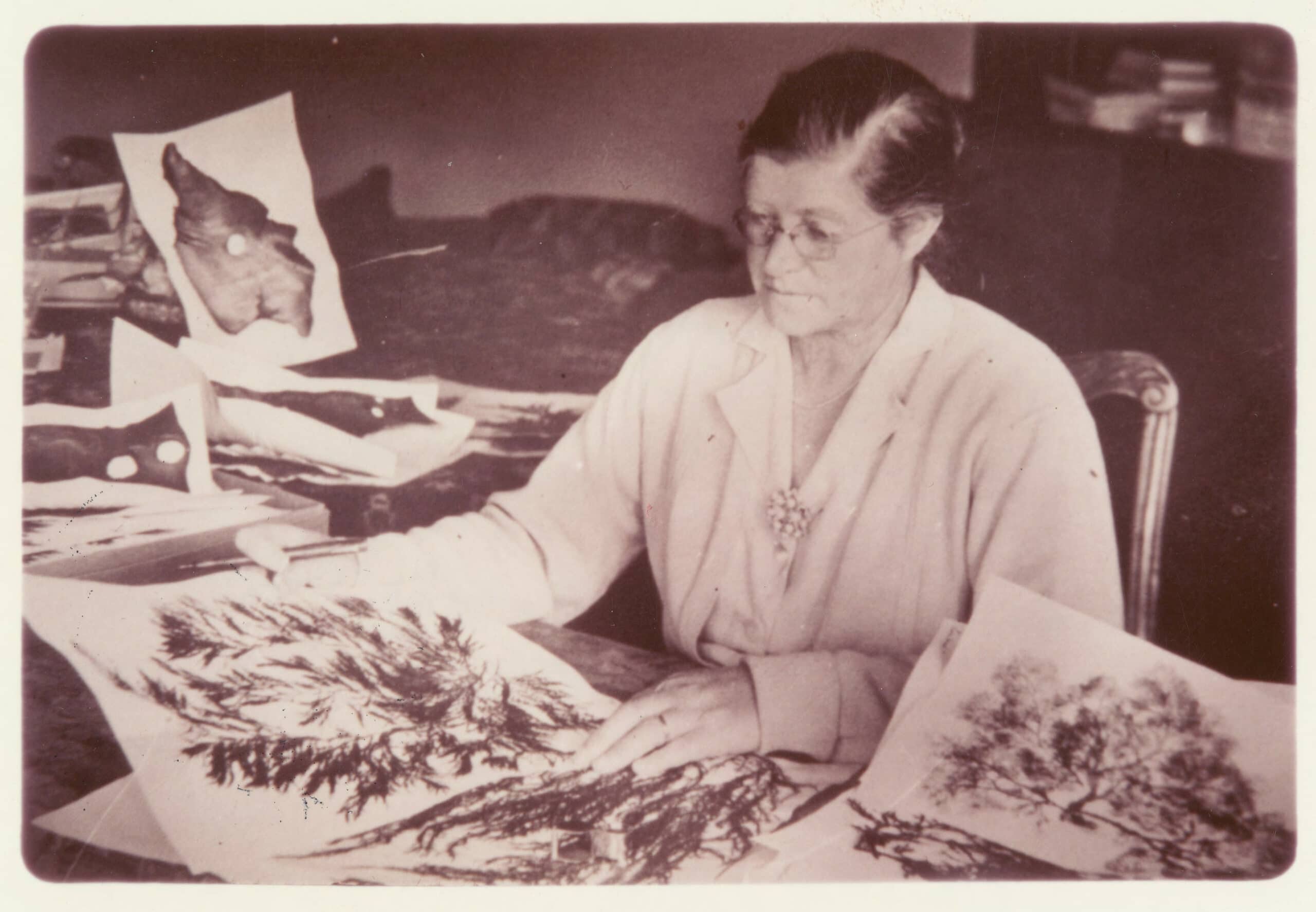
‘The old woman in the old clothes’ dredging for seaweed after a wild storm had swept through Bass Strait was a familiar jovial sight at Low Head throughout the 1920’s to 1950’s.
Unbeknown to the average passer-by, the woman meticulously gathering specimens was philanthropist and pioneering conservationist Florence Perrin, the unsung wheelhouse behind her male cohort of evolutionary naturalists devoted to the protection of Tasmania’s unique wild places.
Advocating for the declaration of the Cradle Mountain-Lake St Clair National Park, the reservation of Ben Lomond, Mount Barrow and Notley Fern Gorge, Perrin even publicised the necessity of a South-West National Park in the early 1940’s.
Never one to shy away, Florence continually called out environmental destruction: “We are a sordid, wretched lot of people with a commercialised outlook.”
More than an activist, Perrin was a savvy philanthropist, ensuring her privilege of family wealth was tirelessly invested in improving the lives of others. Part of the syndicate who purchased Waldheim at Cradle Mountain after Gustav Weindorfer passed, she was key to ensuring the continuing operation of the chalet and saving the surrounding ancient King Billy forests from logging.
Locally at Low Head, she donated a parcel of land to the Country Women’s Association, then raised the funds to build a holiday home there for women “who could not afford a holiday at a hotel” (to) “forget about daily life and household chores for a while.”
Owning a majority of the farmland at Low Head from 1914, Perrin donated for public recreation use or conditionally sold pasture she wasn’t using for grazing or for her seaweed experiments of fertiliser or cattle feed. As self-appointed ‘protector’ of Low Head, buyers of Perrin’s land were selectively given purchasing power on the proviso of a restrictive covenant that they would preserve Low Head’s natural integrity and character of place.
Far from an exclusive selling method, much of the land was sold to women and anyone in dire need of housing. The idealistic covenant strategy became the core of an early establishment of the Low Head Progress and Heritage Association with the founding slogan ‘Low Head but high ideals’.
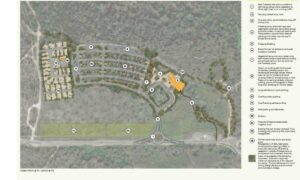
This back-story of steep conservation history at Low Head sheds light on the contemporary ‘Perrin’s Paddock’ debate brewing in the community. Upon first glance, the contested grassy pasture proposed for a new, initially seven but now enlarged to eleven lot subdivision opposite the East Beach is ‘merely’ a paddock.
But talking to those familiar with the land, it’s evident this paddock plays an integral ecological role as a biodiversity corridor from its bottleneck at Lagoon Bay to East Beach. For example, quolls have been observed foraging and endangered Tasmanian devils have been photographed not just at night but playing together in broad daylight.
Being cleared of most native vegetation over past decades, the land is considered under local planning laws to have the same conservation value as a slab of cement despite evidence of significant fauna. In addition, there is no heritage component within the present scheme to leverage opposition to the development based on the Perrin legacy. While the Federal Environment’s Assessment Department has written to the development proposing company who own ‘Perrin’s Paddock’, the process – at this stage – is advisory.
Ironically, the company in question was formed in 1964 to prevent a proposed subdivision at Low Head. The community donated funds to purchase the land and excess funds founded the not-for-profit company, with the intent it could act as a corporate body to protect Low Head land which “should be secured as a recreational and heritage area”, not developed.
This is a vision many locals feel the custodian forebears, including Perrin, would have endorsed. But it seems today this exemplary example of a philanthropic community and ecological conservation is crumbling around the very morals upon which it was founded.
Generations of Tasmanians are indebted to the Perrins, and their progressive conservation cohort, for the declaration of many national parks and reserves and for founding dozens of associations who have ensured ongoing education of, and access to, these wild places. Sadly, today you needn’t be a pioneering visionary to see the devastating effects mankind is persistently inflicting on nature through urban sprawl, over-exploitation of natural resources, and steady erosion of critical ecosystems exacerbating the exponential heating of our planet.
As Perrin warned back then: ”The beauty of our island is being destroyed so quickly that it will never be restored even in our great grandchildren’s time.”
So, amid the present code red climate and biodiversity crisis, what would the Perrins, et al., envision as sustainable use of the paddock? Their past actions suggest they would argue for its preservation, to be utilised for public use not private exploitation. Being forward thinking, perhaps they would embark on restoring the disused pasture to native vegetation, enhancing its ecological values to support the endangered species reliant on it.
What an extraordinary opportunity ecological restoration, coupled with recreational opportunities, on Perrin’s Paddock could be for the proposing company. They can exercise good social corporate responsibility by creating a collaborative local project not only to preserve but also to improve the biological functionality of the land, authentically perpetuating the conservation legacy embedded at Low Head by the founding families and Florence Perrin.
Featured image above of Florence Perrin courtesy TAHO.
Tabatha Badger is an avid bushwalker, activist, landscape photographer, Restore Pedder campaigner and small business owner. Her interests are as eclectic as her contemporary history research topic: Florence Perrin. Tabatha’s first paper on Perrin was presented at the annual Low Head Conference in 2020.
Disclosure: Tabatha is a 2022 Tasmania Greens Senate Candidate.