Treasurer’s Annual Financial Report 2020-21
EXECUTIVE SUMMARY
The 2020-21 General Government and Total State Sector Financial Statements are prepared in accordance with AASB 1049 Whole of Government and General Government Sector Financial Reporting.
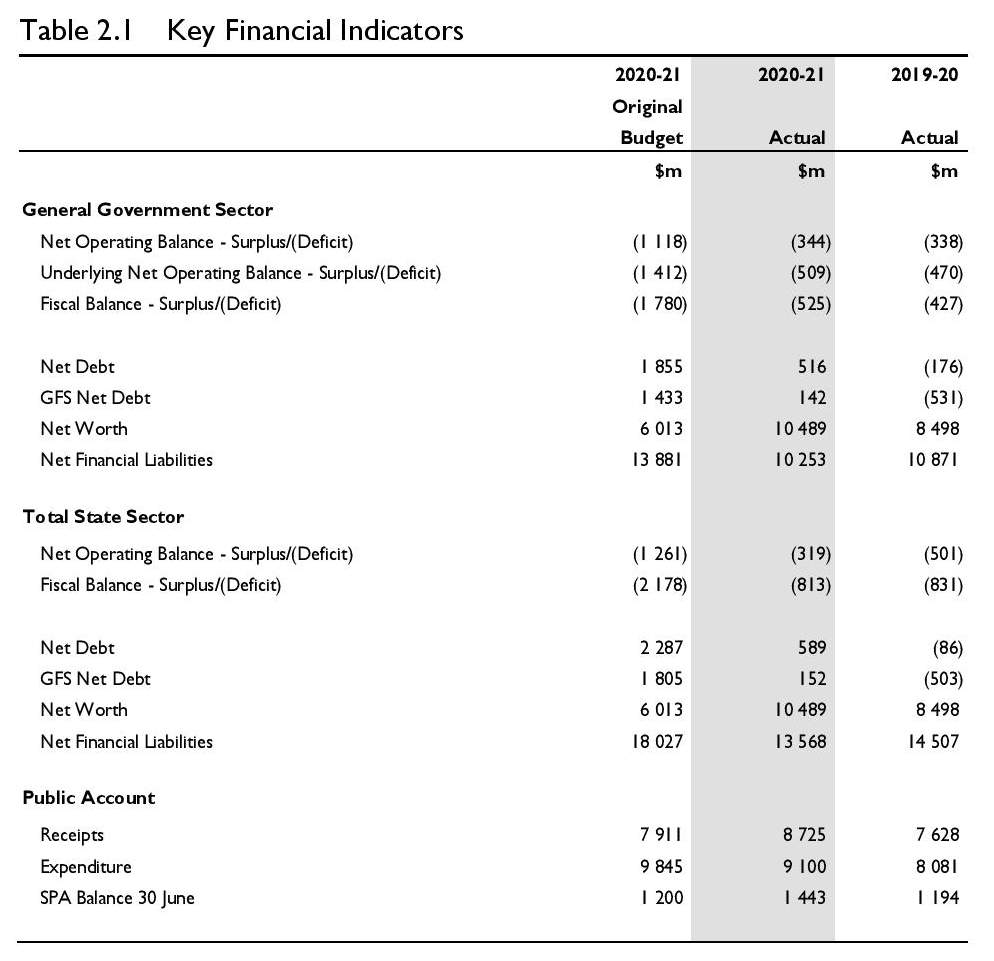
Table 2.1 presents the key financial outcomes for the General Government Sector, Total State Sector and Public Account. The 2020-21 outcomes indicate that the fiscal and economic impacts of the COVID-19 pandemic have been less than originally forecast. However, the pandemic continues to have an impact on Tasmania and initiatives are included in the 2021-22 Budget to provide continued targeted support and stimulate growth across the State.
General Government Outcome
Statement of Comprehensive Income
Table 2.2 provides a summary of the key General Government Sector operating line items and budget variances. The full Statement of Comprehensive Income is located at page 28 of this Report.
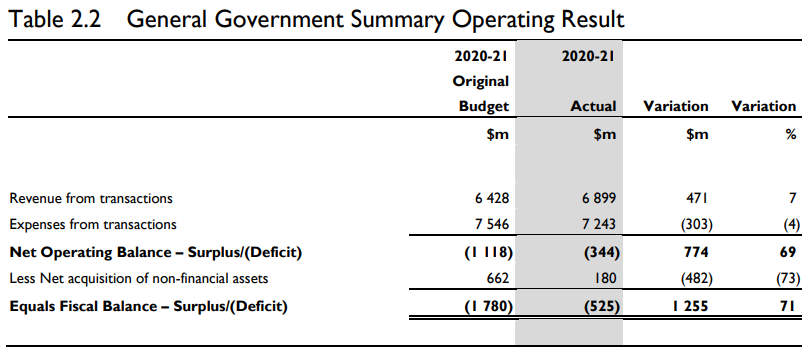
The General Government Sector Net Operating Balance was a deficit of $344 million in 2020-21, an improvement of $774 million from the 2020-21 Original Budget estimate. The main variations are set out below. For further detail on all Statement of Comprehensive Income Statement variations, refer to Note 12.1 on page 115 of this Report.
Revenue Variations
Revenue from transactions was $6 899 million in 2020-21, $471 million higher than the 2020-21 Original Budget estimate of $6 428 million. The main variations are:
Grants revenue $233 million higher primarily due to an increase in Australian Government General purpose payments and National partnership payments. For additional information on Grants, refer to Note 2.1;
Taxation revenue $162 million higher primarily due to increased Conveyance duty, Land tax and Payroll tax. For additional information on Taxation revenue, refer to Note 2.2; and
Other revenue $87 million higher, primarily due to an increase in mineral royalty income of the Department of State Growth and additional recoveries for salaries and wages by the Department of Health from private hospital operators. For additional information on Other revenue, refer to Note 2.6.
Expense Variations
Expenses from transactions was $7 243 million in 2020-21, $303 million lower than the 2020-21 Original Budget estimate of $7 546 million.
The main variations are:
Supplies and consumables $249 million lower. The 2020-21 Budget included significant COVID-19 provisions for unforeseen expenditure, allocated to Supplies and consumables. The impact of COVID-19 on the State has been less than first anticipated. This resulted in lower expenditure across General Government Sector entities; and
Grant expenses $139 million lower. This primarily reflects revised expenditure for the funding of programs of the Department of Health and the Department of State Growth.
Net acquisition of non-financial assets was $180 million in 2020-21, which is $482 million lower than the 2020-21 Original Budget estimate of $662 million. This is mainly due to Purchases of non-financial assets being $471 million lower than the 2020-21 Original Budget estimate. This decrease reflects revised cash flows due to changes in timing and reprioritisation of various Capital Programs. For further detail refer to Note 12.3 on page 120 of this Report.
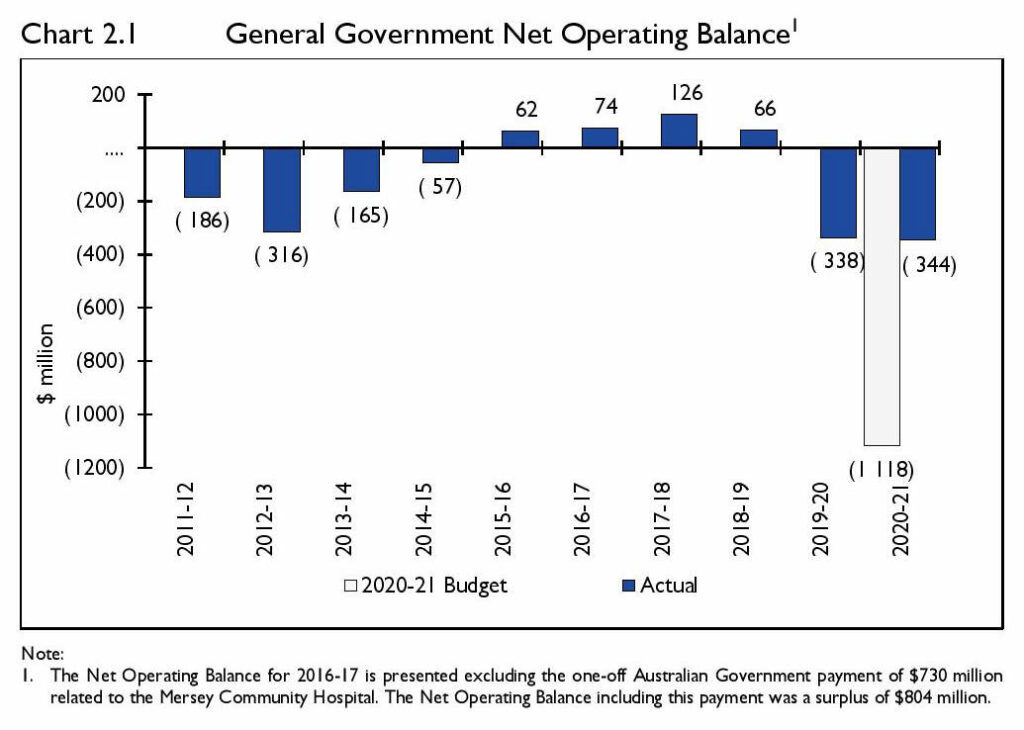
Chart 2.1 highlights the trend in the Net Operating Balance since 2011-12.
General Government Underlying Net Operating Balance
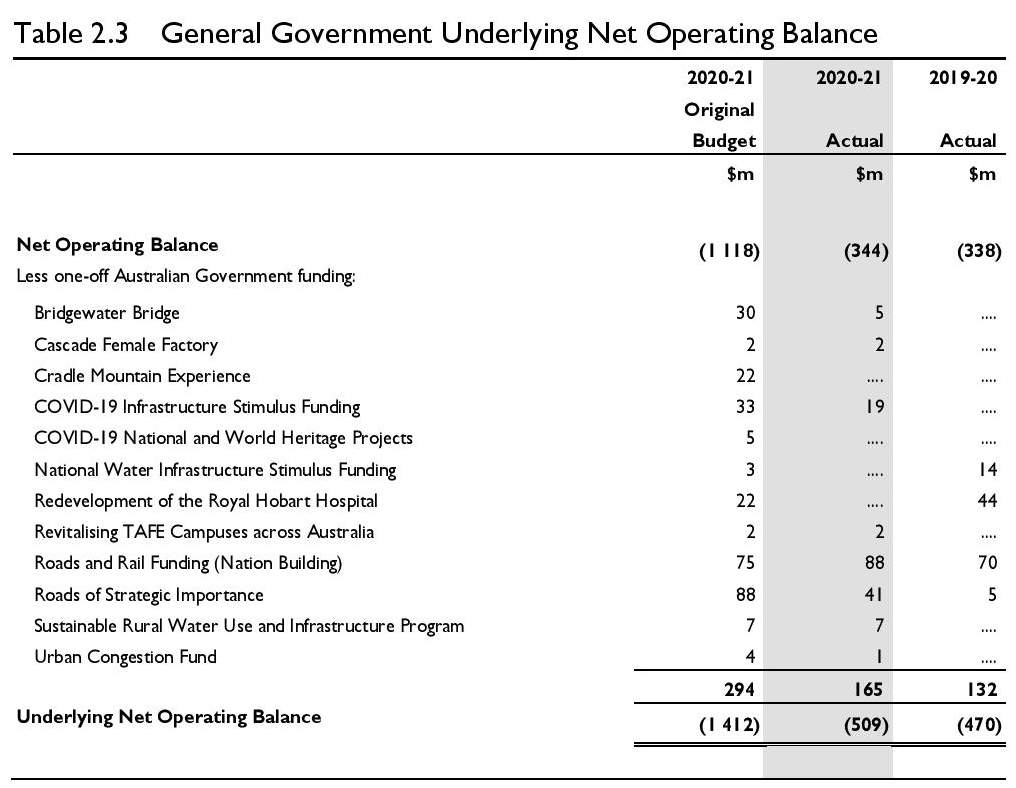
The receipt of Australian Government funding for capital programs, particularly one-off major projects, has the effect of improving the Net Operating Balance outcome. Given the nature of the Net Operating Balance measure, it reflects the receipt of revenue from the Australian Government for infrastructure purposes but does not factor in the expenditure of these funds on infrastructure projects.
The Underlying Net Operating Balance, whilst not part of the recognised standard accounting measures, has been used for a number of years as a measure that removes the impact of one-off Australian Government funding for specific capital projects. The Underlying Net Operating Balance is generally derived by excluding significant one-off capital related funding received from the Australian Government from the Net Operating Balance.
The 2020-21 Underlying Net Operating Balance is a deficit of $509 million, an improvement of $903 million from the Original Budget deficit of $1 412 million.
Statement of Financial Position
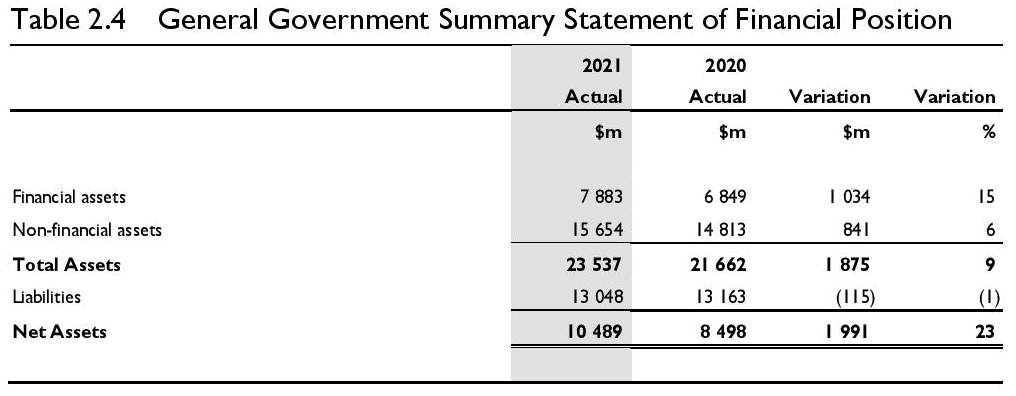
Table 2.4 provides a summary of the key General Government Sector Statement of Financial Position line items and variances. The following commentary is based on the actual movements between 30 June 2020 and 30 June 2021. For further detail on all Statement of Financial Position variations, refer to Note 12.2 on page 118 of this Report.
Asset Variations
General Government Financial Assets are $7 883 million at 30 June 2021, an increase of $1 034 million from the 30 June 2020 balance of $6 849 million. The main variations are:
Cash and deposits $285 million higher. This primarily reflects an increase in the balance of cash held in the Public Account and the timing of new borrowings undertaken;
Equity investment in the PNFC and PFC sectors $531 million higher. This primarily reflects an increase in net assets held by Hydro Tasmania and Motor Accidents Insurance Board. A breakdown of net assets by entity is provided in Note 5.2;
Receivables $87 million higher. This primarily reflects an increase of $51 million for Finance-General which is associated with State Taxes and revenue for fleet management and property services and a general increase in receivables for other GGS entities; and
Other financial assets $125 million higher, primarily due to an increase in the deferred tax assets held by Finance-General.
General Government Non-Financial Assets are $15 654 million at 30 June 2021, an increase of $841 million from the 30 June 2020 balance of $14 813 million. The main variations are:
Land and buildings $537 million higher. This movement is primarily due to capital improvements and revaluations of assets within the General Government Sector; and
Service concession assets $136 million higher. This primarily reflects the revaluation of Service concession assets held by the Department of Communities Tasmania.
Liability Variations
General Government Liabilities are $13 048 million at 30 June 2021, a decrease of $115 million from the 30 June 2020 balance of $13 163 million. The main variations are:
Borrowings $943 million higher primarily due to additional borrowings undertaken by the Government to support the expenditure of the General Government Sector and to ensure Specific Purpose Accounts and Agency Trust Accounts are cash backed;
Superannuation $1 216 million lower which primarily reflects an increase in the discount rate to 2.15 per cent (1.60 per cent as at 30 June 2020);
Employee entitlements $66 million higher primarily reflecting additional annual leave and long service leave entitlements recognised by the Department of Health and the Department of Education; and
Other liabilities $95 million higher primarily due to an increase in the Tasmanian Risk Management Fund outstanding claims liabilities.
Superannuation Liability
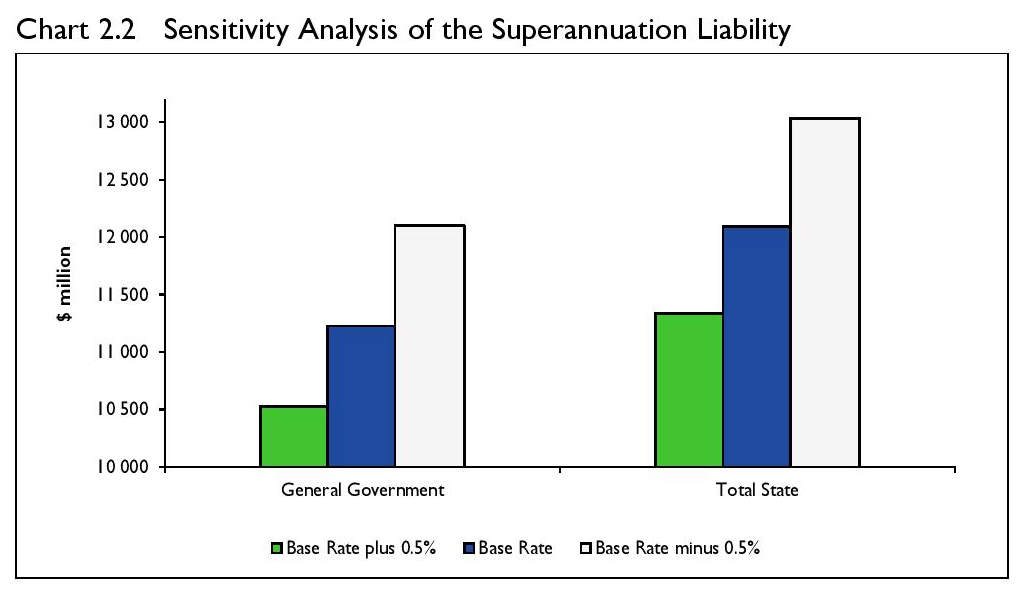
The General Government Superannuation liability as at 30 June 2021 was $9 064 million, which is comprised of the present value of the liability of $11 227 million less the fair value of plan assets of $2 163 million. This is a decrease of $1 216 million, or 12 per cent, from 30 June 2020. The decrease is a result of the latest actuarial assessment of the liability, taking into consideration changes in assumptions used to value the defined benefit obligation, in particular the discount rate.
Government businesses in the Public Non-Financial Corporations Sector and the Public Financial Corporations Sector are for-profit entities and in accordance with AASB 119 Employee Benefits, are able to value the superannuation liability using high quality corporate bond rates. However, the General Government Sector and Total State Sector are not-for-profit entities and in accordance with AASB 119, are required to use the Australian Government bond rate at the measurement date to value the Superannuation liability. Bond markets have been volatile and the discount rate used to value the Retirement Benefits Fund Scheme liability increased from 1.60 per cent to 2.15 per cent between 30 June 2020 and 30 June 2021.
There is a strong inverse relationship between the discount rate and the valuation of the superannuation liability. Chart 2.2 shows the impact of an increase or decrease of 0.5 per cent in the discount rate used to value the superannuation liability. The base rate column represents the gross superannuation liability as at 30 June 2021, valued by the actuary using a base rate of 2.15 per cent. The Sensitivity Analysis is provided in Note 7.6(l) on page 93 of this Report.
Undiscounted Defined Benefit Obligations
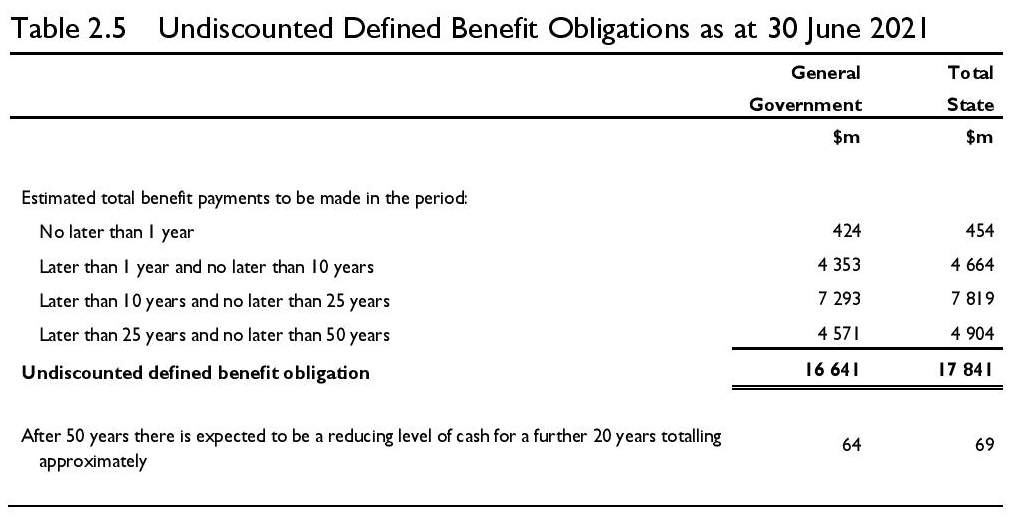
Table 2.5 presents the estimated nominal cash flows required to meet the emerging cost of superannuation benefits payable to members. This represents the total cost of benefits payable and includes the General Government and Total State share, together with the share of benefits that are funded from Scheme assets. A further break down of the years can be found in Note 7.6(k) on page 92 of this Report.
Net Debt
Net Debt comprises Borrowings plus Lease liabilities, less the sum of Cash and deposits and Investments. The reference to negative Net Debt means that Cash and deposits, and Investments exceeds Borrowings and Lease liabilities.
General Government Net Debt was $516 million as at 30 June 2021, a $692 million deterioration from 30 June 2020. However, this is an improvement of $1 339 million from the Original Budget Estimate.
GFS Net Debt
GFS Net Debt is a measure equivalent to Net Debt based on the Australian Bureau of Statistics Government Finance and Statistics reporting framework, and excludes the impact of lease liabilities. As a result, this measure provides a more consistent and comparable time series. GFS Net Debt comprises Borrowings less the sum of Cash and deposits and investments.
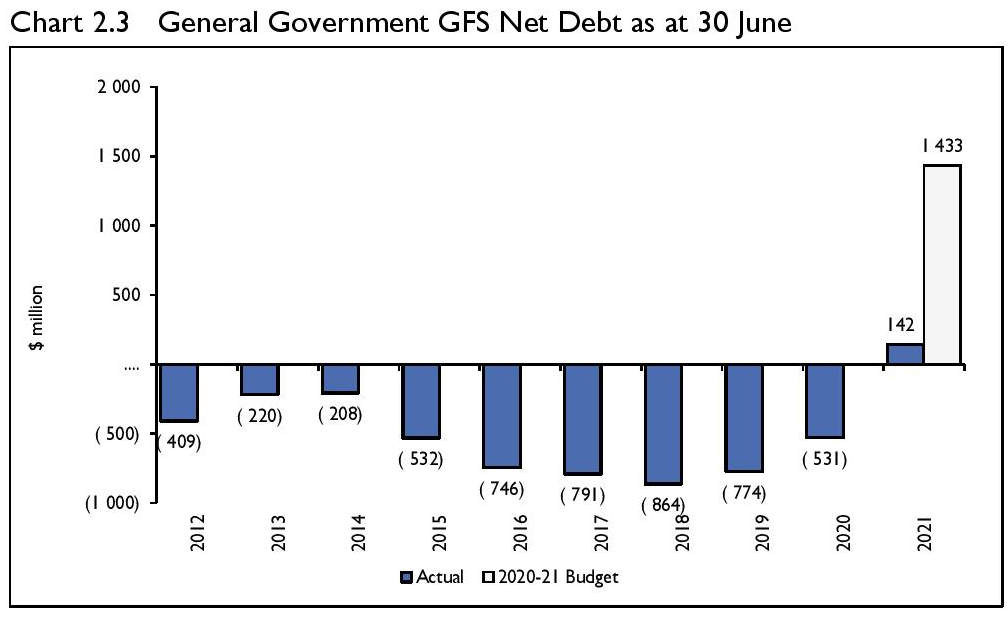
General Government GFS Net Debt was $142 million as at 30 June 2021, a $673 million deterioration from 30 June 2020. This is an improvement of $1 291 million from the Original Budget Estimate.
Chart 2.3 highlights the trend in GFS Net Debt since 2012.
Total State Outcome
The Total State Sector is comprised of the General Government Sector, the Public Non-Financial Corporations Sector and the Public Financial Corporations Sector.
The PNFC and PFC Sectors include a wide range of entities which are outlined in Note 14 on page 123 of this Report. Generally, these entities are commercially focussed and aim to cover the majority of their expenses by revenue from the sales of goods and services.
Statement of Comprehensive Income
Table 2.6 provides a summary of the key Total State Sector operating line items and budget variances. The full Statement of Comprehensive Income is located on page 28 of this Report. Original Budget information for the Total State Sector is not presented in this Report. Original Budget information is provided in the 2020-21 Budget Papers.
General Government Sector Outcomes will influence the Total State Sector. However, it should be noted that, due to the consolidation of transactions, the Total State Sector variation will not always equal the sum of variations from each individual sector.
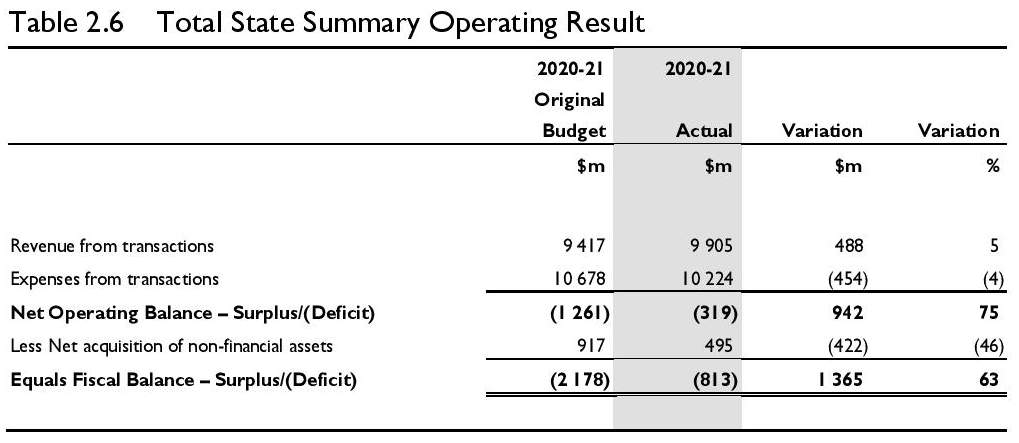
The Total State Net Operating Balance was a deficit of $319 million in 2020-21, an improvement of $942 million compared to the 2020-21 Original Budget estimate of $1 261 million. This movement reflects:
an improvement of $774 million in the General Government Sector. See pages 4 and 115 of this Report for further information on GGS variations;
an improvement of $155 million in the PNFC Sector, which is primarily due to improved operating results across the sector, as the impact of COVID-19 was less than first anticipated; and
an improvement of $14 million in the PFC Sector, primarily due to reduced operating costs and improved investment returns within the Sector.
Total State Revenue Variations
Total State Revenue from transactions was $9 905 million in 2020-21, $488 million higher than the 2020-21 Original Budget estimate of $9 417 million. A breakdown of the total revenue and expenses from transactions for each sector can be found in Note 1. The main variations for the higher revenue are:
Grants revenue $240 million higher. This is due to the higher GGS revenue of $233 million;
Taxation $163 million higher. This is due to the additional GGS revenue of $162 million;
Sales of goods and services $80 million higher. This is primarily due to higher sales revenue of $62 million for the PNFC Sector;
Interest income $115 million lower. This is primarily due to a decrease in income received by the PFC Sector of $97 million as a result of holding lower than budgeted investment assets and lower than anticipated interest rates. This decrease is offset by a corresponding reduction in borrowing costs; and
Other Revenue $120 million higher. This is primarily due to additional GGS revenue of $87 million and an increase of $39 million for the PNFC Sector.
Total State Expense Variations
Total State Expenses from transactions is $10 224 million in 2020-21, which is $454 million lower than the 2020-21 Original Budget estimate of $10 678 million. The main variations are:
Employee expenses $74 million higher. This is due to the additional expenses of $28 million for the GGS and additional expenses of $45 million for the PNFC Sector;
Supplies and consumables $332 million lower. This is primarily due to a decrease of $249 million for the GGS and a decrease of $84 million for the PNFC Sector;
Borrowing costs $96 million lower which is primarily due to a decrease of $114 million in expenses for the PFC sector, partially offset by an increase of $9 million for the GGS;
Grant and subsidy expenses $125 million lower. This is primarily due to a decrease in overall Grant expenses for the GGS of $139 million; and
Other expenses $50 million higher. This is due to the additional expenses of $17 million for the GGS and additional expenses of $34 million for the PNFC Sector.
Statement of Financial Position
Total State Asset Variations
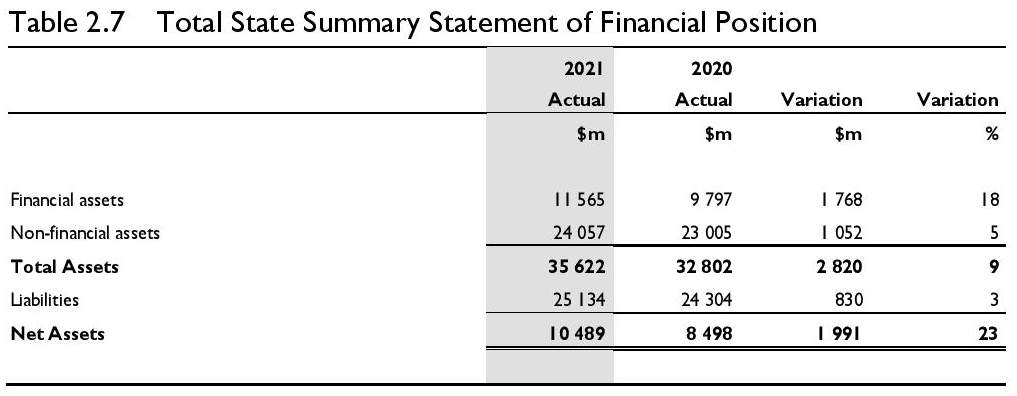
Financial Assets are $11 565 million at 30 June 2021, an increase of $1 768 million from the 30 June 2020 balance of $9 797 million. The major variations are:
Cash and deposits $919 million higher. At 30 June 2021, the cash held by the GGS was $1 466 million which comprised $1 024 million cash held with the private sector and $441 million cash held with Tascorp. At the State level, cash held with Tascorp is eliminated. GGS cash held with the private sector has increased by $848 million from a balance of $176 million as at 30 June 2020 and this is the main reason for the variation at the Total State Sector level;
Investments $667 million higher. This is primarily due to an increase in the investments and non-government client advances held in the PFC Sector; and
Receivables $97 million higher. This primarily reflects an increase of $87 million for the GGS.
Non-financial assets are $24 057 million at 30 June 2021, an increase of $1 052 million from the 30 June 2020 balance of $23 005 million. The major variations are:
Land and buildings $564 million higher. The movement is primarily due to an increase of $537 million in GGS as a result of capital improvements and revaluations;
Infrastructure assets $200 million higher. The movement is primarily due to:
– an increase of $61 million for the GGS which reflects an increase in infrastructure assets for the Department of Education; and
– an increase of $139 million in the PNFC Sector which is primarily due to an increase of $98 million for TT-Line Company Pty Ltd reflecting the initial payment for the purchase of two new vessels.
Service concession assets $136 million higher. This reflects an increase of $136 million for the GGS.
Total State Liability Variations
Liabilities are $25 134 million at 30 June 2021, an increase of $830 million from the 30 June 2020 balance of $24 304 million. The main variations are:
Borrowings $2 241 million higher. The movement in Borrowings held by the GGS and PNFC Sectors are primarily related to Borrowings held with Tascorp, which are eliminated at the Total State level. As a result, the movement is primarily due to the increase of $1 494 million in Borrowings held by the PFC Sector, which reflects an increase in Borrowings and non-government client deposits held by Tascorp;
Superannuation $1 317 million lower. This reflects the most recent actuarial estimate which decreased the GGS liability by $1 216 million and the PNFC Sector liability by $99 million;
Employee entitlements $71 million higher. This primarily reflects an increase of $66 million for the GGS;
Payables $62 million lower. This reflects a decrease of $22 million for the GGS and $35 million for the PNFC Sector; and
Other liabilities $124 million lower. This primarily reflects a decrease of $164 million in derivative liabilities and a decrease of $68 million in the Basslink facility swap fee. These decreases are partly offset by an increase of $63 million in the Tasmanian Risk Management Fund Liability.
Net Debt and GFS Net Debt
Total State Net Debt was $589 million as at 30 June 2021, which is a deterioration of $675 million from the 30 June 2020 balance of negative $86 million.
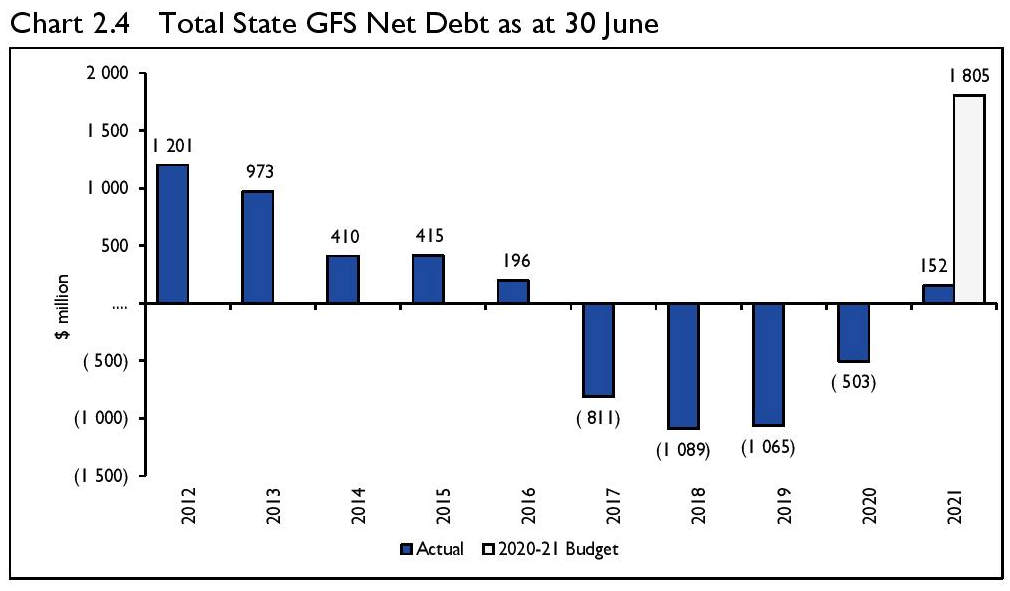
Total State GFS Net Debt was $152 million as at 30 June 2021, a $655 million deterioration from 30 June 2020.
Chart 2.4 highlights the trend in Total State Net Debt since 2012.
Read the full Treasurer’s Annual Financial Report 2020-21.
Media release – Peter Gutwein, Premier & Treasurer, 28 October 2021
Treasurer’s Annual Financial Report 2020-21 confirms Tasmania’s strong financial position
The Treasurer’s Annual Financial Report for 2020-21, released today, has confirmed Tasmania’s financial position is continuing to strengthen despite the ongoing threat of COVID-19.
The 2020-21 TAFR shows that the General Government Sector incurred a Net Operating Deficit of $344 million which is $774 million better than the original Budget estimate.
The TAFR also shows that the General Government Sector Net Debt of $516 million is $1.339 billion less than was originally anticipated in the 2020-21 Budget which is the lowest level of net debt of any state or territory in both dollar terms and on a per capita basis.
The improved outcomes, due to the strength of the economy reflect strong growth in General Government Sector revenue, which was $471 million higher than the Budget estimate, while expenses were $303 million lower than originally anticipated.
The pandemic has been one of the largest shocks to our way of life, our economy and to our finances, but this positive result clearly shows that Tasmania has bounced back strongly and even though we provided more than $1 billion in economic and social supports, the Budget is on track to achieve a surplus and will be back in the black over the forward estimates period.
Importantly, this strong financial position has allowed the Government to invest a record $10.7 billion into our health system and the health and wellbeing of Tasmanians, ensuring we are well prepared for when our borders reopen on December 15.
A record $8 billion will also be invested in education, skills and training to enable Tasmanians to get the jobs that will support and drive our economy forward, and our ambitious $5.7 billion infrastructure program will create more jobs and build better safer and more connected communities.
Tasmania’s labour market is the biggest it’s ever been and we now have more than 263,000 Tasmanians employed and, as reflected in the recent NAB Monthly Business Survey, the Deloitte Access Economics Business Outlook Report and CommSec State of the States Report, economic performance and business confidence has stayed strong.
There is no doubt Tasmania is in a good place. However, we know that there is more to do as we continue to emerge from the pandemic, and we will continue to deliver our plan to grow our economy and create more jobs as we secure Tasmania’s future.