Media release – Museum of Old and New Art, 27 October 2021
Jean-Luc Moulène and Teams and Prototypes of Speculative Engineering will run from 17 December 2021—9 May 2022.
This summer the Museum of Old and New Art will open two exhibitions from international artists Jean-Luc Moulène and James Capper. In his first solo Australian exhibition, acclaimed French artist Moulène will present newly commissioned sculptures alongside existing works, while Capper brings two mobile sculptures from Britain via Broken Hill to Berriedale.
David Walsh, Mona owner and founder says: “Moulène and Capper represent polarities of psyche—desperate intensity versus methodical repose—but I interpret the artistic processes of each as more than the typical drive to create. These guys are driven to understand. To me that means they belong at Mona.”
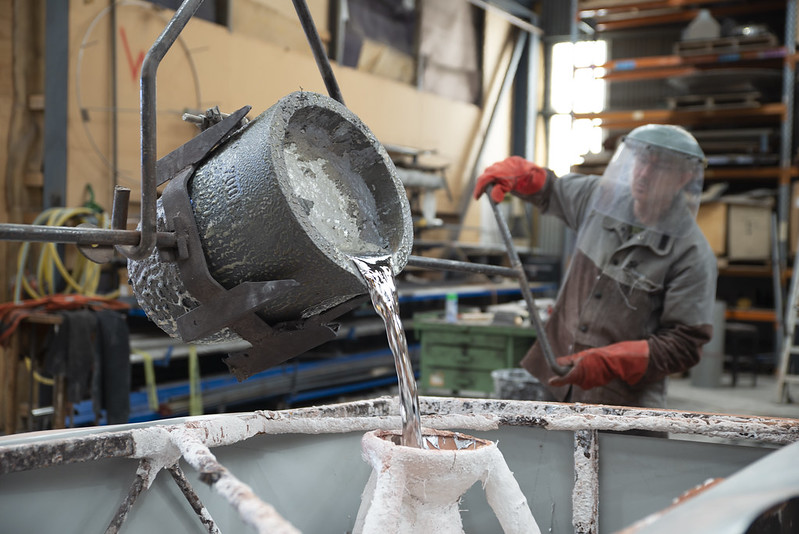
Curated by Michel Blancsubé with Trudi Brinckman, and commissioned by Olivier Varenne, Jean-Luc Moulène and Teams will examine the relationships between material, form and the creative process; between art and industry; between artwork and observer. Four new sculptural works have been created using wax, metal, Triassic sandstone and timber from primeval Tasmanian underwater forests known as HydroWood. Part of Moulène’s stated process is the deliberate sharing of artistic authority. Guided by him, the new sculptures have been produced by Mona in collaboration with teams of specialised Australian fabricators.
The loaned works are Errata, comprising nine pallets stacked high with brightly coloured cans; Axe (Axis), in which bone is wedged between steel props; and Les Trois Grâces (The Three Graces), a video projection showing three nudes, demonstrating Moulène’s extensive range across diverse media.
Prototypes of Speculative Engineering, curated by Jarrod Rawlins and Emma Pike, combines Capper’s interests in mechanical engineering, industrial design and evolutionary biology. Created with industrally coated steel and hydraulic systems, Capper’s sculptures—Hydra Step and Hydra Shuffle II—evoke the evolutionary shift when life moved from water to land. These insect-and-digging-machine hybrids explore crossovers between biological and mechanical processes, and consider humanity’s use of extractive practices.
Capper’s exhibition will also include Blue Frame, a film work that features the sculptures in action in Broken Hill, highlighting the landscapes and communities affected by the mining industry in remote Australian towns.
Jarrod Rawlins, Director, Curatorial Affairs at Mona says: “After Mona’s closure last year, we’re pleased to bring the works of these artists to Tasmania. James’ sculptures embrace a risk-taking mindset that interests us, and Jean-Luc presents the manifestations of his own creative process, in which he elevates raw materials and tests their limits.”
Both exhibitions open on Friday 17 December 2021, and will run until Monday 9 May 2022.
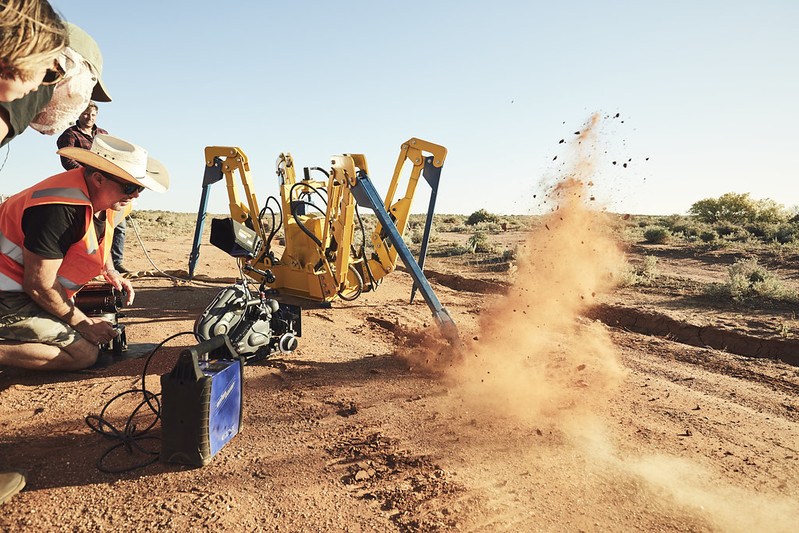
Hydra Step, James Capper.
About Jean-Luc Moulène
Jean-Luc Moulène (born 1955) is a French contemporary artist, born in Reims and now living and working in Normandy. In a wide variety of media, from photography and video to drawing and sculpture, Moulène examines authorship, the natural vs the human-made, labour and processes of production, and the intersection of advanced technologies and contemporary material culture. He identifies himself as a ‘technicien libertaire’ whose production is fundamentally practical. It transforms ‘the process of perception as an aesthetic end in itself into one that incorporates everyday life.’
About James Capper
James Capper (born 1987) lives and works in Bermondsey, London. He makes mobile sculptures that are put into action on varied terrains, adopting the techniques, materials and complex problem-solving processes of engineering and invention. Capper studied at Chelsea College of Art and the Royal College of Art, London, and was the youngest ever artist to be awarded the prestigious Jack Goldhill Prize for Sculpture. He has exhibited around the world in museums, institutions and galleries, and his work is held in public collections such as the Science Museum, London, UK; Yorkshire Sculpture Park, UK; and the Museum of Old and New Art, Tasmania, Australia.