Article
Halving Food Waste: Australia’s Progress on SDG 12.3

Halving food waste: Australia’s progress on SDG 12.3
by Monash Sustainable Development Institute OzHarvest
The Sustainable Development Goals (SDGs) are a set of 17 interlinked goals, adopted in 2015 by all countries, including Australia. They are the ‘blueprint to achieve a better and more sustainable future for all.’
The SDGs provide a long-term vision for our future and are an integrated approach that places sustainability at the core of planning and decision-making processes. Use of the SDGs by governments, civil society and business to assist with tracking — and improving — performance on sustainability is increasing.
Tackling food waste is one of the 11 targets set out under SDG 12. This is in recognition of the fact that fundamental changes are needed to the way we produce, consume and dispose of food in order to reduce the negative impact on our planet, feed more people in need and protect finite resources.
This policy brief outlines Australia’s progress on SDG Target 12.3 — halving food waste by 2030. The Australian government set and committed to this target.
Recommendations
For this to become a reality, MSDI and OzHarvest make the following recommendations:
1. Build the benefits of reducing food waste and emissions saved into national climate policies such as the Climate Adaptation and Resilience Strategy, and future national and international climate policies.
2. Follow the ‘Target.Measure.Act’ approach as recommended by Champions 12.3. This three-step approach is a proven way to achieve results:
Target. Sets ambition and motivation. Governments and companies should adopt food loss and waste reduction targets aligned with SDG Target 12.3
Measure. The old saying ‘what gets measured gets managed’is true for food loss and waste. Governments and companies should measure their food loss and waste to identify the ‘hotspots’needing action, publish the results to inspire others, and monitor to track progress over time.
Act. Based on information gathered from measurement, governments and companies should develop and implement strategies for tackling the identified hotspots.
3. Companies should include food waste reduction in their corporate greenhouse gas emission reduction strategies and other climate programs, starting with signing Australia’s Food Pact delivered by Stop Food Waste Australia to actively track their progress.
4. The Australian Government should fund and resource national targeted food waste reduction programs and initiatives in Australia across key sectors including food retailers, producers, households, workplaces and schools.
5. Australian states and territories should proactively support businesses to take action on food waste through grant programs.
6. Scale up food rescue operations across Australia to ensure those in need have access to nutritious food.
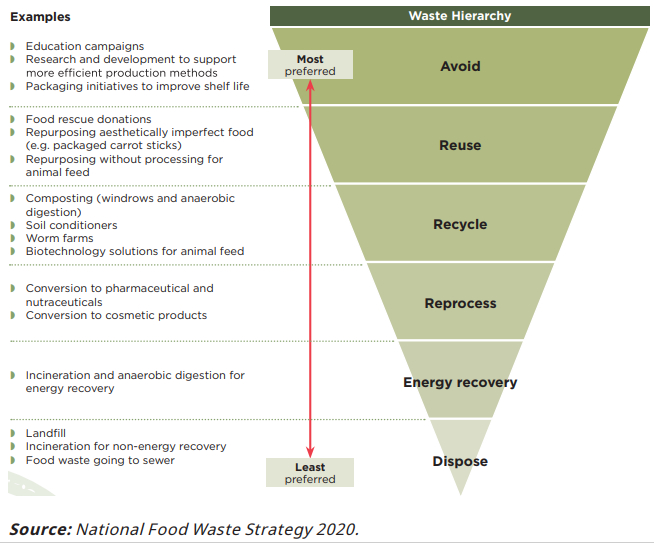
7. Drive food waste and surplus food up the food recovery hierarchy to ensure edible food waste is avoided, reused or recycled.

8. Inspire consumer action to reduce and prevent household food waste. More than 2.5 million tonnes of food waste comes from Australian homes, this is where immediate action can be taken with the biggest impact.
Read the full brief here.