Last year we wrote about the 177 Nations of Tasmania project by Mark Thomson.
177 Nations of Tasmania aims to broadcast interviews with at least one member of all 177 of the nationalities represented in Tasmania’s last census and find out about why they came to Tasmania, what they brought with them ( experiences, culture, traditions, skills, ideas etc), and the experience of settling on a small and fairly isolated island state not known for being very multicultural.
Check out their latest interviews below!
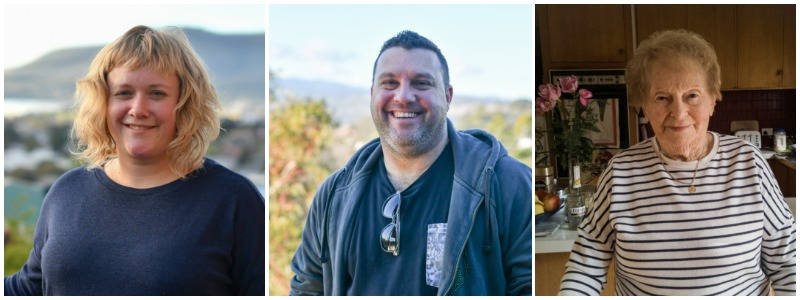
Carole grew up in Brussels in a cosmopolitan neighbourhood in a country in which the two major cultural and linguistic groups have lived side-by-side for a long time. Growing up in this environment, Carole speaks of having to be open to differences in others and this can be seen no better than in her advocacy for her son Leo, born just before the Covid lockdown in Tasmania and diagnosed with Down’s Syndrome. Like many migrants, she has faced the tough situation of not being able to introduce her little boy physically to all his family in Belgium and talks about dealing with this.
Just over 8 years ago a friend in Belgium asked if Carole wanted to accompany her to Australia. It was not a place Carole had considered. She had just spent months working in Zambia and traveling around Africa and was looking to travel some were similarly more adventurous. But she ended up coming and meeting her current partner in Mackay, Queensland. However, neither of them were keen to stay long term in Mackay and after a holiday to Tasmania decided to make the move to Hobart.
Jeff was born in Toronto and came to settle in Launceston via Western Australia and Hobart, for a combination of lifestyle and work reasons. Jeff’s a Skin Cancer Specialist, and Tasmania has the second highest rate of melanomas in Australia after Queensland, which has is the skin cancer capital of the world. He met his Australian wife on a flight from Vancouver to Mexico when he was still a medical intern and she was doing a ski season in British Columbia.
Although Canada and Australia are largely culturally very similar, Jeff has observed a few differences especially around education and has some astute observation around a few idiosyncratic quirks of life in Tasmania including the Launceston-Hobart rivalry and the custom of wearing shorts in winter!
Anna’s story highlights how complicated defining ‘nationality’ can be sometimes, and though I’m trying to use a standard based on the Australian Census’s ‘Country of Birth’, there is a category ‘Eastern Europe, not fully defined’, showing that many people in Eastern Europe throughout the 20th century were displaced or found themselves within changed borders.
Anna was born in the 1920s in what was then Yugoslavia (today it is Croatia), but only a few years before it had been part of the Hungarian area of the Austro-Hungarian Empire. In fact, as a result of being on the wrong side in WW1, Hungary lost 60% of its territory, leaving many Hungarians living within the borders of different countries. In Anna’s case, she would grow up in Burgenland, Austria, on the border with Hungary, and the majority were Hungarian speakers and her early schooling was in Hungarian.
Of course, WW2 and the German annexation brought some shocking changes and Anna suddenly found herself at high school where instruction was suddenly only in German. The Nazi occupation was a hard time, but after the war, she met a Hungarian emigre in a refugee camp and married him two weeks later.
They emigrated to Australia in 1950 and settled down for a time in country Victoria. Later they moved to Sydney. After her husband died, she would visit her son, who had moved to Tasmania, initially to pick apples…and eventually she moved here.
But this is the briefest of summaries of a long life. Listen to the episode to hear about life in rural Austria in the 1930s and 40s and more about the migrant experience from a member of a generation of which fewer and fewer remain.
More episodes are available at 177 Nations of Tasmania podcast home.