Dr Lisa-ann Gershwin, as part of a submission by the Tasmanian Independent Science Council to the Australian Parliament, made this statement to the Senate Environment and Communications Legislation Committee, Inquiry into the Environment Protection and Biodiversity Conservation Amendment (Standards and Assurance) Bill 2021, Public Hearing 4 May 2021
Environment Protection and Biodiversity Conservation Act 1999 (EPBC Act)
Dear Senators, thank you for allowing me to speak today. I will be quite brief, less than five minutes. I just wanted to take a moment to bring it back around to what we are debating about, what we are weakening, rather than strengthening, and why it matters.
The EPBC Act is failing many iconic land and aquatic species, and yet we dither.
Since the introduction of the EPBC Act in 1999, there have been at least 5 well-documented cases of vertebrate extinctions, and we don’t even track the other 97% of species – that is, the invertebrates – so god only knows about them, and god only knows how many more that are teetering on the brink. And yet we dither.
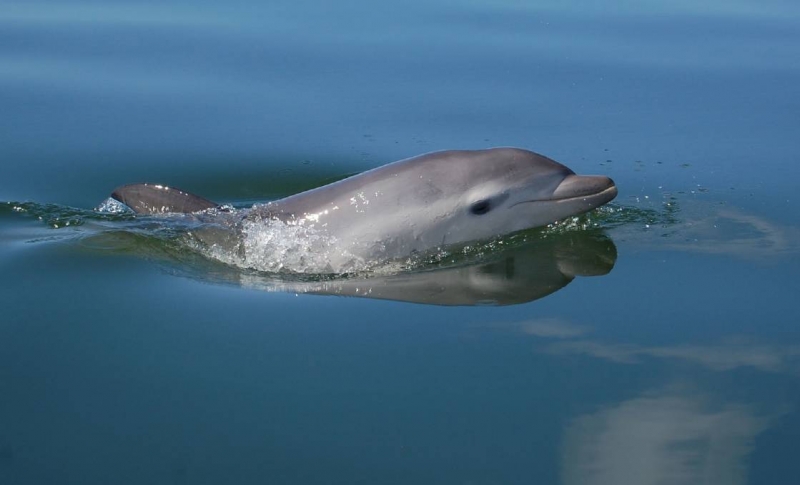
Let me tell you a story about my little dolphin. Several colleagues and I named and classified this new species in 2011 (Charlton-Robb et al., 2011). You’ve probably never heard of the so-called Burrunan dolphin, with the scientific name Tursiops australis. But I am blushingly proud to be one of its discoverers. It is southeastern Australia’s very own endemic dolphin, found nowhere else in the world.
It is the common inshore dolphin in two capital cities, Melbourne and Hobart — if you see a dolphin, it’s probably this one! But its three resident populations are all in great peril.
- In Melbourne’s Port Philip Bay: It is plagued by urban runoff, disease, fluctuations in food, boat strikes, and heavy metal poisoning. In fact, research in 2014 found that it had the second highest mercury content of all the dolphin species studied (Monk et al., 2014): chronic exposure is thought to suppress immunity and interfere with neurochemical pathways.
- In eastern Victoria’s Gippsland Lakes: Just this year, it lost 20% of its population from a skin disease that’s similar to 3rd degree burns, and almost every year it is in competition for food against increasing swarms of jellyfish: jellyfish eat the eggs and larvae of small fish such as pilchards, then the dolphins have nothing to hunt.
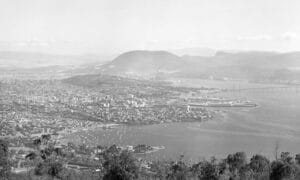
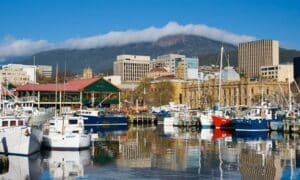
- In Hobart’s Storm Bay: It used to be common – this is the species in the iconic photo for Pennicott Adventure Tours – it is one of the first things visitors see at the Hobart Airport — but there’s not a single study on this species here, we know nothing about it, except that locals see it less often in the last few years.
In Tasmania, by far its biggest threat is salmon farming. Salmon farming is — in practice — largely exempt from the EPBC Act, simply because the state government looks the other way.
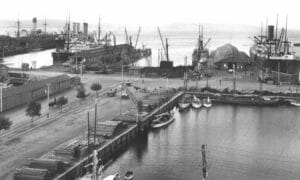
- Like Victoria, heavy metals are a problem here too. In the 1970s the Derwent held the shocking title of being the world’s most polluted estuary (Bennett, 1999), because of the heavy metals. Today, they are being resuspended by an unfortunate process of water chemistry that unbinds the molecules from sediments when the dissolved oxygen is very low — the inevitable condition created by salmon farming.
- But make no mistake, the biggest problem for dolphins is noise. Salmon farming has turned quiet bays into unrelentingly noisy industrial sites, where big ships and heavy machinery are operating at all hours. It is creating a serious mental health crisis for human locals, so imagine the effect on dolphins that use echolocation — or sound frequencies — in all aspects of their life, from finding food to social cohesion.
- And on top of that deafening thrum, the salmon industry sets off up to about 40,000 underwater ‘cracker bombs’ a year to deter seals (Zwartz, 2018). These explosives shatter bones, rupture eardrums, and herniate brain tissue, so imagine what they do to the echolocation of dolphins.
In Victoria, the threats this dolphin faces are largely environmental — disease, climate, pollution. But in Tasmania, what should be its refuge, it faces completely manageable human threats — ships’ noise 24/7, machinery noise 24/7, and 40,000 underwater seal bombs a year.
This little dolphin is listed as Endangered under the Victorian Flora and Fauna Guarantee, and is currently being assessed as Critically Endangered, but it has yet to be listed under national or international codes because there’s almost no funding for the required research. Vicious circle. It has little protection in Tasmania, and with weaker legislation, it probably won’t get it. Yet still we dither.
Here’s the problem: my dolphin — our dolphin — is collateral damage of a state government decision to grow the salmon industry at all costs. It is untenable to put the state government, which is responsible for growth, in oversight of the casualties of that growth. This is the fox guarding the hen house! Oversight by its very definition should be ‘above’, not ‘in’. You alone have the power for positive change. So that we don’t dither.
In closing, I just wanted to quote the American naturalist William Beebe:
“The beauty and genius of a work of art may be reconceived, though its first material expression be destroyed; a vanished harmony may yet again inspire the composer; but when the last individual of a race of living beings breathes no more, another heaven and another earth must pass before such a one can be again.” (Beebe, 1906)
Dear Senators, on behalf of the ‘races of living beings’ who have no voice — my little dolphin and so many more — I implore you to strengthen, not weaken, the EPBC Act.
Thank you.
REFERENCES
Beebe, W. 1906. The bird, its form and function. New York, Henry Holt and Company.
Bennett, B. 1999. Healing the Derwent’s murky blues. Ecos 100: 10-17.
Charlton-Robb, K., L.-a. Gershwin, R. Thompson, J. Austin, K. Owen and S. McKechnie. 2011. A New Dolphin Species, the Burrunan Dolphin Tursiops australis sp. nov., Endemic to Southern Australian Coastal Waters. PLoS ONE 6(9): e24047.
Monk, A., K. Charlton-Robb, S. Buddhadasa and R. M. Thompson. 2014. Comparison of Mercury Contamination in Live and Dead Dolphins from a Newly Described Species, Tursiops australis. PLOS ONE 9(8): e104887.
Zwartz, H. 2018. Tasmania’s salmon farms shooting thousands of non-lethal ‘beanbag’ rounds at seals, ABC News.