

Digital technologies have changed how people interact with information. Programme for International Student Assessment (PISA) data shows that 15-year-olds increasingly read online to fulfil information needs (e.g. online news versus newspapers). At the same time, technological changes in the digitalisation of communication continue to reshape people’s habits (e.g. chats online versus emails).
Fifteen-year-olds’ total online consumption has risen from 21 hours a week in PISA 2012 to 35 hours per week in PISA 2018 – almost the equivalent of an average adult workweek in OECD countries.
The massive information flow that characterises the digital era demands that readers be able to distinguish between fact and opinion, and learn strategies to detect biased information and malicious content, such as phishing emails or fake news.
Academic research is inconclusive about the prevalence and importance of misinformation and fake news. Yet, the consequences of being poorly informed have been largely documented. It can lead to political polarisation, decreased trust in public institutions and undermined democracy.
Students’ use of the internet continues to increase while the opportunity to learn digital skills in school is far from universal.
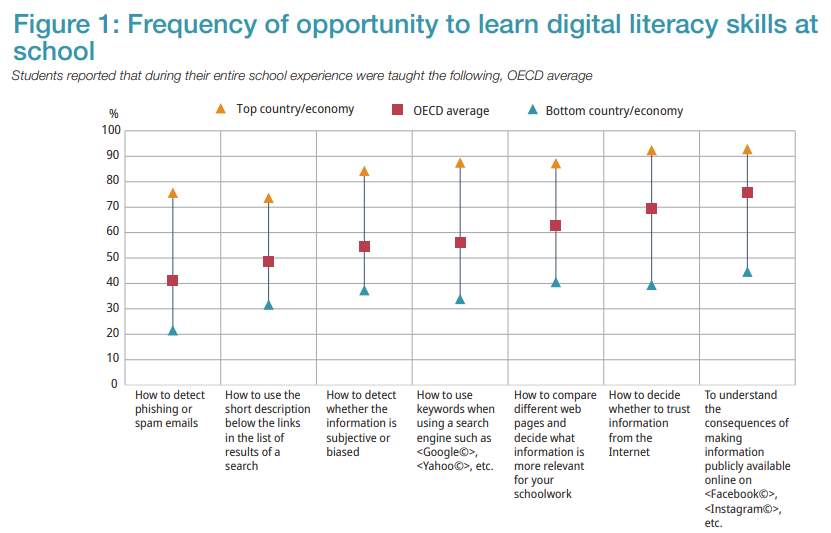
Items are ranked in ascending order of the percentage of students within OECD average. Source: OECD, PISA 2018 Database, Table B.2.6.