Featured - Row 1
‘Parties Need to Start Representing PWD and Select them as Candidates’
Braddon candidate Tammy Milne takes a look at political issues from the point of view of people with disabilities (PWD).
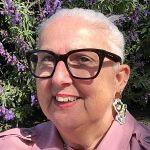
Tasmanian Times has been proud to provide plenty of exposure, through transcripts of the CDAT and Town Hall forums, to Clark independent candidate Lisa Gershwin who is ‘running on a disability platform’.
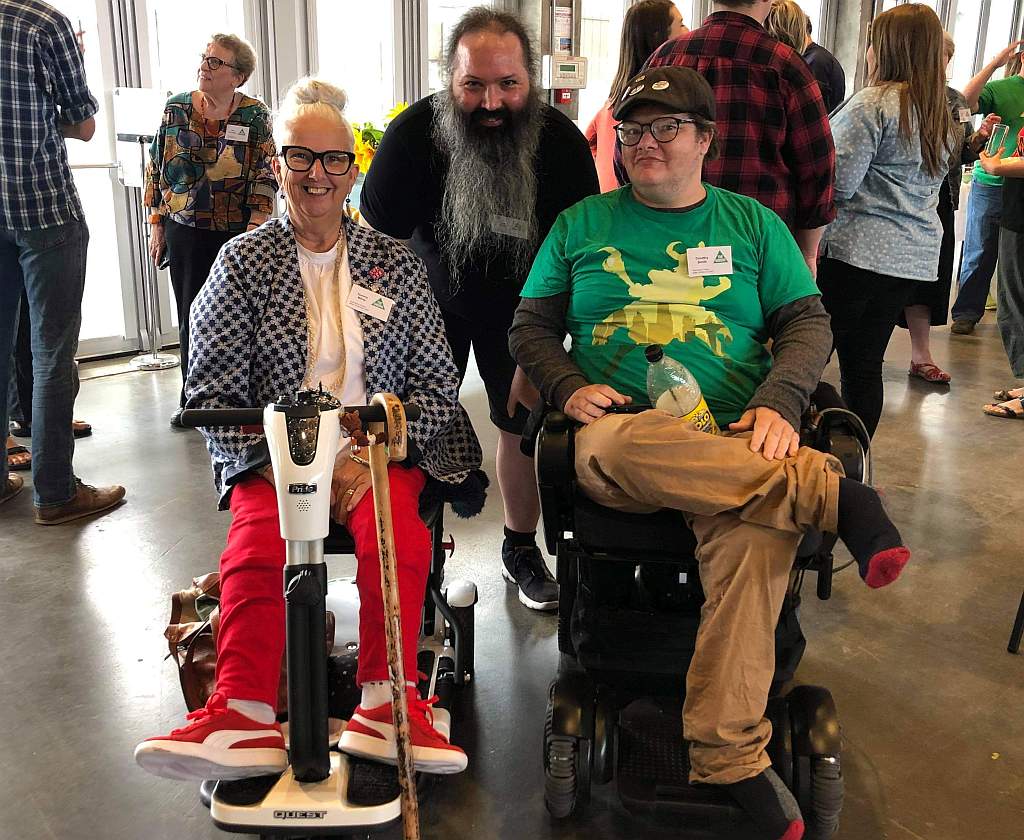
Another such candidate is Tasmanian Times contributor Tammy Milne, who is standing for the Tasmanian Greens in the seat of Braddon. We invited her to talk about why she’s running and what some of the issues are for people with disabilities (PWD).
I am north-west coast Devonport and bred.
I was born with my disability (AMC) Arthrogrophosis multiplex Congenita which effects my feet, legs, hips and shoulders. I consider my life to be one of, yes, challenges but it has also been rich and full of opportunities.
I started working for the Department of Education in 1988 and was given the opportunity by a teacher who had moved from Sydney to work at Reece High with deaf children. He interviewed me for a potion of signing aide and saw the potential in me overlooking my disability. Remember this was 1988 and we still had a lot of discrimination against PWD.
Funnily enough 1988 was also the year I met my still partner Phil. We have a beautiful daughter together Lucy (see above) who is now 20 and a third-year law student.
All my experiences through out my life have made me a fierce advocate for PWD. When I was 5 my mum tried to enrol me in the local primary school the head mistress at the time told my young mum, ‘there are schools for children like yours’. She meant special schools, residential schools where little disabled children when sent as boarders away from their families. My mum would not hear of it and found a more progressive principal at another local government school and I enrolled and went there.
I believe that segregation of children with disabilities from mainstream schooling is state-sanctioned discrimination. How can we truly eradicate discrimination of PWD if we don’t take steps at the most fundamental of children’s rights?
As a society we are diverse and part of that diversity is disability. We need to see disability in every aspect of our society: in schools, in the workplace, everywhere.
I also believe that our health system needs to be better geared towards disability. People with disabilities get sick just like those without but our disabilities are often not related to our sickness. Having a disability doesn’t mean you are sick. Our society is moving away from the medical model of disability which terms disability as something that health professionals can fix. The social model of disability sees society as the issue and that by fixing our environment (physical and social) our disabilities will have accommodation made, ie. physical access to building and social inclusion so that we are welcomed in social circles.
Now lets talk jobs. I have a dream that our state and federal public services actually walk the walk when it come to equal opportunity employment. We need to be seeing more people with disabilities in our public service. Over three-quarters (76.8%) of people with disability reported a physical disorder as their main condition. The most common physical disorder was musculoskeletal disorder (29.6%) including arthritis and related disorders (12.7%) and back problems (12.6%). If this is the case then we need to be seeing the diversity of physicality in our workplaces and the public services should be the place to start.
Transport is a huge issue for PWD. I drive, I have driven for 40 years with a modified car using hand controls. I am fortunate because having a job means not living below the poverty line on a Centrelink payment. I could afford nice cars and could drive myself. Now I’m older my transport needs have changed as I now use my wheelchair constantly. I had to take money from my super to buy a car that has a wheelchair ramp. Again PWD living on Centrelink don’t have this luxury and its created a whole new level of financial and physical discrimination.
The state government taxi access scheme for PWD is constantly threatened to be withdrawn and is very expensive for PWD to get anywhere and conduct an active life style outside of their homes because the cost out of pocket is so great and just not affordable for people on Centrelink. It cost me $114 to get from Devonport to Burnie in a taxi while in a car it’s about $20 of petrol or less. See how that limits PWD without car access? I can get a support worker to come to Spotlight in Burnie in my own car with companionship and someone to assist me for less than the cost of a taxi.
I can’t even talk about the bus service in Tasmania for PWD.
I have a degree and a postgraduate diploma and I still can’t work out if the bus is going to arrive with access for me or not.
I’ve had friends who have been waiting at the bus transit to go to Launceston and Hobart and the bus turns up inaccessible and their plans were then dashed. In Melbourne when the trains aren’t running on two occasions now Vline has proved PWD (me and my family) a taxi to Geelong from Melbourne and back. No fuss, just equity.
My crusade is to get PWD on to committees, not just disability committees but committees in the mainstream so we can better advocate for ourselves what we need. I’ve had a crack at getting on the board of TASCOSS and the Cradle Coast Authority because in reality with one in 5 people living with disability in Australian and more in Tasmania we should be represented on these committees.
I also want more PWD to be preselected from political parties for the same reason. I am bloody fortunate to be a member of and preselected by the Greens, supported through my council elections and subsequent time as a councillor on Devonport City Council and now preselected for this state election. The two major parties need to get with the program and start representing PWD and selecting PWD as candidates.
As I’ve said before and ill say I again, ‘You cant be it if you cant see it”. We need to see disability proudly represented and in plain sight in every aspect of our community.
Tammy Milne is a deaf interpreter, a community activist in various fields and a person living with Arthrogrophosis Multipex congenita.