Statement – Shelter Tas, April 2021
Shelter Tas’ 2021 State Election Asks
Everyone needs and deserves a safe, appropriate, affordable and secure home, but thousands of Tasmanians are living in housing hardship due to rising rents and too few affordable homes. Rents across the State have increased by over 35% in the last 5 years.
Tasmania has led the way with our Affordable Housing Strategy and Action Plan, and recent boosts to social housing. In 2021, we need to re-calibrate the Strategy to meet current demand and plan for the future.
With an imminent State election, we call on on all candidates to support Shelter Tas’ longstanding target of 10% of dwellings to be affordable social rental housing. This will double our level of social housing (currently at 5-6%). Tasmania needs a target that will keep pace with our growing population and address the growing rental crisis.
The 10% target is endorsed by all the housing and homelessness services across the State. Housing is the necessary foundation for education, work, social participation, health and wellbeing, and we know that too many Tasmanians are without safe and affordable housing. The waitlist for social housing is at 3,813 households, and on average, even people with the highest priority applications have to wait more than a year for a home.
As the housing costs rise across the State, more Tasmanians are facing unaffordable rents and homelessness than ever before. We will need the incoming State Government to join our vision for safe, secure, affordable and appropriate housing for all, especially for Tasmanians earning low incomes. It is imperative to plan now to build the essential safety net of 10%. Building these new homes will stimulate the construction sector and provide much needed jobs in all regions.
We are pleased to see other peaks are following our lead in calling for the 10% target, and welcome support from TasCOSS and National Shelter.
We call on all organisations and individuals to join Shelter Tas in advocating for 10% affordable social housing, to boost the current rates of building, and address the chronic shortage of affordable rentals. In the lead up to this State election, all candidates need to know that housing is Tasmania’s number one priority. Whoever leads Tasmania will inherit the responsibility to fix our housing crisis, and the sure way to do this is to deliver 10% affordable social housing.
Shelter Tas’ key priorities for election 2021:
- Fund the community and public housing sector to deliver an additional 1,000 social housing dwellings per year for this 4 year term of government, and commit to the 10 year target of 10% of all Tasmanian dwellings to be affordable social housing.
- Set a timeline to strengthen, reform and modernise the Residential Tenancy Act to improve conditions in Tasmania’s rental market.
- Ensure that the comprehensive Tasmanian Housing Strategy (recommended by PESRAC) prioritises social and affordable rental housing and includes a housing focus in all policies approach.
- Commit to ongoing and sustainable funding to enable the homelessness sector to provide support, and tenancy services to meet increasing demand across Tasmania.
- Commit to affordable housing in all neighbourhoods, including in-fill development in established inner-city suburbs; and measures to ensure that Local Government Planning Schemes and infrastructure (power, water and sewerage) do not delay the delivery of affordable and social housing.
For more information on election policies and announcements, click the following links for:
Hickey: ‘Housing is long-lasting infrastructure with a really meaningful impact’
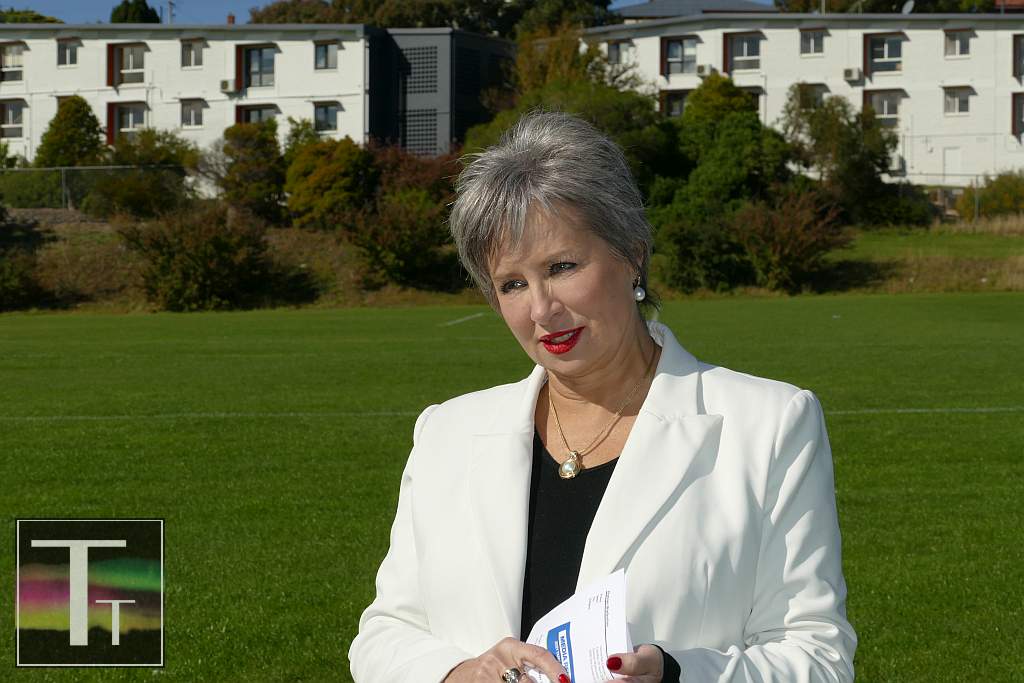
Transcript of media conference with Sue Hickey, independent candidate for Clark, behind Oakley Court, Glenorchy, 21 April 2021.
Sue Hickey
I was really annoyed to find yesterday, released very late in the afternoon, a one page release from the government saying they’re going to address housing. I’m telling the Premier that it’s way too little and way too late. I have been calling this out for three years. From the day I got elected, I have been calling it out every single day that we needed to name up housing as the number one position for the government because it has such a terrible impact on the people of Tasmania. All we’ve seen is that it’s grown, it’s completely blown out of control. So he only wants to build 3500 homes over seven years when we have a priority one waiting list of 3800 homes now. And I can tell you, there’s so many more people who are not on the waiting list, but are in desperate need to get onto that waiting list. Today we had a man in complete distress come in. He’s been waiting for three years as a priority one with references from the children’s psychologist to say he needs a three to four bedroom home; he is sleeping on the floor of his elderly father’s house. There are simply not enough houses. But if we build houses, we create jobs. If we want to get 4000 nurses here, we’re going to need to have homes to house them. So the solution is build the homes, you can then get people in secure accommodation so they can go to work and get a job.
Journalist
Yes. So Labor and the Greens and the Liberals have different strategies and approaches to this issue. How would you rate each party’s performance and their plans?
Sue Hickey
Well, I don’t trust the Liberals at all because it just hasn’t worked. They just have not made it a priority under any standard. I think Labor has quite a bit of work and in the space of doing shelters and looking after youth, so I applaud them for that. The Greens have very ambitious target of 8000 homes. But good, let’s be big, bold, brave and accountable. Let’s set a target that’s out there and let’s go towards it. Until we actually name it up, and we as a community say to the government, this is not good enough. Now governments can’t do everything. What we need to do is incentivise private developers. We need to get the not-for-profits being able to scale up and build more; So if the government can give loans to its mates as interest-free loans, then it should be able to invest that same sort of money into the not-for-profit sector to build many more homes. I don’t want everyone living in social homes, I want people living in affordable homes. I want young people to have aspirational homes. And I also want the private sector doing a lot more work. So the premier has his hi-viz army, let’s turn them to working on building homes, because that creates jobs, creates wealth, and solves the housing issue at the same time.
Journalist
Why do you think the government isn’t building enough homes?
Sue Hickey
It just hasn’t been sexy. And I think because I’ve been nagging and carrying on about it, there’s almost been a mental block to do anything about it. So you know, Liberal governments are notorious for wanting to build roads and bridges and call it infrastructure, ‘we want to invest in infrastructure’. Well, housing is infrastructure, it’s long-lasting infrastructure with a really meaningful impact. We don’t want people sleeping under the bridges. We need people in houses, I can’t tell you how distressing it is to face a mum or a dad with young kids who are living in their car, who are trying to get their kids to school when they have to wait for the public toilets to open. And they can’t put milk in their cereal because they don’t have a fridge. You know, it is simply impossible to get the child washed. So there’s a great sense of shame, mental illness comes with it, great distress. And I have to face these every single day in my electorate office as do my staff. It’s simply a horrible experience.
Tasmanian Times
It takes time to get houses built. What policies do you have in the interim to deal with, as you say, those people who are sleeping under bridges?
Sue Hickey
Well, we’re about to come into another winter. I’ve previously suggested that we get some, you know, army tents here, that we get some there’s lots of container homes on the market. I tried to get those in a while back, the government did a model of it and sort of stuffed it up but they were they did provide accommodation. We can find solutions, short term solutions; I don’t want people living in converted containers forever. But that would be a better solution than sleeping in a hedge, or in the back of a car. What we need is warmth. So maybe we look around for another hotel or something that we can use as well. It we can use it as a medevac hotel, then we might be able to use it for some temporary housing, there must be solutions to these problems. And I’m sure there’s a lot of empty buildings around the city that can be converted to temporary accommodation to get us through winter while we build these houses. But until it is the number one priority, we will not get anything done.
Journalist
And could you fill us in on the history of the site behind you and why you feel proud to be here today?
Sue Hickey
Behind me is Oakley Court. This was one of the government’s most shameful housing estates. It was a government-run shopfront for drugs, for prostitution and all sorts of crime. It was an extremely dangerous place for people to live. I lobbied and lobbied and lobbied the government, until one woman was badly raped with a hammer, and they finally decided to do it up. So it’s been done up, the bad tenants have been moved on to more suitable accommodation, and this has been converted back to its original purpose, which is for 50-year-olds plus. And it’s a state of the art complex through renovation. It created jobs and people are now wanting to go and live there. It’s a safe place. The neighbours are happy. It’s a great outcome. And I’m immensely proud that this happened on my watch.
Journalist
Do you think the liberals are connected to the people that actually need these homes? And do you think they value their vote?
Sue Hickey
I think that value their vote, of course, but no, they’re not connected. They’re not seeing the real people like I am. And in fairness, you know, they’re very busy being ministers, but you know, a little walk outside and actually meet the real people who are suffering wouldn’t hurt. And then they might have a change of opinion. This is a dire situation. It was a crisis three years ago, and now it’s a tsunami of people who are homeless and facing destitution as the rents rise and people just can’t afford to live in the rentals that they’ve got. Remember 40,000 households are renters, traditional renters, and they’re finding they just can’t live in these houses as the rents have escalated. So we just have to build more houses so that we get the supply and demand ratio right.