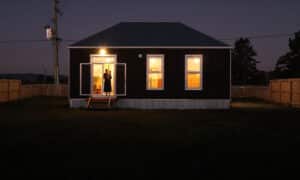

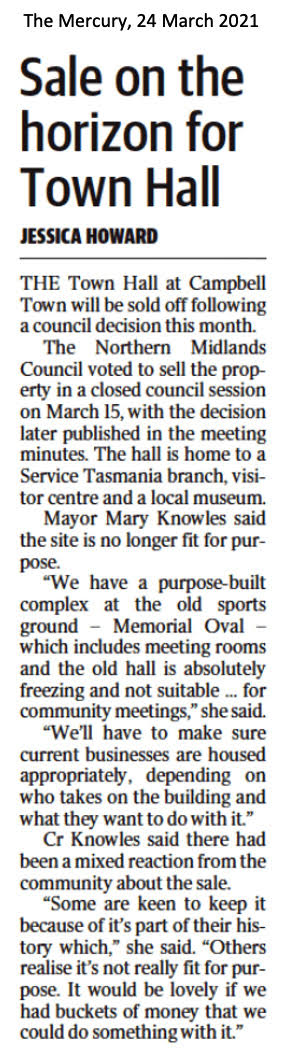
 The decision by the Northern Midlands Council to sell the Town Hall in Campbell Town has been covered in the Tasmanian Times and also published in The Mercury on 24 March, where the source of the story was not acknowledged, but follows my media release on the matter. [Fig.1]
The Mercury report included an interview with the Mayor of the Northern Midlands, Mary Knowles, allowing Cr Knowles to strongly promote the Council reasons for selling the Town Hall, but did not ask anyone in Campbell Town how they felt about it, completely talking over the heads of the citizens of the town.
Do the views of the citizens of a small country town matter to a big city newspaper?
The population of the Northern Midlands municipality is mainly located in the north, where the Council area serves as an overflow suburb of Launceston. The Northern Midlands Council is also responsible for the Launceston Airport.
Is the Northern Midlands a city council, or a country municipality?
With most of the population near the City of Launceston, the north is like an outer city council, but most of the municipality is rural, but sparsely populated.
The south of the Northern Midlands is a long way from the seat of power in Longford, and seems to be managed in a brusque way, sometimes better suited to the style of the old time carpetbaggers from the north.
Perhaps the rural south is out of sight and out of mind for most of the time, unless a matter cannot be ignored.
Now that the Council has decided to sell the Town Hall, they will watch to see if there is any objection.
Silence will empower their decision.
While the residents of Campbell Town are celebrating their bicentenary year with 2021, the Council has been advertising entrance statements for the town with 1826 on them, which is explored in another article (Campbell Town Entrance Statements & Dual Name).
Where 1826 comes from remains a total mystery, as the town was established and named in 1821 by Gov. Macquarie. When examining a Council produced pamphlet for Campbell Town, the year 1826 was used as the establishment year, instead of 1821, and other false historic information was also seen, and a website used that applied to a project in Campbelltown in New South Wales, a web site that hasn’t been working since 2007.
Being so loose with facts in the historic heart of the Central Midlands is quite negligent, and reveals a high level of disdain for the south by the Council.
This disdain deepens into a dark stain on democracy when it is found that the Council has not run community consultation about the prospect of selling the Town Hall.
At the meeting of the Campbell Town District Forum of 2 February 2021, a special committee of Council under the direction of the General Manager, Anna Bonython made a presentation to the committee of her work for the Council investigating the fate and future of the Town Hall, where we can read ….. “She informed the Forum that she has submitted an Interim report to NMC and is currently waiting for the council review before she can proceed to commence discussions with the community from which a small working group will be formed.” [Fig.2]
A month later, at the meeting of 2 March 2021 the committee were informed by Cr Calvert concerning investigations into the Town Hall ….. “the review is progressing, and that the committee will be advised in due course.” [Fig.3]
Instead of going through a process of community consultation, where the Campbell Town community may have come up with innovative and imaginative ideas, finding new ways to use the Town Hall, the Council went straight to a decision to sell in a closed meeting on 15 March 2021. [Fig.4]
If the Town Hall is to remain a public building, it is entirely in the hands of members of the Campbell Town community to dispute this Council decision to sell, and call for the community consultation which has been astutely avoided.
Does the Campbell Town community have to organise their own community consultation, and tell the Council what they want, instead of marching off to the agent with a shotgun sale? Would the thinking in the minds of the Councillors be of interest to anyone concerned?
The old Avoca Primary School was offered to the Northern Midlands Council by the Tasmanian Government for community use. In the transcript of that discussion, some councillors were very keen to accept this old school, as long as they could sell the property later. [Fig.5]
When the General Manager pointed out to the councillors that if they ever sold the old Avoca School, the money would go directly to the state government, they decided not to accept the property.
There was no consideration about having discussions with the Avoca community about what they could do with the property. It appears that the Avoca community is quite invisible to the Council.
In the discussions much was said about the old Ross School, revealing how the councillors live in a bizarre fantasy land. The Ross School was closed in 1999, and then given to the Ross community for community use, but did the Council ever talk with the Ross community about what they would like for the old school?
When I first inspected the buildings in 2003, they were empty, with no community use happening.
The Tasmanian Wool Centre had been granted the lease on the building with a view to developing a college of stone masonry, proposed by the Tasmanian sculptor Stephen Walker, but this project came to naught, and the buildings remained empty.
In 2007 a Council officer suggested that I apply for the lease of the buildings, to pursue community, historic and art projects. I submitted an 8 page document, with references, applying for the lease, and include some extracts below. [Fig.6]
I was able to make an inspection, and found the buildings quite neglected, with the wood fire full of dead bees. My offer to lease and pursue community related projects was rejected, with the Tasmanian Wool Centre extending their lease of the property.
Later in 2007 I moved to Queensland, and when considering moving to Ross in 2014, I wondered about revisiting community activities with the old school. Then it was found the school property was going to auction, where it was handed in without a single bid, and was then listed for sale.
When visiting Tasmania in 2014, we made an inspection of the school with a view to purchase, and had a builder make an inspection. The place was in a bad way, with neglect, rotting floors in one part, and a nest of dead bees still in the wood fire.
We could but wonder why the Tasmanian Wool Centre had held the lease on the building for all those years, done nothing with the property, and actively neglected the buildings. We also wondered why the Council had done no work to clean up the property when presenting it for sale.
The builder estimated the cost of making the property usable would be $400,000, which on top of the asking price of over $300,000, would make this a very expensive project, quite likely nudging toward a million dollars.
In the light of the high level of cost involved in taking on this neglected school, we offered $100,000 for the property, which the Council declined.
It turned out that the Council could not sell the old Ross School until ten years had gone by.
Looking back on my lease application in 2007, I can but wonder now if I was being kept out of the building, so the Council could sell the property, especially as I would have been seeking to invite the community to use the property and bring life back to the old school.
In another place I read that David Foster also sought a lease on the old school, as a home for his wood chopping museum, but his application was also rejected.
The old school was eventually sold to a fellow Queenslander, who later expressed reservations about making the purchase. If the school had still been sitting there when we moved to Ross in 2015, we would have pushed hard for community use, to keep the property in public hands.
With the old school oval located between the town hall with the public toilets and the school buildings, it was a natural part of the civic centre in Ross, where it could be developed as a town park, with a tennis club, and rose garden with old trees, where community activities could happen, including arts and history.
The new building could have become an art gallery, something which Ross lacks.
When the Anglican Church in Ross was closed with a view to sale, members of the community began pushing for it to be community owned and used for a range of community activities.
Why did the Ross community let the Council sell the old Ross School?
Before the school was sold, the unelected special committee of Council in Ross, the Ross Local District Committee, set up to advise the Council, presented a wish list, which included ….. “The vacant land next to the Hotel be purchased using the funds from the sale of the Ross School and developed into a town square.”
Minutes of the Ross Local District Committee, 20 January 2015
https://www.northernmidlands.
Why hadn’t the Ross committee been fighting tooth and nail to keep the old school public, for community use?
An examination of the list of committee members present reveals the attendance of the Manager of the Tasmanian Wool Centre.
Why was a specific area of privately owned land identified for purchase by the committee, when a similar area of publicly owned land existed next to the Ross Town Hall, with the old school oval?
The Council immediately purchased this land, hired consultants to design a park, and presented this to the community as a done deal.
If the Council had asked the ratepayers and residents of Ross what they wanted for the town, it is impossible to imagine that the Council would be told to buy privately owned land for a new town park.
The new town park in Ross proceeds, which will end up costing around a million dollars.
The pattern is quite clear in Avoca, Campbell Town and Ross, with a Council driving the sale of public property and development, liberated of proper and thorough consultation with the community.
Often the Council will consult their special committee of Council in a town, and refer to that as official community consultation under legislation, even when they have not consulted the whole community on that matter.
This arrangement creates a form of echo chamber between the special committee and the Council, allowing the community to be ignored and become invisible to the Council.
The Council may also ignore the special committees when it suits them to, as appears to have happened with the Town Hall in Campbell Town, because they wanted to speed the process along toward sale.
There is a certain level of madness in all these dealings, which does not contribute to a healthy and happy community.
Last year the Council proposed selling the Ross Swimming Pool, which includes the old Ross Medical Clinic.
To Save a Pool in Ross – Kim Peart, 1 July 2020
I had been pushing for community use of the clinic, but the Council refused to discuss the matter with me. It was suggested that I offer to lease the building.
I did not accept this, but believed the Council should discuss a community project for a public building. The next I knew, the Council quietly put an ice-cream shop into the building.
The Council clearly had commercial intent for the pool property, and like the Town Hall in Campbell Town, may one night in closed meeting decide to sell the Ross Swimming Pool.
When debate loud and angry rose up over the swimming pool in Campbell Town, it was revealed that the volunteer committee who work at the pool were required to hold a lease on this Council run pool.
How can a pool be run by a Council, with volunteers having to hold a lease on the site?
This is bizarre, and would explain the suggestion that I apply to lease the old medical clinic. Not only is the Council selling off public buildings, but they are also commercialising community activity.
Who does the Northern Midlands Council serve, commerce or community?
In the case of the old Ross School, it was commerce. In the case of the Town Hall in Campbell Town, it is commerce first, community later.
In The Mercury article Mayor Knowles declares: “We have a purpose built complex at the old sports ground – Memorial Oval – which includes meeting rooms.”
I am told there was a gym in the plan, but that vanished in favour of meeting rooms, which the Council promotes commercially.
Nearby there is a business set up for meetings, at the Grange, who have complained about unfair competition from the Council.
The Council have recently undertaken a commercial subdivision in Perth, placing large tree planters along a suburban road, interfering with traffic flow.
Campbell Town was supposed to have more trees planted along the street, but like Birnam Wood in Macbeth, those trees have walked north to help the Council sell the lots in that subdivision.
Perhaps the Council will decide to change their name to Northern Midlands Realty.
Perhaps the Tasmanian Government were annoyed at how the Council dealt with the old Ross School, denying the community the use of the building, or any say in the fate and future of the property.
The game has changed, with the State no longer giving public property to the Council, which they then neglect, and then sell.
We can but hope for a better future, but this will depend on the citizens standing up and speaking out.
As the RSL motto runs ….. “Eternal vigilance is the price of liberty.”
Kim Peart is a long-time resident of Ross, a writer, a keen afficionado of Second Life, and the founder of Space Pioneers.
Reference Material
Fig.2 …..
CAMPBELL TOWN DISTRICT FORUM
Meeting held on Tuesday 2nd February 2021 commencing at 9.30am
https://www.northernmidlands.
6.5 Town Hall Review
The guest speaker, Anna Bonython, was invited to speak at the start of the meeting.
Anna shared a list of her credentials for carrying out the appraisal of the Town Hall on behalf of NMC. She informed the Forum that she has submitted an Interim report to NMC and is currently waiting for the council review before she can proceed to commence discussions with the community from which a small working group will be formed.
Anna has completed an independent study of Town Halls, to see how they have repurposed their buildings, in other similar communities across Australia and is proposing to use it to commence discussions with the working group. The working group will also work with her to start mapping the social capital and find where there are gaps.
Fig.3 …..
MEETING OF THE CAMPBELL TOWN DISTRICT FORUM
HELD IN THE UPSTAIRS MEETING ROOM AT THE TOWN HALL, CAMPBELL TOWN ON TUESDAY, 2 MARCH 2021 COMMENCING AT 9:30AM
https://www.northernmidlands.
6.4 Town Hall Review
Feedback to be provided once Council report is received.
Cr Calvert advised that the review is progressing, and that the committee will be advised in due course.
Fig.4 …..
NORTHERN MIDLANDS COUNCIL MINUTES – ORDINARY MEETING 15 MARCH 2021
https://www.northernmidlands.
As per provisions of Section 15(2)(f) of the Local Government (Meeting Procedures) Regulations 2015.
DECISION
Cr Davis/Cr Polley
A) That Council:
• i) accepts the report from Watershed Solutions; and
• ii) determines to sell the Town Hall in Campbell Town; and
• iii) initiates the sale of the town hall at Campbell Town subject to adherence to Sections 177 and 178 of the Local Government Act 1993.
Cr Davis/Cr Polley
B) That Council in relation to this matter:
Carried unanimously
i) considered whether any discussion, decision, report or document is kept confidential or released to the public; and
ii) determined to release this decision to the public.
Carried unanimously
Fig.5 …..
NORTHERN MIDLANDS COUNCIL MINUTES – ORDINARY MEETING ….. 15 MARCH 2021
https://www.northernmidlands.
That Council advise the Education Department that they do not wish to pursue the transfer of the former Avoca Primary School property to Council’s ownership.
DECISION
Cr Goninon/Cr Brooks
That Council advise the Education Department that they do not wish to pursue the transfer of the former Avoca Primary School property to Council’s ownership.
Voting for the motion:
Mayor Knowles, Cr Brooks, Cr Goninon, Cr Goss, Cr Lambert
Voting against the motion:
Cr Adams, Cr Davis, Cr Polley
AUDIO RECORDING OF THE MEETING OF COUNCIL
15 March 2021 – Ordinary Meeting – open council first session recording …..https://www.northernmidlands.
38:12 ….. Avoca Primary School …..
Cr Goninon ….. I’ll move the motion that Council advise the Education Department that we do not wish to purchase …..
Councillor Brooks seconds
Mayor Knowles ….. Any discussion?
Cr Goninon …… It’s a danger for Council to take on older buildings that are going to require maintenance in the future. I believe this one is in a pretty good state, but ongoing will cost this Council money, as there doesn’t appear to be any immediate use for it, except for an organisation that has put its hand up, but can’t find a business plan for it, unless we can buy it for a dollar and sell it for $300,000, I suggest that they keep it.
Cr Adams ….. I think rushing into this, we had the experience of the Ross School. I think Cr Polley had something to do with that years ago. Council ended up with that and it became a great asset ….. and it was sold and some of the money was used in Ross to replace the toilets, for the new Ross that is about tourism and whatever. I think the simplistic view that you can never take on anything takes the risk to engage into buying a building which may not show great opportunity at the moment it is in good nick. It’s a great asset, whether something could come out of that, we’d need to look at it, and there is this other body that is interested in it from its own perspective. I’m cautious about saying no, throw it away.
Cr Polley ….. I support Cr Adams in the case of Ross when the Ross School was closed, I was the local member. The Government of the day, I made representations, it was given over to Council, with the only condition that if it was ever sold, that the money be used in the town of Ross, and it sat there for quite some time. At the time it was handed over, you probably wouldn’t have been able to sell it, but some years later, it was sold, I think for in excess of $300,000. If you’d held it a bit longer, you’d probably get $700,000 or $800,000, you’d probably get a million now. The point is, we should not just, I think we should go back and say we’re prepared to take it, but we want the same formula as Ross, and that is that the government agree to hand the building over to the community, and if in the future it sold off, the money should be used in the town of Avoca, or if the Council can find some other use for it. I can tell you now, the price of housing in the Fingal Valley has gone through the roof, so eventually that land could be used for something, so if we went back and then if they refused to do that won’t take it. I think we should at least go back asking them to do the same as they’ve done, and I think the same was done out at Woodsdale, oh Levendale School was only closed down 6 or 7 years ago. It was handed over, or offered to the Council for nothing, whether they took it up, I don’t know. But at least the offer was made. It’s a precedent, and the precedent was set by the former government.
Mayor Knowles ….. Councillor Davis will be next, but the General Manager needs to answer.
General Manager ….. I think from what I’m hearing here there is an understanding that the State government made it quite clear. We sought that advice with regard to coming into ownership, it would be passed to us for community purposes. If you sell it, it has to be passed back to the State Government. I’m hearing the suggestion that, if Council was to take it up, we have to ask that question about our ownership, and if we can dispose of it in the future, as we did down in Ross.
Mayor Knowles ….. Councillor Davis is next.
Cr Adams ….. I just wanted to clarify, if the mover and seconder of the motion would allow a further process to ask the State Government if they would pass it over and we could gain an asset.
Cr Goninon ….. My understanding was, and it’s the same as the General Manager’s, that’s why I suggested that we couldn’t, and the Government has been asked, and if we did, we’d have to maintain it. If we get rid of it, the money goes back to the State Government again, and they said they won’t change that. That’s why I said if we could buy it for a dollar and sell it in a few years time …..
Cr Adams ….. No chance of lobbying?
Mayor Knowles ….. Cr Davis
Cr Davis ….. Thankyou Madame Mayor. I wasn’t aware of that. It’s certainly not clear in the papers, preceding discussions. I believe we should take it on. It’s in good nick. I’ve been down and had a look at it. It’s a very attractive building, with a lot of potential for future use. If we decided at some point down the track that we didn’t want to use it for community services, whatever we decided, I’m sure we could then enter into that conversation with the Government about what we would do at that point in time. In the mean time, I would be very happy to support a motion, as indicated by Cr Polley, that we take it on.
Mayor Knowles ….. Cr Goss
Cr Goss ….. I’ve just got some questions around if we take it on, what kind of costs are we up for. There must be some annual ongoing expenses, and before we make our decision. I would like to receive a report ….. We may have had a report in the past, but I can’t remember off the top of my head what it was, but even things like mowing the grass and cutting hedges, and sweeping the leaves of the front deck, or whatever it is, and even other things, like providing security. Probably one of the biggest risks is people get in that we don’t want to be there and so I’d like some of those things ….. think best how we could do that, have a caretaker living there, or something, I don’t know.
General Manager ….. Madame Mayor, the costs are, some initial costs have been identified in the report. They don’t cover all the ones that have just been mentioned, but the ongoing maintenance costs would be $10,000 or $15,000, that’s annually. That doesn’t include 5 year return for full paint, and the ground maintenance is estimated at $20,000 per year. So you’re looking at $30,000 to $35,000 just for the general maintenance. Insurance hasn’t been taken into account in those numbers, and security hasn’t been taken into account, and obviously, damage on the site, depending on the amount of damage, what needs to occur there, we actually at this time have nobody interested in the site. Obviously, it’s the decision of Council, if they wish to take it on, but I believe there’s enough detail there about what the ongoing costs might be at this time.
Mayor Knowles ….. OK. We have a recommendation there. I’ll put that recommendation. All those in favour.
Councillors …. Aye.
Mayor Knowles ….. Anyone against? Cr Polley, Cr Davis and Cr Adams are against. So, the motion is carried.
Fig.6 …..
Application to lease the old Ross School – Kim Peart, Tuesday 23 January 2007
Page 1 ….. I was first made aware of the Ross School by Councillor Tru Dowling, who showed me around the buildings 4 years ago, when I was preparing for the Tasmanian Bicentenary event with Jorgen Jorgenson in Ross in July 2004. On a visit to Ross recently I was surprised to find that the school remains empty and unused. The buildings appear to be in good condition, though in need of some maintenance, such as maintenance and a thorough cleaning up.
Page 2 ….. When I visited the Ross School on Friday 12 January I spoke with a woman and resident of Ross in the grounds with her daughter, who expressed great sadness at the state of the school and that it stands neglected and in a deteriorating condition. Other residents of Ross probably hold similar feelings and fears for the future of this historic school. I hope that my proposal will offer hope for the future of the Ross School and help to create a new role for it in the community.
Page 4 ….. The new school building could be dedicated to a range of community related activities. If there were need for an on-line centre in Ross, this could be a good location. The building could also be used for community education and this role could be explored. I would be interested in running art classes, workshops and history seminars. The imagination is the only limit on what could happen, together with numbers to participate and could include computer courses, enterprise workshops, first aid courses, a book club, writing workshops, theatre, photography and film making. If there is a need for youth activities in Ross, this could be explored with parents. Activities for older residents in Ross could also be considered. There may, for instance, be interest in a garden club, which would help to care for the grounds. A tennis club might even get going in the outside court. Should we agree to a project with the Ross School, we could prepare a flier, outlining some of the possibilities with the school and invite interested Ross residents to a meeting at the school to say what they may like to see happen there for the community.