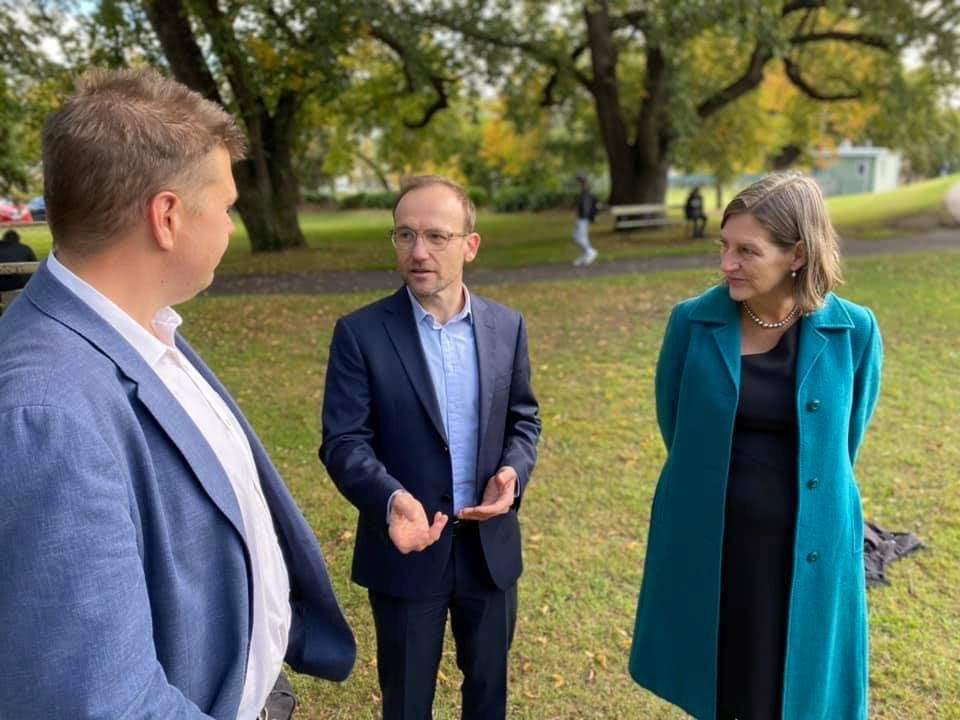
Jack Davenport, Adam Bandt and Cassy O’Connor.
Media release – Tasmanian Greens
Greens call for billionaires’ tax to fund Tas jobs
With one in seven Tasmanians struggling to find enough work and new figures from the Labour Force survey showing that underemployment in lutruwita/Tasmania is the worst in the nation, Leader of the Australian Greens, Adam Bandt, said in Launceston today that it was time to create decent jobs for everyone who wants one as we recover from the COVID crisis by building back fairer and greener.
With official statistics counting someone who works only 1 hour a week as ‘employed’, the Greens said Tasmania’s nation-high underemployment rate – which measures people in employment but needing more hours of work – showed the trouble people were having finding decent work.
With 42,600 people in Tasmania unable to find enough work or any at all, the Greens argue that it is time to invest in nation-building, planet-saving projects to guarantee a decent job for everyone who wants one. This would help address the long term employment challenges for Tasmania, drive up wages and halt the flow of young people to the mainland.
Launching the Tasmanian component of the Fight for the Future plan in Launceston today, Adam Bandt says Tasmania could be a unique beneficiary of the shift to a green economy. The plan would help reduce the state’s unemployment rate to 2% through government investment in nation-building, planet-saving projects, backed by a national Jobs Guarantee.
The investments in Tasmania would be funded in part by a new federal 6% billionaires tax imposed on billionaires’ wealth, which has skyrocketed during the pandemic. While millions of Australians found themselves in depression-era dole queues and struggling to get by, many billionaires have doubled their wealth.
Tasmanian Jobs Focus
Last week’s official Labour Force figures show that Tasmania is battling an underemployment crisis, with 26,200 people unable to find enough work, or 9.4% of the population. That is on top of 16,400 people who are unemployed, meaning that in all, one in seven Tasmanians is struggling to find a job or sufficient hours of work.
The Liberals have said that cuts to government programs will begin again when unemployment is at 6% while Labor has previously said they consider around 5% unemployment to be satisfactory, but the Greens will push for a job for everyone who wants one, with a 2% unemployment rate.
The Greens’ plan will initially create 13,500 jobs in Tasmania, including through the following programs:
- 1,250 jobs through our public housing construction plan (with an additional 125 apprenticeships)
- 270 jobs through protecting the environment with a Nature Fund
- 2,200 jobs in the caring economy, including more funding for aged care
- 300 jobs in the arts, media and music industries
- Investing in a manufacturing revival creating 1,650 jobs
Other investments will create jobs in the health, education, infrastructure and services sectors, backed up by our national jobs guarantee that ensures that every person who wants a job can get one.
The Federal Greens will introduce a billionaires’ tax to help fund these job-creating, planet-saving projects, while the State Greens will lift mining royalties, Casino tax rates, fish farm royalties and introduce a levy on some developers.
Leader of the Australian Greens, Adam Bandt MP, said:
“It’s so good to be back in Tasmania, the spiritual home of the Australian Greens.
“It’s approaching a year since Tasmania had its last locally transmitted case of COVID, but the Liberals in Canberra and here have left the state in the grips of an employment crisis, where one in seven Tasmanians is without a job or enough work.
“Insecure work is getting out of control and too many people are doing it tough. Housing costs much more than before the pandemic, but wages are flatlining and people don’t have enough work.
“Meanwhile, the mining billionaires doubled their wealth during the pandemic and 1 in 3 of our biggest corporations pays no tax.
“While many people are doing it tough, the billionaires are making out like bandits.
“It’s time to make the billionaires and big corporations pay their fair share of tax. That will help Tasmania build back fairer and greener, with projects that will deliver lasting benefits to the state and a decent job to everyone who wants one.
“In recovering from the COVID recession, we can tackle the long-term problems our country faces by government investing directly in job-creating, nation-building, planet-saving projects.”
Greens candidate for Bass, Jack Davenport, said:
“Together, we can build back greener and fairer from COVID-19, take real climate action, and ensure no one is left behind.
“By prioritising his wealthy mates, donors and big business, Peter Gutwein is becoming increasingly disconnected from people in his electorate.
“As a social worker I’ve seen the devastating impacts of intergenerational unemployment and underemployment and how it denies families opportunities to better health and wellbeing.
“While the Liberal and Labor parties are cosying up to big corporations and selling out Tasmanians, the Greens are here to stand up to them and make them pay their fair share for the benefit of the Tasmanian people.”
BACKGROUND:
Unemployment – total
- Pre COVID (Feb 2020): 4.9%, 13,600 people
- Peak during COVID (Oct 2020): 8.2%, 22,600 people
- Current (March 2021): 5.9%, 16,400 (2.11% of national unemployment)
Unemployment 15 – 24 year old (non-seasonally adjusted)
- Pre COVID (Feb 2020): 12.9%, 5,900 people
- Peak during COVID (Nov 2020): 18.7%, 8,100 people
- Current (March 2021): 13.8%, 6,200 people
Unemployment – women
- Pre COVID (Feb 2020): 4.3%, 5,700 people (vs men 5.5%, 7,900)
- Peak during COVID (Oct 2020): 8.6%, 11,100 people (vs men peak in Sept 8.4%, 12,200)
- Current (March 2021):5.8%, 7,500 people (vs men 6%, 8,900)
Underemployment
- Pre COVID (Feb 2020): 11%, 30,300 people
- Peak during COVID (April 2020): 16.4%, 43,600 people
- Current (March 2021): 9.4%, 26,200 people
Total number of people who can’t find enough work or any work at all = 42,600 (March 2021)