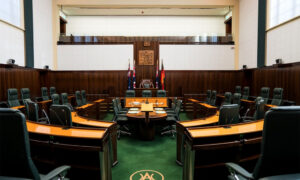
With the snap decision to call an early state election, four local government councils may well be impacted should the candidates be successful.
The Tasmanian Electoral Commission has confirmed that under Section 308 of the Local Government Act 1993, wherever a mayor or councillor resigns then a by-election will be called.
With two more years until the next round of local government elections, the Councils which could be impacted include the Derwent Valley Council with Mayor Ben Shaw, Glenorchy City Council with Mayor Kristie Johnston, Huon Valley Council with Mayor Bec Enders and the Hobart City Council with Simon Behrakis and Will Coats. Apart from Johnston, the other four have been pre-selected by the Tasmanian Liberals.
Labor are also likely to pre-select some councillors with Central Coast’s Amanda Diprose one of those named, as well as long serving Launceston Councillor and former Mayor Janie Finlay. The full ticket across five electorates is however yet to be finalised.
Where a mayor resigns to take up a position in Parliament both a mayoral and a councillor position are vacated at the same time.
For a few of the close runners in the 2018 election this could be another opportunity to campaign for the top job.
The deputy mayor is eligible to nominate at a by-election as a candidate for the office of mayor without having to resign the office of deputy mayor.
Section 308 of the Local Government Act 1993
By-elections
(1) A by-election for a vacancy in the office of councillor is to be held if –
(a) it is not possible to carry out a recount of votes; or
(b) not all the offices have been filled at an election.
(1AA) A by-election is not to be held during the period specified in section 307(3) .
(1A) The Electoral Commissioner may fix a day as the closing day for a by-election.
(2) . . . . . . . .
(3) Except as provided in subsection (3A) , a by-election is to be held in accordance with this Part as if it were an election.
(3A) The Electoral Commissioner, in consultation with the relevant general manager in relation to a by-election, may determine –
(a) the day on which notice of the by-election is to be given; and
(b) the nomination period; and
(c) the closure of electoral rolls.
(4) A vacancy in the office of mayor is to be filled by a by-election held in accordance with subsections (1A) , (3) and (3A) .
(5) The deputy mayor is eligible to nominate at a by-election as a candidate for the office of mayor without having to resign the office of deputy mayor and, if so elected, ceases to hold the office of deputy mayor.
(6) If a mayor vacates office as both mayor and councillor, the vacancy in the office of councillor is to be filled by a by-election held concurrently with the by-election for the office of mayor.
(7) The term of office of a councillor or mayor at a by-election to fill a casual vacancy is the remainder of the term of office of the councillor or mayor who caused the vacancy.
Amended update to explain the situation where a Councillor or Mayor is successful in becoming a Member or Parliament.
The Local Government Act 1993 was amended 10/12/2018 and SCHEDULE 5 – Office of Councillors, addressed the former situation where an elected Councillor and/or Mayor, if elected into Parliament, could retain their Council role for 12 months as well as their Parliamentary role.
The amendment changed this arrangement and today the Councillor/Mayor must vacate their local Government role the day they begin office as a member of Parliament.
Amended: Valid from 10/12/2018
Vacation of office
(1) The office of a councillor becomes vacant if the councillor –
(a) dies; or
(b) resigns; or
(c) is absent without leave from 3 consecutive ordinary meetings of the council; or
(d) is removed or dismissed from office under this Act; or
(e) becomes a paid employee of the council; or
(ea) is, on the day on which he or she begins to hold that office, a member of any Parliament in Australia, and is such a member for 30 days continuously during that term of office of the councillor; or
(eb) becomes, after the day on which he or she begins to hold that office, a member of any Parliament in Australia; or
(f) is no longer eligible to nominate as a candidate under section 270.
This was the previous legislation before the amendment in 2018.
Amended: Valid from 31/05/2017 to 22/06/2017
Vacation of office
(1) The office of a councillor becomes vacant if the councillor –
(a) dies; or
(b) resigns; or
(c) is absent without leave from 3 consecutive ordinary meetings of the council; or
(d) is removed or dismissed from office under this Act; or
(e) becomes a paid employee of the council; or
(ea) is, on the day on which he or she begins to hold that office, a member of the Legislative Council, or the House of Assembly, and is such a member for 30 days continuously during that term of office of the councillor; or
(eb) becomes, after the day on which he or she begins to hold that office, a member of the Legislative Council, or the House of Assembly, and is such a member for 12 months continuously during tha term of office as a councillor; or
(f) is no longer eligible to nominate as a candidate under under section 270.