by Tone Wheeler
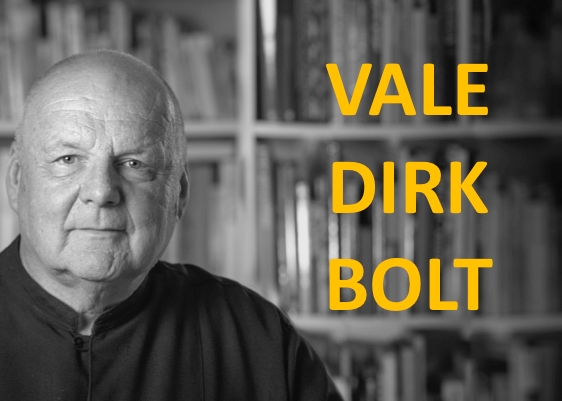
You may never have heard of Dirk Bolt, but not only was he one of our best architects of the modern era, he went on to become one of the most significant worldwide proponents of sustainable urbanism. His story is exceptional and is worth telling, particularly as a memoriam to his passing in December last year.
DB, as we shall call him, was born in Groningen, northern Netherlands on 24th October 1930. He began studying architecture at Delft University, but in 1951 he moved to Australia, following his love Guusje (Kusha) van der Laan, who was in one of six families who moved to Tasmania to find a peaceful life after playing an active part of the Dutch resistance in WW2.
DB completed studies in town planning and architecture at Hobart Technical College, under Sydney Blythe. He works full time in an architect’s office (9am-4:50pm) then attends evening classes (5pm-10pm), followed by a bus and 4 mile walk home in pitch darkness, with leftovers for supper. While a student, he designs a house for his brother Frank Bolt, a photographer.
In 1953 he marries and in 1954 joins the AIA as a student member and begins working in the office of David Hartley Wilson. Upon graduation, he became a partner and formed ‘Hartley Wilson and Bolt Architects and Planners’, delivering some significant contributions to Tasmanian architecture within just a few years.
These include the Scottish Union Building (1960), then the tallest building in Tasmania at the time
(AIA Tas. Chapt. Enduring Architecture Award 2013); the Calvin Christian School, Kingston, Tasmania (1961) where he designed the first 3 classrooms and master planned future development for the Association of Christian-Parent Controlled Schools; and the Sandy Bay Bathing Pavilion, Long Beach, Hobart (1962) (now listed on Tasmanian Heritage Register).
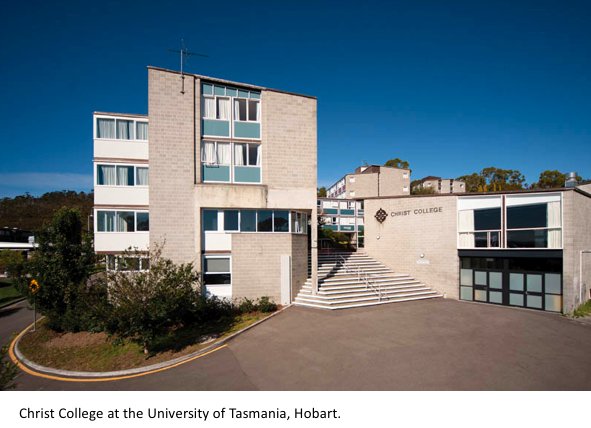
His most interesting work in Tasmania was Christ College at the University of Tasmania (1961-62), commissioned to accommodate the relocation of University of Tasmania to Sandy Bay, it was the first residential college. Designed with materials to mature over time, such as natural concrete blocks and untreated timber, it is one of the earliest and most notable examples of Brutalism in Australia. It won the AIA 2011 Enduring Architecture Award (Tasmania) and is listed on Tasmanian Heritage Register, noting: “Bolt created a virtual hill town of visually different buildings grouped around a garden court.”
Read the full piece at Tone on Tuesday.