
Latest Australian Bureau of Statistics job data suggest an increase in employment, yet Tasmania’s situation remains one of the worst in the country.
Michael Ferguson, Minister for Finance, pointed to a 1.3 per cent increase in the number of payroll jobs in the two weeks to 22 August the number of payroll jobs in Tasmania grew 1.3 per cent, which was the highest growth rate in the country.
“There are now more jobs for our youth than there were before the onset of the pandemic, with 3.2% more jobs as at 22 August for those aged 20 and under compared to mid-March,” he said.
“We are also seeing steady improvements in jobs in our most impacted industries, such as hospitality and arts and recreation industries, and are cautiously optimistic that this will continue.”
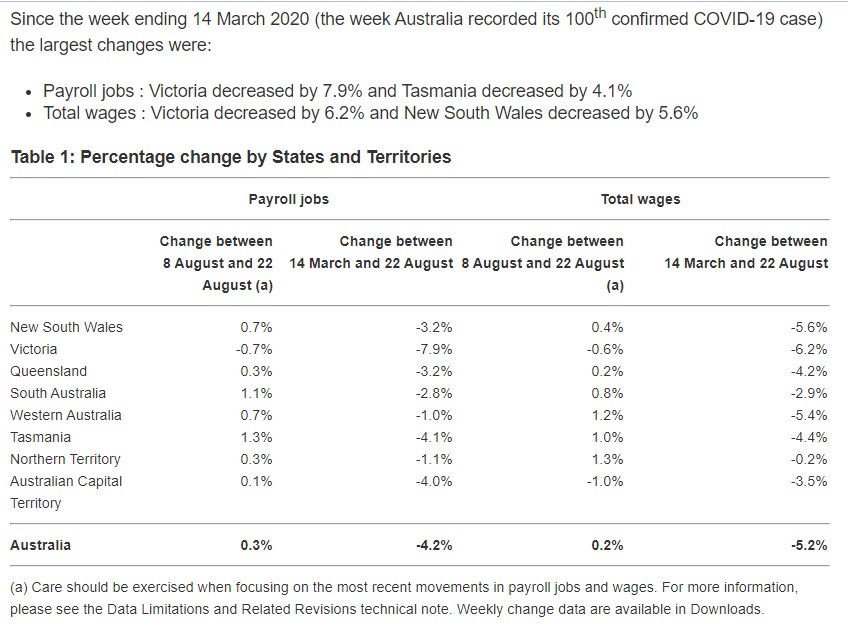
Tasmania however is still the second-worst affected state behind Victoria, with payroll jobs still down 4.1% since mid-March. The only worse-performing state is coronavirus hotspot Victoria. Total wages in Tasmania are also down 4.4%
Shadow Treasurer David O’Byrne said the fact Tasmania’s recovery is slower than anywhere except a state under extreme lockdown measures is extremely concerning.
“One of the worst results this fortnight was in construction, with almost 1,200 jobs now lost in the industry – twice as many as in July,” he said.
“Peter Gutwein promised to build Tasmania out of recession, but his government has demonstrated an inability to actually build anything, and the construction industry is haemorrhaging jobs. Their track record on building projects is a litany of delays and false starts and the Tasmanian economy will suffer because of it.”
He noted that retail jobs have also reduced by nearly 300 in the past month, with concerns this will increase due to imminent cuts to JobKeeper and JobSeeker payments.
“Despite a small increase in the overall number, it remains clear the government doesn’t have a plan for jobs, particularly in the industries hardest hit by the pandemic,” O’Byrne said.
At a national level, the hardest hit sectors in terms of payroll job losses remain Accommodation and food services (-21.1%) and Arts and recreation services (-14.3%).
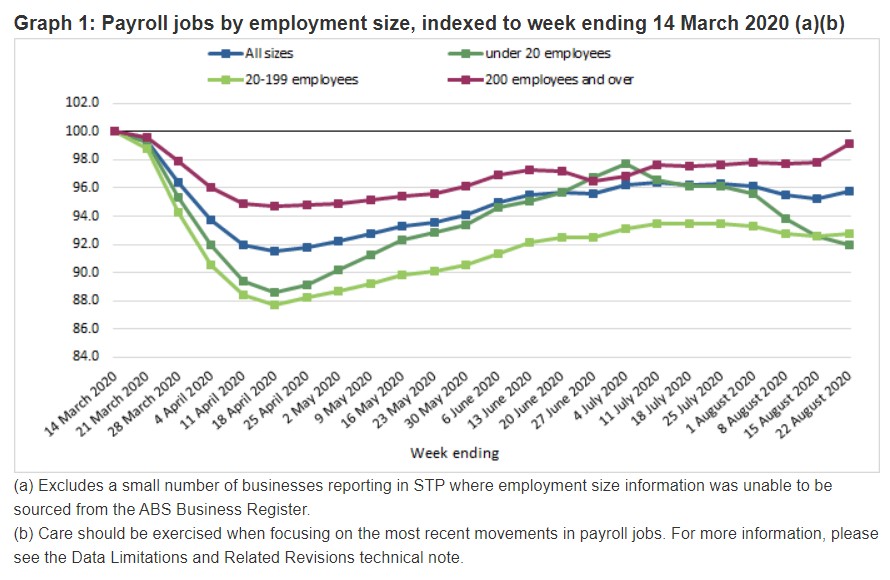
Small and medium-sized businesses are not recovering as well as large businesses with over 200 employees on the payroll.
This is particularly the case in Tasmania, where payroll jobs for businesses with under 20 employees only grew by 0.1% in the latest statistical fortnight, still down 6.9% from March. For businesses with between 20 and 199 employees, growth was 0.6% in the recent period but jobs are still 7.4% below March levels. Businesses with over 200 employees grew 2.5% to now be only 0.4% down on March numbers.
Business Conditions
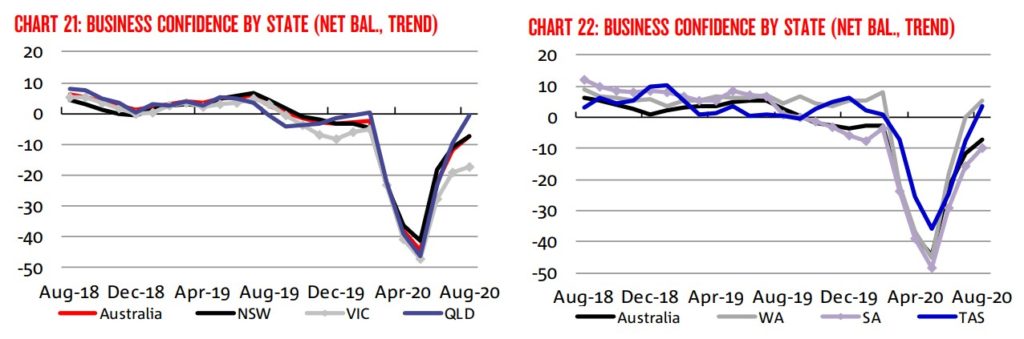
According to the National Australia Bank business conditions survey, a recent weakening reflects weakening employment indicators, trading, and profitability, while the improvement in confidence in Victoria reflects progress on controlling COVID-19 infection numbers – which has continued into September.
The monthly survey for August showed business conditions fell 6 points in August to -6 index points while business confidence, rose 6 points to a still negative reading of -8 index points after the sharp fall in July.
Confidence remains negative but not all the blame for the fall in business conditions can be sheeted home to the lockdowns across Victoria and especially Melbourne.
According to the NAB’s chief economist, Alan Oster, conditions went backwards following a strong rebound in recent months with weaknesses emerging in Queensland, South Australia and Tasmania (all of which still have closed borders and low infection rates) showing steeper falls than in Victoria.
But he said Victoria was the problem state in August because of the tough lockdowns.
The NAB said the impact of the Melbourne stage 4 restrictions on activity is evident in Victoria with a decline in conditions – though not as bad as feared.
“Encouragingly, confidence in Victoria improved in the month, likely reflecting an improvement in case numbers. That said, Victoria continues to show the weakest confidence and second-worst conditions across the states,” the bank pointed out.
The fact that the other states have seen a pull-back suggests that the virus continues to pose a risk everywhere, not just states with significant containment measures in place” said Oster.
Jobs remain a major concern and “the weakness (in business conditions in August) was primarily driven by a deterioration in the employment index – suggesting that while the economy has generally begun to open up, the labour market is still weakening,” Mr Oster said.
NAB says the decline in conditions was broad-based across states except for NSW. The decline in WA was more modest.
“Given the sheer magnitude of the fall in activity in Q2 and the subsequent lockdowns in Victoria, it’s is likely we will see a protracted recovery and a rise in the unemployment rate before it gets better,” Oster commented.
“Policy makers have provided unprecedented support – but we think there will need to be more. This would help businesses and the economy recover more quickly and the focus can again return to growth.”