“Your latest article is a litany of misinterpretations, confusion, and incorrect assumptions. I think you are perhaps out of your depth here in objectively presenting the Foresty Watch conclusions, interpreting forestry legislation and code of practice.”
“Several of your points require attention,” wrote MJF, a long time commentator on Tasmanian Times on all things forestry.
As the author of this earlier TT article ‘Forest Code Breaches ‘Explained Away’ by FPA‘, I did indeed do my research. Upon receiving media releases I contacted STT, the Forest Practices Authority, Forest Watch, and I read the Forest Practices Code 2015, the Forestry Plans for Coupe SX027E, and the relevant sections of the Forest Practices Act (1985).
I sent six questions to STT specifically around their management of SX027E, and as has come to be expected; the response was a generic publicity blurb which I provided in the previous article.
Given the accusations made by MJF, I forwarded the eight points he raised back to the people at Forestry Watch, an independent volunteer-led organisation of scientists and concerned citizens monitoring the actions of Sustainable Timbers Tasmania.
Back in March 2018 MJF advised me:
“I am a forest practices officer although I’m not sure how well known. Not retired and actively working with private plantations mainly on the NW coast. I have never worked for FT/SST.”
Questions & Answers MJF and Forestry Watch
MJF: The wet weather limitations are defined under Section C2 of the Code.
FW: Correct. The limitations are specified in the code.
MJF: The Forest Practices Code specifies wet or dry season logging. As an FPO I interpret these to be winter/spring and summer/autumn. To say The volunteers observed logging operations by STT contractors in the coupe during wet weather conditions, despite the Forest Practices Plan for the coupe explicitly specifying that harvesting operations are only to be conducted in dry weather is a non-event. The contractors needed to be exceeding the Wet Weather Limitations to be causing an offence. Unless the volunteers could actually measure all the criteria then there is no case, its not just a matter of witnessing some rain fall.
FW: Forestry Watch did not measure the breach in regards to the ‘wet weather limitations’ under section C2 of the Forest Practices Code 2015 (FPC), rather, we responded to a prescription of the Forest Practices Plan (FPP).
The FPA have stated that there is an alleged breach of section 21 of the Forest Practices Act (1985), and a decision will be made according to s 47B of the Act. Please refer to the Act – SECT 21 1 (a).
As defined by this section of the act, “any person who in carrying out any act, or in omitting to carry out any act, contravenes or fails to comply with the provisions of the plan; Where a forest practices plan has been certified by the Authority in respect of forest practices on any land and is in force under this Act , is guilty of an offence”. There is no mention under section 2C of the Code that Wet Weather Limitations will be applied where a “dry weather only” prescription is applied in an FPP.
MJF: You say the FPP was varied to include a section to be cable harvested. This is not an offence in itself but draws into question the original wisdom of FT to ground log the whole coupe but later (2016) deciding it was necessary to cable log part of it (or all of it?).
FW: No comments.
MJF: During the variation to change to cable, FT overlooked the fact that dry weather harvesting was originally specified on the whole coupe in the FPP text. This is the technical breach P Volker is referring to and he is quite right. FT should have addressed that factor in the 1st variation but apparently did a second to correct the FPP wording for accuracy. No big deal and no implications.
FW: The change of harvest method to cable in the FPP was authorised by the FPA on 19th of October 2018, the variation to address wet weather harvesting was only applied after the FPA was notified of the wet weather breach by FW volunteers.
This change of the FPP to allow wet weather harvesting was recommended by the FPA on the 31st of August, 2020, just days after the notification from FW volunteers on the 27th of August, 2020. Once the variation to the FPP is certified, logging may continue. Importantly, the FPA authorised 3 other variations to the FPP between 2018 and 2020.
Despite multiple reviews of this FPP since the harvesting method was changed, the requirement for “dry weather only” was not amended. This equates either to very poor planning ability or the likely fact that the coupe should not have been logged during wet weather due to environmental sensitivities.
MJF: The maps you provide (3) are all different to some extent so difficult to know which one you are promoting as the current in-use version. If part of the coupe has been changed to cable, then the FPP Map should reflect that operational change by an added boundary and explanatory note. None of your maps indicate this so I suspect you may not have the current version. Or perhaps the whole coupe is now cable harvested. You do not make that distinction in which case a modified map would not be required. It would also reflect more poorly on FT’s original assumption to ground log if they have now decided that was not possible
FW: I can see how MJF could have been confused here. For clarification the map with 3 class 4 streams was from the original 2009 FPP map. The FPP is dated as being modified on 12 September 2016 with changes including: ‘removal of three (3) internal class 4 streams’ and ‘addition of one (1) class 4 stream’.
Perhaps updating the captions in the article and the maps would be helpful.
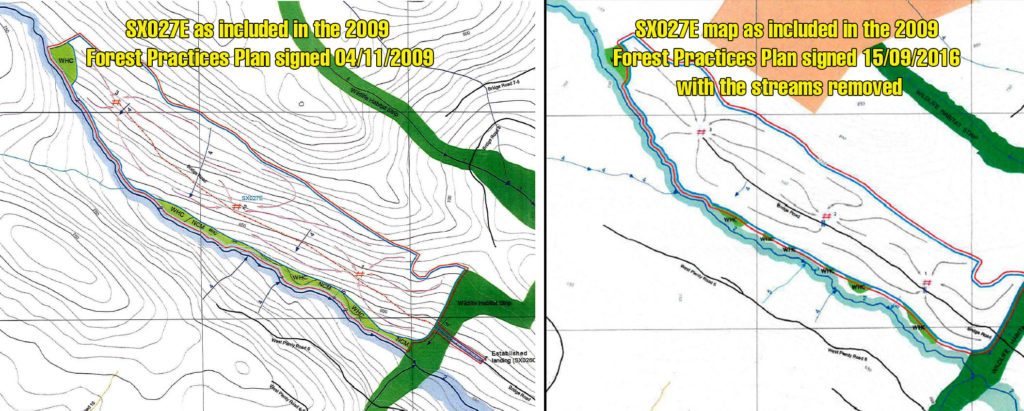
SX027E maps side by side showing 2009 and 2016 revisions
Author: Noted and the images have been re-captioned in the original article.
MJF: The disappearing class 4’s is interesting. Apart from the incomplete mapping of stream length I find it hard to believe there are so few C4s present in a coupe which is over 2km long. However, also consider there are drainage depressions to be recognised as well as watercourses (or steams of various classes). Drainage depressions under the FPC are different to watercourses (or streams), Both have separate definitions. Class 4 streams can be permanently flowing or intermittent. I suggest your experts don’t appreciate the difference between DD’s and watercourses, the definitions of which are also determined by scientists which may not suit hydrologists’ personal views.
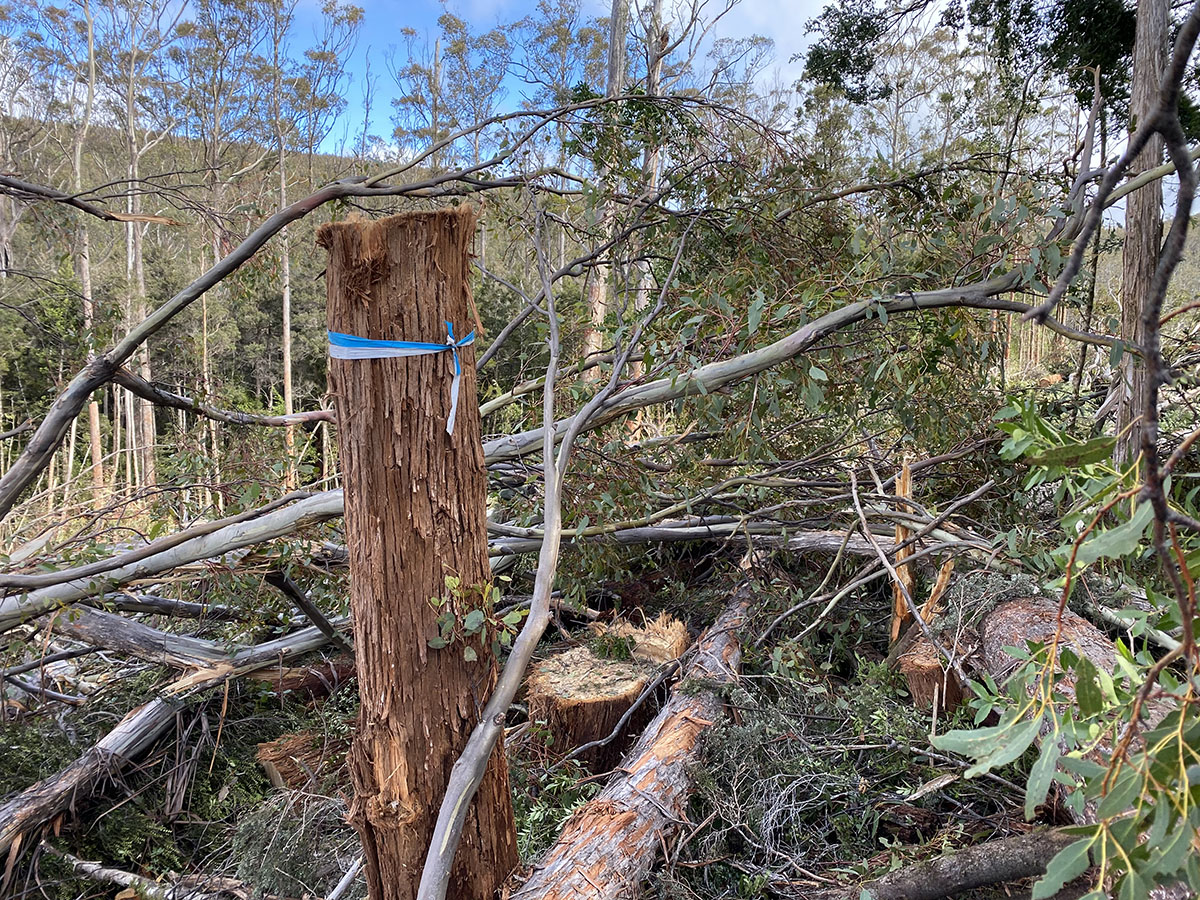
FW: I would suggest that the removal of previously mapped watercourses is suspicious, especially when there were significant quantities of water flow in the locations where the streams were marked on the original 2009 FPP map. Although these areas have now been logged and debilitated significant flows were present.
MJF: Re your 47D (1) Salvage of illegally harvested timber or native vegetation quotation, you also should read 47D(2) to get things into context.
FW: Perhaps some confusion here also. The FPA has referred the breach of section 21 to section 47B of the Act. This states that:
If the Authority is satisfied that an offence under section 17(4) , (5) or (5B) , 18B , 21(1) , 21(3) , 41(5) or 42(5) has been committed, it may, on payment of a prescribed fine by the alleged offender –
(a) cause any proceedings in respect of the alleged offence to be waived or discontinued; and
(b) if the alleged offence involved the unlawful harvesting of timber or the unlawful clearance and conversion of a threatened native vegetation community, allow the alleged offender or another person specified by the Authority to retain the whole or any part of that timber or, as the case may be, the whole or any part of the threatened native vegetation from that community.
MJF: O’Hare’s statement: “They modified the FPP on the 31st of August so works could continue. Blatant industry corruption at its finest out in plain sigh.” This is plainly ridiculous. It is not industry corruption to do variations which are required on occasions to reflect changed conditions for the better. This shows O’Hare’s ignorance. Simply to change some old FPP wording that was overlooked and no longer applies due to a permitted change to the harvest system is not the crime of the century. What it is is making sure the FPP text is consistent with the planned outcomes. The only problem here was FT thinking they could ground log the coupe to start with. Using cable ensures a much cleaner and less disturbed site to finish with which is a better result.
FW: MJF may consider it as ridiculous as he likes. The reality of the situation is that the FPA, who are supposedly an independent regulator, changed the planning prescriptions to a logging operation in response to a breach of the Forest Practices Act. As I highlighted in response to point 4, FT and the FPA varied the plan 3 times before modifying it to suit wet weather harvesting.
Additionally, neither FT or the contractor adhered to the FPP or self-regulated by reporting their breach to the FPA. Instead, this breach was reported by members of the public. Irrespective of the harvest method, it was specified that harvesting does not occur in wet weather. Operations have been conducted over multiple years with this prescription in place. I would suggest that modifying planning documents to suit the needs of FT and it’s contractor is corrupt, especially when the extractive use of a resource on public land is the method of delivering a loss to our state’s economy, let alone the destructive effect on Tasmania’s natural values.
“There are many more points that could be further examined Geoffrey but you get my drift,” said MJF in closing.
Questions put to STT that were not answered by STT
- The three year plan does not provide any information on what is/was in this coupe – can you advise more please?
- Do STT contractors have a schedule to work to, that is, they know they can harvest a coupe, but does STT advise them when to start, or when they are allowed to work the coupe?
- When did harvesting commence on this coupe?
- Why did harvesting occur within streamside reserves?
- We are advised streams were mapped within this coupe in 2009 by STT but are not updated on the 2016 plan – can you advise please, and why have they been removed?
- We are advised “there were very few hollow bearing habitat trees within the Wildlife Habitat Clumps” – can you advise or explain please?
- And any other comments for publication please.
Previous reading by the author into Forestry in Tasmania
Back in 2018 when MJF made contact me over the issues of the proposed James Neville-Smith Dover Woodchip Port, he recommended I purchase a copy of Against the Odds by Alex Graeme-Evans, and I did. It is a weighty tome of 420 pages perhaps in honour of the paper on which it is printed. It is a wide-ranging history of the Tasmanian timber industry as seen through the eyes of the pioneering Risby timber family 1826–1995.
I also have a copy of, and am again reading for a second time, The Rise and Fall of Gunns, by author and academic Quentin Beresford who won the $25,000 Tasmania Book Prize for this forensic work in 2015. The judges called it a difficult and painful story which had an impact on all aspects of Tasmanian politics and society.
Another on my bookshelf is Into the Woods, The Battle for Tasmania’s Forests by Anna Krien, who armed with a notebook, a sleeping bag and a rusty sedan, ventured behind the battle lines to see what it is like to risk everything for a cause. She spoke to ferals and premiers, sawmillers and whistle-blowers. She investigated personalities and convictions, methods and motives. Krien won both the Queensland and Victorian Premier’s Literary Awards 2011.
During some recent Facebook exchange with a local Huon Valley identity, George Harris, President of the Huon Resource Development Group, I sought his advice on reading material.
Harris naturally condemned Beresford’s book and also suggested that Risby is the book to read. There is no question the history of the pioneering Risby family who first arrived in Tasmania in 1808 is interesting reading. Their free settler life in the very early days of Hobart, shipbuilding, the origins of the early Hobart Regattas, timber trading ketches, Huon piners and Bushmills and bushfires is our history.
What is missing however, is relevant material that describes the success or otherwise of modern-day forestry practices in Tasmania, in the past 20 years.
GEOFFREY SWAN: Forest Code Breaches ‘Explained Away’ by FPA.