

Dr Ivan Maksymov.
Vibrating a slightly inebriated earthworm on a sub-woofer speaker in a rural Victorian backyard shed hashelped to land Australia one of the world’s most popular science prizes
It may also radically change our understanding of how the brain functions – and how to interact with it.
Dr Ivan Maksymov of Swinburne University of Technology is a researcher and an associate investigator with the Centre for Nanoscale BioPhotonics (CNBP).
His out-of-the-box approach has seen him awarded one of the world’s ten ‘Ig Nobel’ awards to be presented this year. Maksymov and fellow-collaborator Andrey Pototsky, from the Department of Mathematics at Swinburne, have won the Ig Nobel in Physics.
Their work was inspired by a hypothesis from a Danish scientist that the brain not only functions using nerve-based electric pulses, but also acousto-mechanical (or sound wave) signals. As a result of the vibrating worm experiment in the backyard shed, potential new ways of dealing with the brain can be explored. The experiment shifted to the shed, due to the COVID lockdown in Victoria.
“I was very fortunate to join the Centre for Nanoscale BioPhotonics (CNBP) because I was inspired and encouraged to put forward ‘wild ideas’ and conduct pioneering research,” notes Dr Maksymov.
“Earthworms were used because they are cheap, don’t require ethics approval, and their axons are somewhat similar to mammalian nerve fibres.
Plus, one can easily anaesthetise a worm using vodka.”
Physicist Maksymov began his work at the Centre for Nanoscale BioPhotonics as a postdoc, where the idea to use earthworms was suggested. He then moved to Swinburne as an Australian Research Council Future Fellow and collaborated with mathematician Andrey Pototsky.
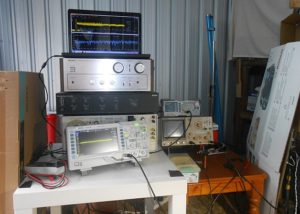
How to science at home, Dr Maksymov style.
Their work was first presented to Australian-based and international neuroscientists, and was soon generating international interest through popular science blogs.
Dr Maksymov’s early experiments involved imploding (collapsing violently inwards) a gas bubble near a nerve fibre to verify the hypothesis on sound wave impulses.
As Dr Maksymov notes: “imploding a bubble in water or another liquid results in shock waves, emission of light and gas temperatures similar to those on the surface of the sun. Needless to say, I have my private experimental set-up in my shed for such implosions!”
* The 30th Ig Nobel Awards have been made at Harvard University since 1991, and are designed to recognise achievements that “first make people laugh, and then make them think.” The awards showcase creative and different approaches to solving serious and complicated problems. See more on the awards here