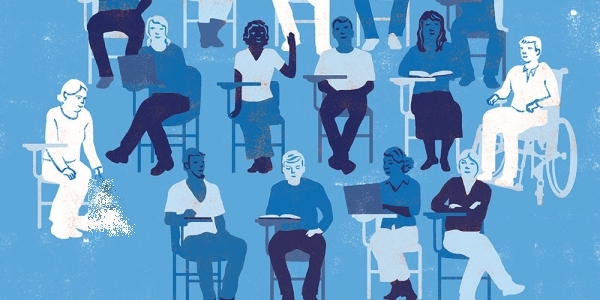
disability on campus – adoption of new national disability guidelines will ensure the safety of tertiary staff and students with disability during return-to-campus stages at Australian universities. The guidelines were produced by the Australian Disability Clearinghouse of Education and Training (ADCET), which is hosted by the University of Tasmania.
“The guidelines recognise that people with disability have a right to feel safe and confident when returning to campus after working from home, and one solution does not fit everyone,” ADCET Manager and National Disability Coordination Officer Darlene McLennan said. “For example, deaf and hard of hearing staff and students may require people to wear transparent face masks so that they can lipread and converse. Implementing the guidelines’ practical recommendations will help ensure that return-to-campus plans are viewed through a ‘disability lens’.” The guidelines can be downloaded free of charge here.
arts survey – a new study of Tasmanians working in the creative and cultural industries will help researchers and policymakers understand the impact of COVID-19 on the sector. “We know that the creative and cultural industries have been hit especially hard by COVID-19,” University of Tasmania School of Creative Arts and Media lecturer Dr Kathleen Williams said. “We now need to understand the ways creative workers are planning for the future and their aspirations given these difficult times. We hope Tasmanian creatives will share their insights with us.”
The survey is available for Tasmanian residents over 18 years old who identify as working in the creative and cultural industries; you can find it here.The survey takes about 20 minutes to complete and closes at midnight on Sunday, 23 August.
A previous survey from The Tasmania Project found that creative and cultural industries were among the top four sectors in Tasmania that respondents thought should be prioritised for government support during recovery.
 End COVID For All – while Australia has one of the world’s better healthcare systems, many of our neighbours around the world are ill-equipped for a pandemic. With no fences standing between any of us and COVID-19, the new end COVID for all campaign urges solidarity with all our neighbours, and encourages the federal government to provide vital support to vulnerable nations. The campaign was initiated by Micah Australia, with support from the Australian Council for International Development (ACFID) and Campaign for Australian Aid. It has since grown to a coalition of over 150 organisations made up of businesses, churches, health groups and more.
You can find out more about the campaign here.
STEM excellence – the 2020 Tasmanian STEM Excellence Awards for excellence in science, technology, engineering and maths are now open for nominations. These awards recognise the achievements and innovations of our leading local scientific practitioners, researchers, teachers and students who help deliver the knowledge, products and services that improve our quality of life.
There are six categories and a total prize pool of $30,000 up for grabs:
- the Premier’s Tasmanian STEM Researcher of the Year;
- Tasmanian Young STEM Researcher of the Year;
- The Minister’s Tasmanian STEM Innovation of the Year;
- Tasmanian STEM Teacher of the Year for Primary Years;
- Tasmanian STEM Teacher of the Year for Secondary Years; and
- Tasmanian STEM Communicator of the Year.
The awards link in with National Science Week, which runs from August 15 to 23. Nominations can be submitted at www.stategrowth.tas.gov.au until 11:59 pm on Friday 18 September 2020.
Scams Awareness Week – the ACCC has launched a podcast series This is Not Your Life (listen below) for this year’s National Scams Awareness Week to provide Australians with tips on how to protect their personal and financial details from scammers. Scamwatch has received a staggering 24,000 reports of stolen personal information this year alone, an increase of 55 per cent compared with the same time last year.
“During the COVID-19 pandemic, with more people working and socialising online, we have unfortunately seen a sharp increase in scammers seeking personal information,” ACCC Deputy Chair Delia Rickard said. “Personal information, such as bank and superannuation details or passwords, are extremely valuable and scammers will try to steal them for their own financial gain. Our increased use of technology has created more opportunities for them to do so.” Once a scammer has that information, they can then use it to access individuals’ bank accounts or superannuation, take out loans under their names and impersonate them on social media to try to get money from family and friends.
Have a suggestion for something to include in Good Citizen? Contact us with Good Citizen in the subject line.