Arts
Amy Sherwin: A Biography
Amy Sherwin was a Tasmanian-born soprano singer. She was known as the ‘Tasmanian Nightingale’.

Early life
Amy Sherwin (full name: Frances Amy Lillian Sherwin) was born on 23 March 1855 near Huonville, Tasmania. Her parents were farmers.
She developed a love for music at a young age. Her parents could not afford music tuition, so her mother took it upon herself to give her piano and singing lessons. One of her first ‘proper’ music teachers was Frederick Augustus Packer, who was a renowned Hobart composer and organist.
In 1878, Sherwin travelled to New Zealand, where she met and married a German merchant and entrepreneur named Hugo Gorlitz. They had two daughters together. The couple separated at some point during the early-1900s.
Career

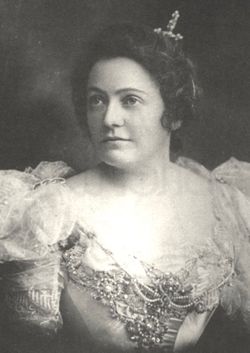
Amy Sherwin
Sherwin’s amateur debut occurred in 1866, when she performed in a production of Puss in Boots at the Del Sarte Rooms.
She eventually joined an Italian opera company in 1878, aged 23. She played Norina in the company’s production of Don Pasquale, and gained success when she performed in Hobart, Melbourne, Ballarat, and Sydney.
In 1879, Sherwin performed in a five-week season with the Strakosch Company in San Francisco. During one performance, she sang Violetta in La Traviata, and her voice was praised for its great range. Little did people know that she had just recovered from pneumonia.
She later gave performances in New York and Boston, where she was hailed as the ‘Tasmanian Nightingale’.
On 7 April 1883, Sherwin performed in the Carl Rosa Opera Company’s production of Maritana at Drury Lane in London. It was the first time she performed in England.
Having been abroad for nine years, Amy Sherwin finally returned to Tasmania in triumph. On 12 July, she was given a reception by the Mayor of Hobart, Charles Harbottle. This was followed by an enthusiastic welcome from the crowds as she made her way down Liverpool Street in an open barouche. Harbottle made the following speech at the Town Hall, where about 4,000 people had gathered to greet her:
“Miss Amy Sherwin, I have been asked by the committee to present your with an address, which I will do with very great pleasure, because many here recollect you in old times when you delighted them – myself amongst the number – in this hall with your sweet voice. We have watched with great pleasure, first of all your career in the Australian colonies, which was gratifying to us, but upon your arrival in the Old Country we became proud of your great success, and of you as the Tasmanian Nightingale. Other Australian colonies have claimed you as theirs, but we protest against this and claim you as ‘our own’. I trust that the success you have already achieved will be but the forerunner of still greater success.”
She held some concerts in Melbourne in 1887, but they were not well-attended because they clashed with jubilee festivities. Sherwin embarked on an eight-month tour of Asia to make up for her losses.
In 1890, Sherwin gave positively-received performances in Europe, but she declined a three-year engagement at the Imperial Opera House in Berlin.
She toured South Africa in 1896 before touring Australia.
She eventually realised that her acting detracted from her operatic singing, so she decided to concentrate on concert work. In 1902 and 1906, however, she again toured Australia.
Sherwin officially retired from touring in 1907 and moved to England.
Final years and legacy
Sherwin’s final years were spent in poverty and marred by sickness. Despite this, she would still sit at the piano and sing.
When the Hobart Mayor Joshua Wignall heard that Sherwin was living in poverty, he encouraged Tasmanians to contribute to a fund to help her. “She [has] made Tasmania known all over the world,” he said. £200 was raised.
Sherwin died in London on 20 September 1935, and was buried in the Bromley Hill cemetery. The Tasmanian government sent over a wreath that bore an inscription that said: “A tribute to the memory of a famous Tasmanian, from the Government of Tasmania.”
There is no doubt that Sherwin was a talented singer. No other Tasmanian-born singer, past or present, has achieved the level of international acclaim that she experienced during her career. It was this acclaim that helped Tasmania become known around the globe.
Despite the invention of audio recording devices in the late-1800s, there are no known recordings of Amy Sherwin singing.

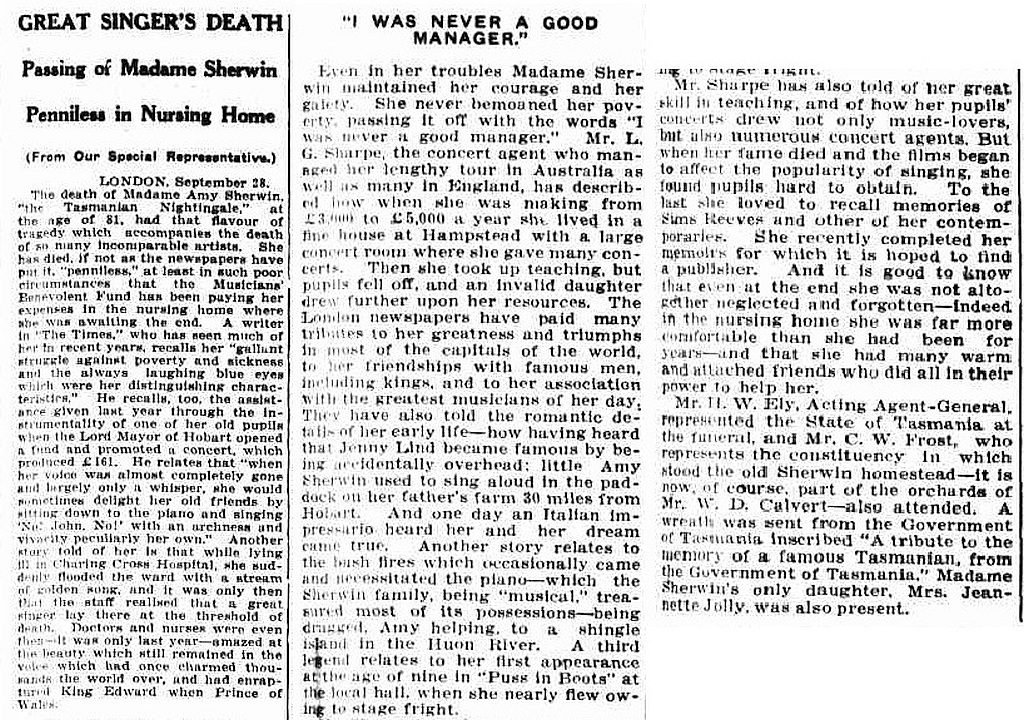
From The Mercury, Mon 14 Oct 1835.