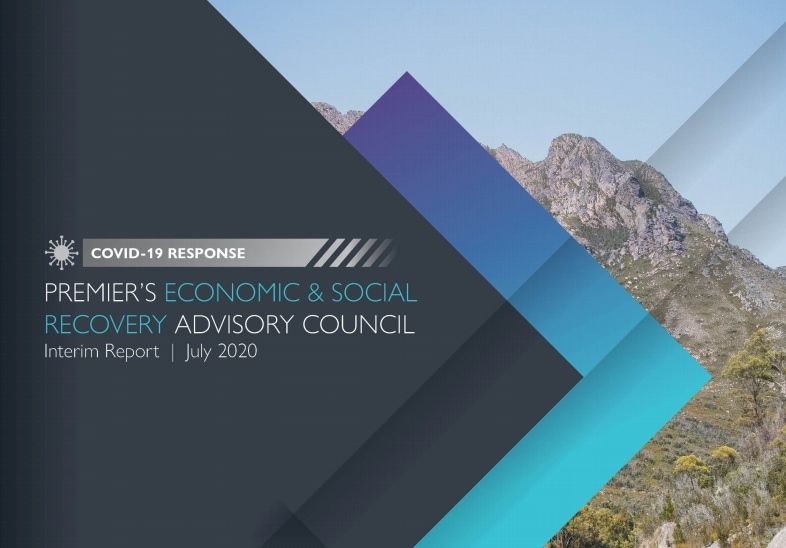
The Premier’s Economic and Social Recovery Advisory Council (PESRAC) delivered its Interim report to the Premier on 20 July 2020.
The Interim report provides an overview of the economic and social impacts of COVID-19 and outlines the Council’s recommendations with regard to the recovery journey and its immediate priorities.
In preparing the Interim report, the Council has had the benefit of considerable data and information from Tasmanian businesses, individuals and the broader community.
The Interim report has been informed by:
- published and unpublished data and information available to us;
- our targeted consultation with Government agencies and peak bodies; and
- additional information contained in other submissions provided to us.
A list of the submissions that the Council received during the first phase of our work will be published to the website on 21 July 2020.
Introduction to the Council’s Work
Like other Australians, in early 2020, Tasmanians watched the novel coronavirus (COVID-19) rapidly spread throughout the world. We prepared for when the virus would inevitably arrive on our island.
COVID-19 has impacted all our lives, none more than the families and communities who have lost loved ones. We are particularly saddened by this loss of life, made more difficult by physical distancing where families and friends were not able to farewell their loved ones as they would have wished.
COVID-19 is challenging our society in so many ways.
Thousands of Tasmanians have lost their jobs, perhaps for the first time, or had their hours significantly reduced. Some have experienced business failures, placing financial, emotional, and mental stress on individuals and households. For frontline
and essential workers, going to work became stressful and demanding in ways we had never experienced before. Temporary visa holders have been ‘stuck’, unable to work or return home, and were excluded from national income support measures.
The Tasmanian way of life that makes this place so unique has been suddenly disrupted. Lifestyle choices we so often take for granted were temporarily unavailable to us, from heading to the ‘shack’ or camping for Easter, to calling in for a chat at the
Neighbourhood House or dropping in for a beer at the local RSL Club.
Families have been separated through border closures or other restrictions. Babies have been born without visitors in hospitals and without the traditional ‘home visit’ from a child health nurse.
Children have felt the impact as individuals, through isolation from family, friends, school, support services and community involvement. They have also felt the impacts of the concerns or stresses of the adults who care for them.
Parents and carers have taken on additional caring responsibilities, often under challenging circumstances. They have balanced working from home and home schooling or dealing with employment loss and reduced income while, at the same time, facilitating their children’s education.
Older people were isolated from their families, communities and support mechanisms, and many were genuinely scared for their lives.
Tasmanians who have been used to accessing support and services face-to-face, have had to shift to more online service delivery. For some people this has provided greater access and flexibility, for others, it has resulted in the loss of an essential human
interaction. It has exposed the digital divide between those who have access and can use technology and those who don’t or can’t.
The uncertainty surrounding the virus and the restrictions put in place to contain it have all had an impact on the well-being of Tasmanians. Together, we have been resilient in the face of these challenges. That resilience will be key to recovery.
Our governments, health system and community acted quickly to suppress COVID-19. Tasmanians have shown strength, compassion and kindness. We have followed the rules in difficult circumstances. This is an achievement we should all be proud of.
While the immediate actions taken were required to save lives, they will have longer-term impacts on our economy and our well-being. As we see COVID-19 cases still rising around the world, and measures being re-implemented in Victoria to control the recent outbreak, we know we will continue to live with this virus for some time to come. However, while COVID-19 is not yet behind us, we must continue to work together in new ways to give our State the best chance of recovery and being prepared for future uncertainty.
On 30 April 2020, the Premier set up his Economic and Social Recovery Advisory Council to provide him with advice on how best to support Tasmania’s short, medium, and longer-term recovery from COVID-19. As a first step, he asked us to quickly bring him any actions for immediate implementation that we see as important in the journey to recovery. Those recommendations are listed in Chapter 6.
In approaching the first phase of this task, the Council sought first to listen and learn. We initially reached out to Government agencies and peak bodies, as well as drawing on a wide range of available economic and social indicators, to understand the broad impacts of COVID-19 on Tasmanians.
Through submissions and data review, we have learned a lot and begun to understand the impacts of COVID-19 on Tasmanians. We understand some impacts will particularly affect those already disadvantaged and, by doing so, risk increasing the socio-economic divide for some people and places. We know impacts will also be felt disproportionately for particular industries, small businesses, and regional areas.
Just as it took all of us to work together to ‘flatten the curve’, it will take a whole-of-Tasmania approach to recover from COVID-19’s impacts. The Government must lead, but cannot shoulder the responsibility alone for recovery. Every Tasmanian has a part to play in working together to build a better Tasmania – right down to simple things such as making the choice to buy Tasmanian. All three levels of Government have important, but different, roles to play in returning Tasmania to the pre-COVID-19 situation that saw Tasmania and Tasmanians the envy of many.
In developing our first-phase recommendations, we have considered the impacts on all aspects of people’s lives. We see well-being for Tasmanians as a key measure of our recovery. A well-being focus balances the importance of the things that make a good life in Tasmania. These include having a job or income security, accessing the basics such as food and housing, being healthy, loved and safe, having access to learning, connecting with culture and family, and participating in all our State has to offer. It highlights the importance of jobs in supporting people in Tasmanian communities throughout all other aspects of their lives.
We intend to carry this well-being approach through to the second phase of our work, which is to develop medium and longer-term recovery measures. We note this approach is consistent with the existing State Government commitment to develop Tasmania’s first-ever strategy to improve the well-being of Tasmanian children and young people. This is a strategy we wholeheartedly support as a key driver of economic and social recovery in the medium and longer-term.
To understand the ongoing effects of the pandemic on Tasmanians as we enter the recovery phase, we must identify and address gaps in data which helps us understand the impacts of COVID-19. This data will also inform further actions we recommend to
mitigate impacts and will ensure our responses remain informed and evidence-based.
In this report, we look broadly at Tasmania’s economic and social structure and the relevant impact of COVID-19. We consider the measures introduced to protect lives and to suppress the virus and the impacts these measures have had on Tasmanians and, more broadly, the communities they call home. We acknowledge the work of governments to date to mitigate these impacts and support our recovery. We look to the future – to how we can continue to manage the virus and ensure a stronger recovery. In doing so, we take an aspirational approach to ensure that the Tasmania that emerges has a strong foundation in equity – a healthy, educated population with the skills to take up new jobs underpinned by our entrepreneurial spirit.
To achieve this, we have identified a set of strategic priorities to shape the immediate recovery response:
1. Rebuilding local demand, by:
– Building confidence – because this will embed resilience.
– Building capacity – because this will provide the platform for growth and
jobs, as well as strengthening our ability to support those in need.
– Increasing local demand and keeping the pipeline flowing – because this
will provide economic momentum over the short and medium-term.
– Supporting enterprise recovery – because this will provide private sector
and not-for-profit organisations the assistance required to move forward.
2. Addressing structural issues, by:
– Tackling the immediate structural impacts of COVID-19 – because the
earlier the action, the better the mitigation.
– Staying focused on addressing the social issues – because there have been
deep social impacts.
– Encouraging government to deliver differently – because we all have to
focus on improvement.
Our recommendations address these priorities, and they will shape the approach we will take to the second phase of our work. Our intention in undertaking that second phase is to work collaboratively with Tasmanians to develop medium and longer-term
recovery arrangements. We expect that this consultation will take place during August to October 2020.
This is an opportunity to reset and create a stronger, flourishing future for Tasmania. Recovery is in all our hands. As Tasmanians we can all work towards our future together.
Immediate Priorities
Restoring Demand and Jobs
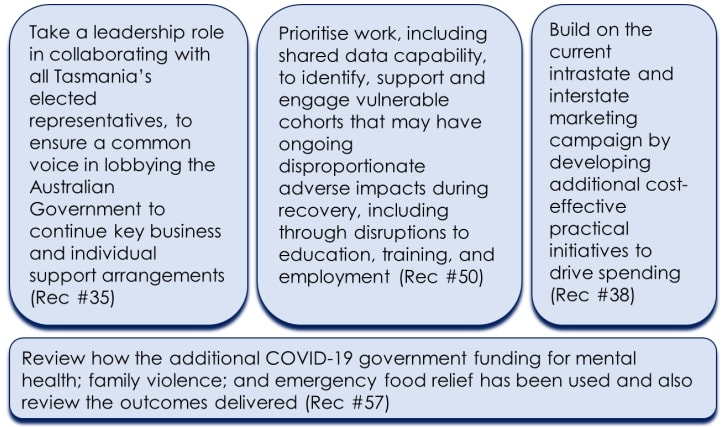
The state government should:
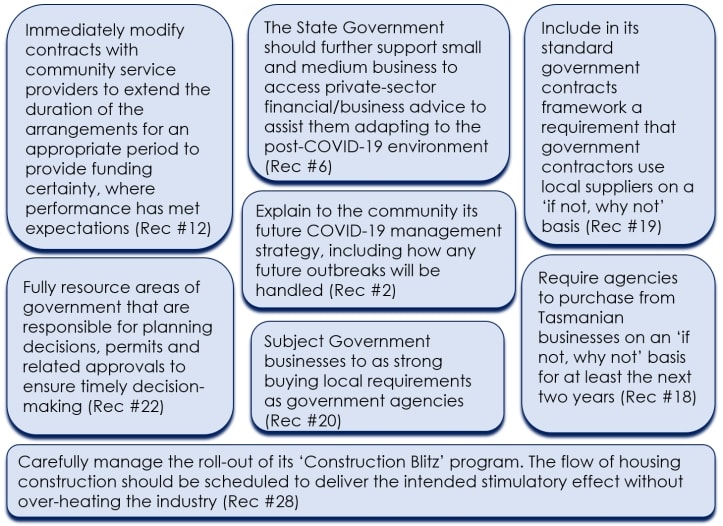
Start Addressing the Structural Issues
The state government should:
Media release – TasCOSS, 20 July 2020
Investment in wellbeing recognised as essential to COVID-19 recovery
The Premier’s Economic and Social Recovery Advisory Council’s (PESRAC’s) report provides recognition that a key measure of our recovery is improving the wellbeing of all Tasmanians.
TasCOSS CEO Ms Adrienne Picone said that this recognition was essential to an effective recovery and adequate investment would be the next step.
“We are pleased to see the Council recognise that investment in the lives of Tasmanians must sit at the foundation of any effective rebuilding strategy for our state,” she said.
“We look forward to seeing this translating into investment in Tasmania’s greatest asset — our people — as we move to the next stage of the recovery process.
“The disruption caused by COVID-19 will be felt throughout our communities for some time. As identified in the report, investment must be made in areas of increased demand, including mental health, food security, family violence, and digital literacy and capacity-building.
“The Council’s findings in these areas are consistent with Premier Gutwein’s approach to COVID-19 that has prioritised the health and wellbeing of Tasmanians; acknowledgement that a strong, resilient population is the key ingredient needed to rebuild our state’s economy.”
Ms Picone said it was important that the Council had also acknowledged the negative affects the COVID-19 response has had on our young people, women and other disproportionately affected cohorts.
“This represents the reality of what Tasmanians are experiencing in their families and communities as a result of the more than 20,000 job losses in our state since the closure of our borders back in March,” she said.
“Many of the strategies for addressing structural issues already exist, now is the opportunity to fund them for the benefit of all Tasmanians as recommended by PESRAC.
“We look forward to the next step of this process and to a recovery that includes every Tasmanian.”

Media release – Madeleine Ogilvie MP, 20 July 2020
Madeleine Ogilvie MP independent member for Clark said the PESRAC Interim Report July 2020 is a step in the right direction:
“We clearly need to encourage more local spending. “Buy Local” policy should apply to not only State Government, but GBE’s and Local Government. We ought to engage large private sector businesses in this buy local push too.
“At the end of the day, we know there is a limit to the amount of on-island economic activity that can be sustained if we are merely trading amongst ourselves.
“We urgently need to figure out how to bring more revenue into Tasmania, particularly while borders are closed. To do this we must work not just with government but also with the private sector.
“Let’s ink the deal with NZ to at least get some travel and tourism back on foot.
“We can rev up our tech sector, to provide a ‘Tassie jobs bubble’ for remote digital working. These jobs will help young people and women who as we know have been disproportionately affected.
“The Macquarie Point development has great potential to hub remote working arrangements for mainland firms, Australian Government Departments, research organisations and Universities.
“The tech sector, science and research has the capacity to increase jobs in Tasmania. The report underscores the need for more innovation, more enterprise and more commercialisation.
“The Marinus Project with its associated jobs and economic activity should be rapidly accelerated. A special purpose vehicle through which the Australian and Tasmanian Governments could hold joint ownership, would secure our future.
“It is heartening to read the community calling for MPs to collaborate for the benefit of Tasmania. I look forward to assisting to rebuild our great state.”

Media release – Cassy O’Connor MP | Greens Leader, 21 July 2020
PESRAC Report Ignores Climate Emergency
Tasmanians hit hard by the social and economic costs of the coronavirus pandemic are looking for meaningful, long term solutions but they have been sadly let down by the Premier’s Economic and Social Recovery Advisory Council.
The report of the Council presents more of the same. It’s a business as usual approach that pays lip service to longstanding social and economic disadvantage and makes no mention of climate change.
As the Greens pointed out in our interim submission* to the Council, the pandemic presents a once in a lifetime opportunity to tackle entrenched social and economic disadvantage through meaningful action on climate, electrifying Tasmania, affordable housing and developing green skills through TASTAFE.
Regrettably, the Council has not presented a vision for a sustainable, post-COVID Tasmania where we lift people out of disadvantage and give young people, who are terrified about the state of the climate, hope for the future and the skills to equip them for a heating planet.
It’s ironic that an interim report which talks about taking a wellbeing focus, fails to address the biggest factor that will impact on the lives of young Tasmanians – climate change.
Seven months after Australia’s worst ever bushfires torched mainland states, and eighteen months after fires tore through southern Tasmania and the TWWHA, the Premier’s hand-picked Council has completely dodged the enormous social and economic wellbeing benefits of training, skills and employment in bushfire prevention and community resilience.
It’s sad, but the interim report represents the same stale thinking that has held Tasmania back for decades. It pushes private sector investment and divisive major projects legislation, but doesn’t go near the elephant in the room.
Tasmania faces twin crises of COVID-19 and accelerating climate impacts. A genuine response to the State’s social and economic recovery would not ignore the need for climate action. It would make it a centrepiece.
It was a mistake, that has now become very apparent, for the Premier to stack the Council with business interests and ignore environmental and climate scientists.
The result is a weak report to government.
We hope the Council will find its way to more evidence based, 21st century solutions to Tasmania’s recovery as it prepares further recommendations for the Premier.
* The Greens’ submission is available here.

Media release – Rebecca White MP, Labor Leader, 22 July 2020
Interim PESRAC report must be backed up by action
Tasmanian Labor says the government must act on the recommendations in the interim report from the Premier’s Economic and Social Recovery Advisory Council (PESRAC) to achieve the best results for all Tasmanians.
Labor Leader Rebecca White said areas of concern highlighted in the report must be resolved to achieve a genuine and sustained economic and social recovery.
“The report contains a number of positive initiatives to help us on the road to recovery, including several proposals from Labor’s COVID-19 Recovery Package, which is designed to build a better and fairer Tasmania,” Ms White said.
“The focus on buying local, along with recommendations to provide free TAFE courses in key jobs areas and apprenticeship requirements on government projects, are positive measures that Labor has been arguing for to get Tasmanians back into jobs.
“But it is disappointing that PESRAC has had to push the government to implement some measures that are already supposed to be government policy, such as the Buy Local policy, the apprenticeship quota and affordable housing construction.
“The report also highlights the government’s failure to act on issues Labor has been raising for years, including the high proportion of part-time and casual jobs in Tasmania, the state’s poor health and education outcomes and the alarmingly high youth unemployment rate.
“It is now up to the government to act on these recommendations to build a better state for all Tasmanians – and it must ensure that recommendations are picked up in the November budget to not only deliver economic outcomes but also social outcomes.
“I look forward to the second phase recommendations from PESRAC, which will guide our state’s medium to long-term recovery.
“Labor’s recovery package includes numerous projects that can contribute to longer term recovery, including the Hobart Showground Renewal and the Burnie Port Master Plan.
“We need big thinking and bold ideas to achieve long-term economic and social recovery. We need to buy local, build local and employ local so that no one is left behind in recovery.”