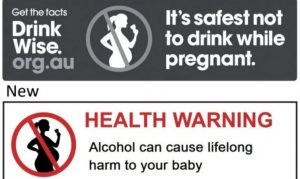
How the old and new labels compare.
The Alcohol, Tobacco and other Drugs Council Tasmania (ATDC) is urging Ministers Jeremy Rockliff and Sarah Courtney to support an “effective, evidence-based pregnancy health warning label for alcohol products.”
The Tasmanian Ministers are on the Australia and New Zealand Ministerial Forum on Food Regulation (Forum), comprising ten governments at state, territory and national levels, which will vote on an alcohol warning label this Friday. The vote is directly aimed at preventing harm caused by prenatal alcohol exposure, including miscarriage, stillbirth and Fetal Alcohol Spectrum Disorder (FASD).
More than 150 organisations and 3,500 community leaders and advocates across Australia have signed an Open Letter that has been sent to the Forum Ministers this week.
ATDC Chief Executive Alison Lai said: “We encourage Ministers Rockliff and Courtney to respond to the community’s plea for the red, white and black pregnancy health warning label that has been found to be most effective in alerting people to the risks associated with alcohol use and pregnancy.”
Lai said that ATDC members work very closely with people impacted by alcohol and other drugs across Tasmania, and they wholeheartedly support a visible health warning label for alcohol on the basis that health and wellbeing of families and children should be the highest priority.
The implementation of the new label design requirements has hitherto been delayed by the Australia and New Zealand Ministerial Forum on Food Regulation, which is chaired by Tasmanian Liberal Senator Richard Colbeck.
The forum sent the label back for review just weeks after Colbeck met twice with alcohol industry lobbyists, including a major political donor.
Documents tabled in the Senate show Senator Colbeck spent half an hour with representatives from multinational beer and spirits manufacturer Diageo and Lion Pty Ltd, the Japanese-owned company behind dozens of Australia’s best known beers and ciders, on 27 February. According to disclosure returns lodged with the Australian Electoral Commission, Lion Pty Ltd has donated $280,000 to the Liberal Party of Australia and $22,330 to the National Party of Australia over the past five financial years.
Centre Alliance senator Stirling Griff, who initiated a Senate inquiry into foetal alcohol spectrum disorder, asked Senator Colbeck in question time in May whether “lives or alcohol industry profits are more important to the government?”
Griff referred to a FSANZ analysis showing the one-off cost to alcohol manufacturers of implementing the new labels was $4924 for each product, while the annual cost to taxpayers of health and disability services for new FASD cases was $3 million – $13,847 per person.
Senator Colbeck said while the cost to industry of changing the labels on its products was ‘one consideration’, FSANZ had also been asked to review the colour requirements of the label, echoing the industry’s position that it should focus on ‘contrast’. “…in some circumstances red, quite frankly, just isn’t practical,” he said in the Senate.
Consumer Testing
This appeal to Forum Ministers to adopt a frank, visible health warning label, coincides with the first-ever comprehensive consumer testing of alcohol health warnings.
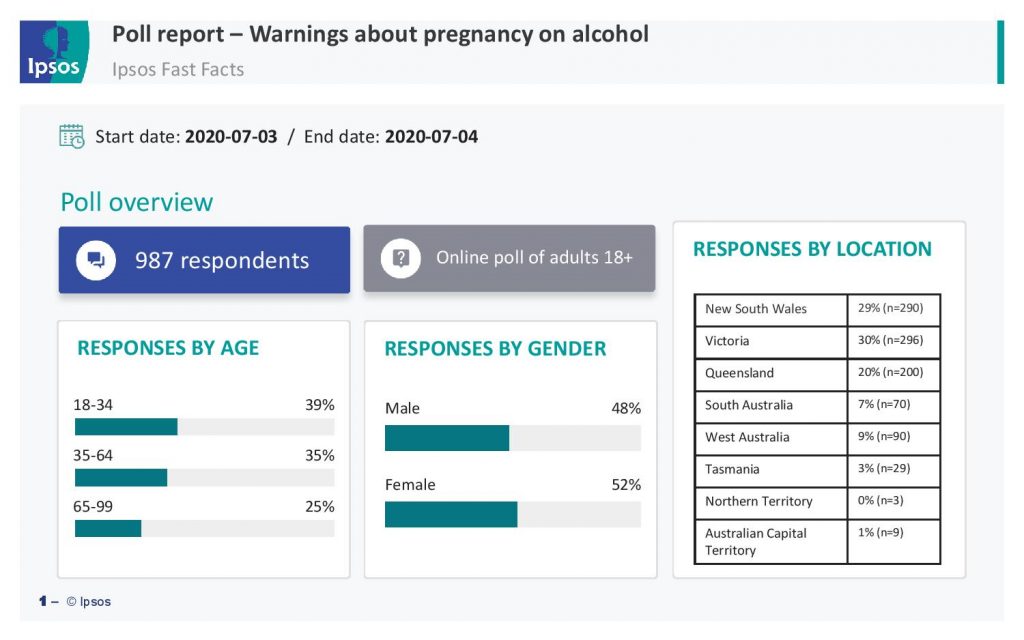
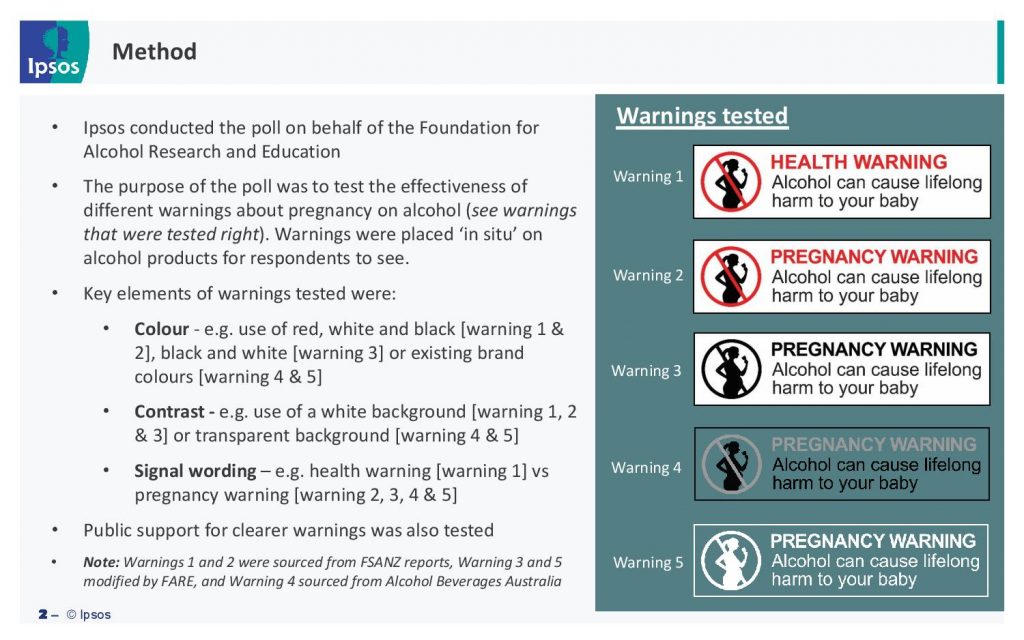
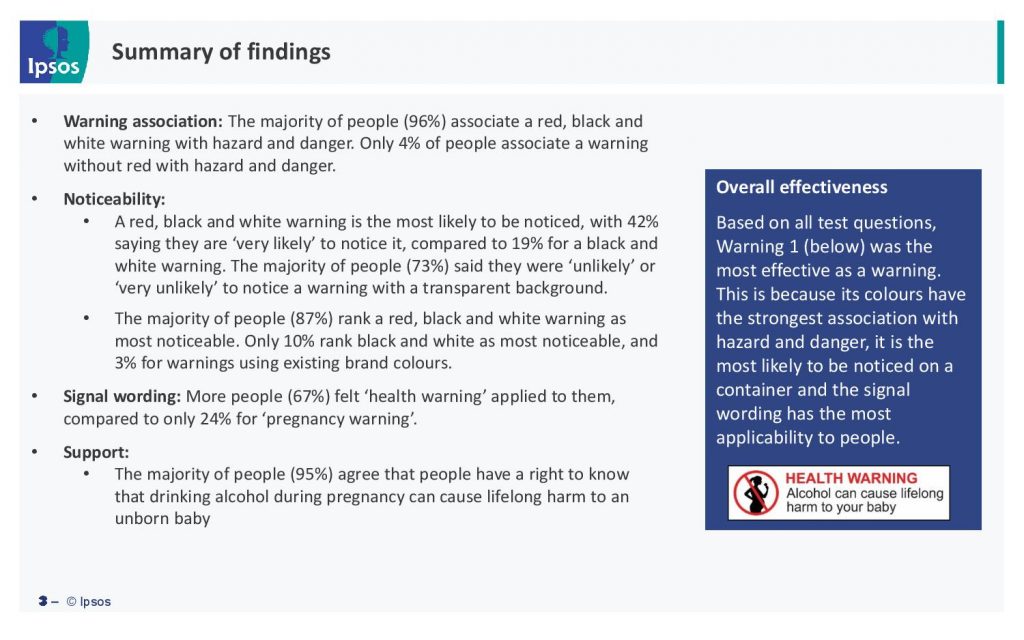
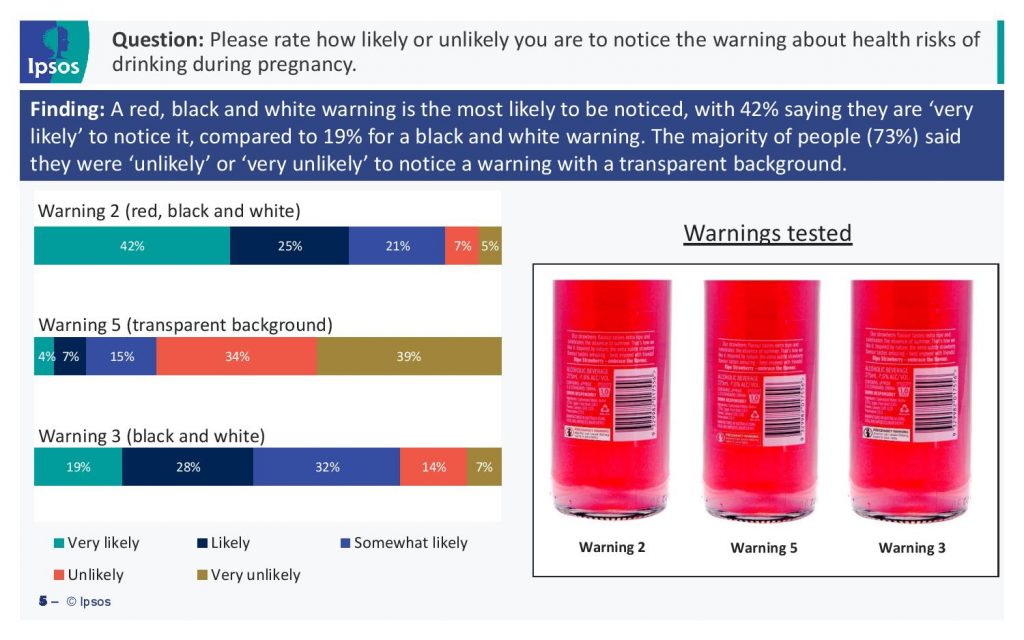
The consumer testing, conducted by IPSOS for the Foundation for Alcohol Research and Education (FARE), compares the effectiveness of five different warnings, building on years of evidence-based work by the food standards authority, Food Standards Australia New Zealand (FSANZ). The consumer testing compared the evidence-based warning developed by FSANZ (warning 1) with other warning designs that the alcohol industry has been lobbying Ministers to consider. See bottom of page for the complete summary.
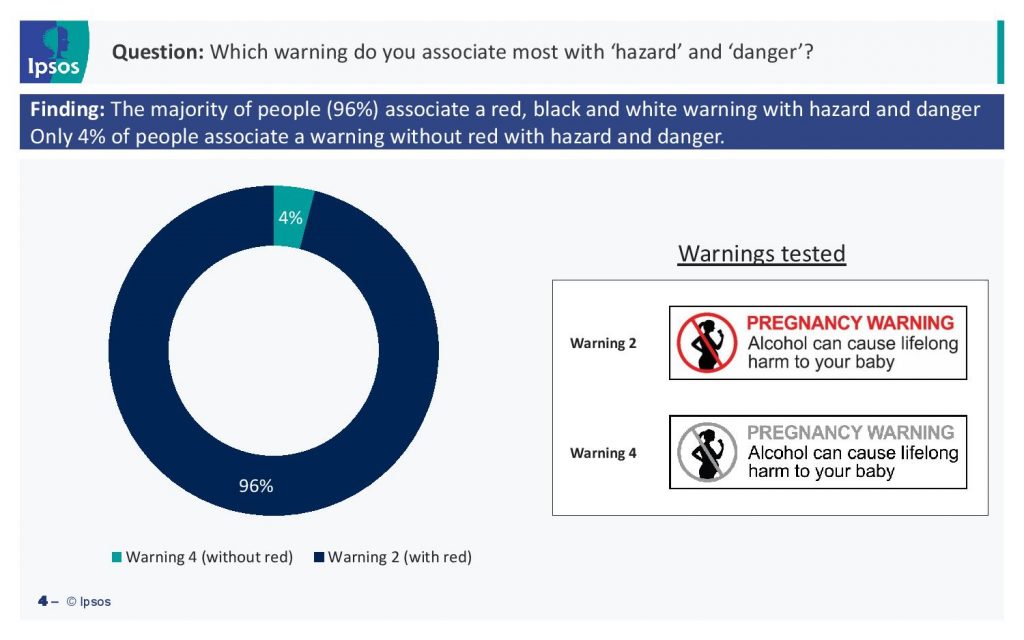
FARE CEO Caterina Giorgi said: “The consumer testing found the vast majority of people (96 per cent) associate danger and hazards with a red, black and white-coloured warning label, while only four per cent of people perceive a label without the colour red to be a warning.”
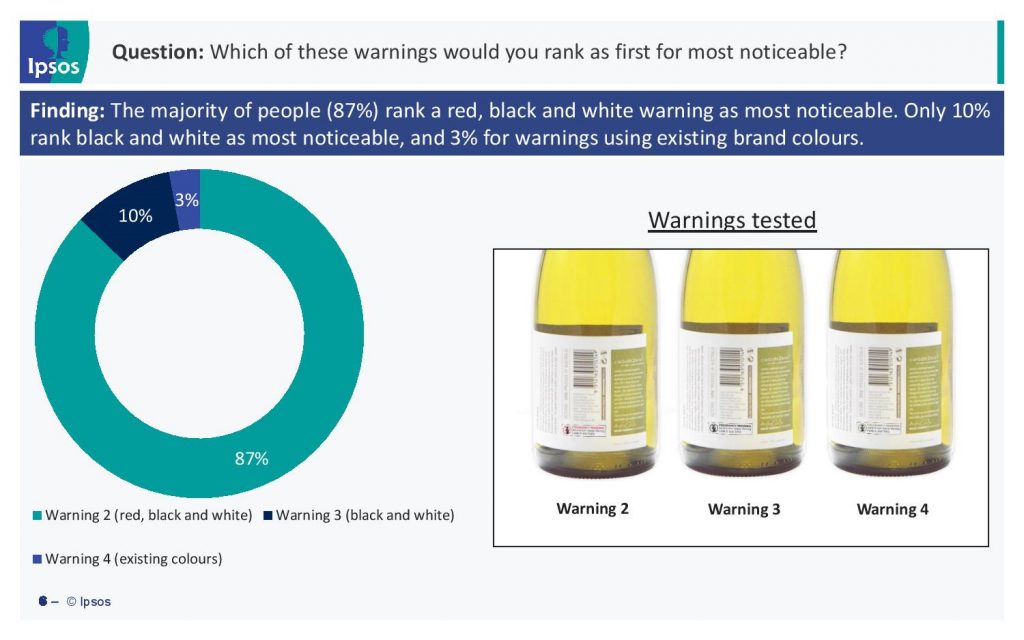
“Having a red, black and white label is important so the message can be understood by all Australians regardless of their literacy levels or cultural backgrounds,” Giorgi said. “The majority of people (73 per cent) were either ‘very unlikely’ or ‘unlikely’ to notice the warning in the alcohol company’s brand colours with a transparent background, known as ‘contrast’. And yet the alcohol industry is lobbying Ministers to adopt a camouflaged label, which would, in effect, be invisible,” she said.
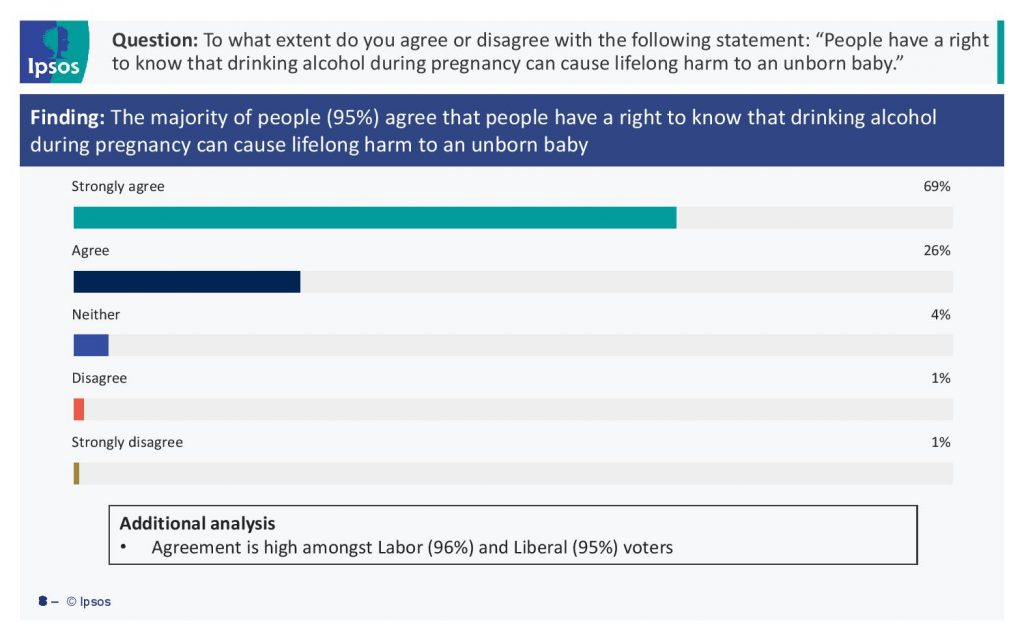
The vast majority of consumers surveyed (95 per cent) also agreed that people have a right to know that drinking alcohol during pregnancy can cause lifelong harm to an unborn baby, hence Giorgi xonsiders Ministers have a responsibility to raise awareness of this risk among all Australians.
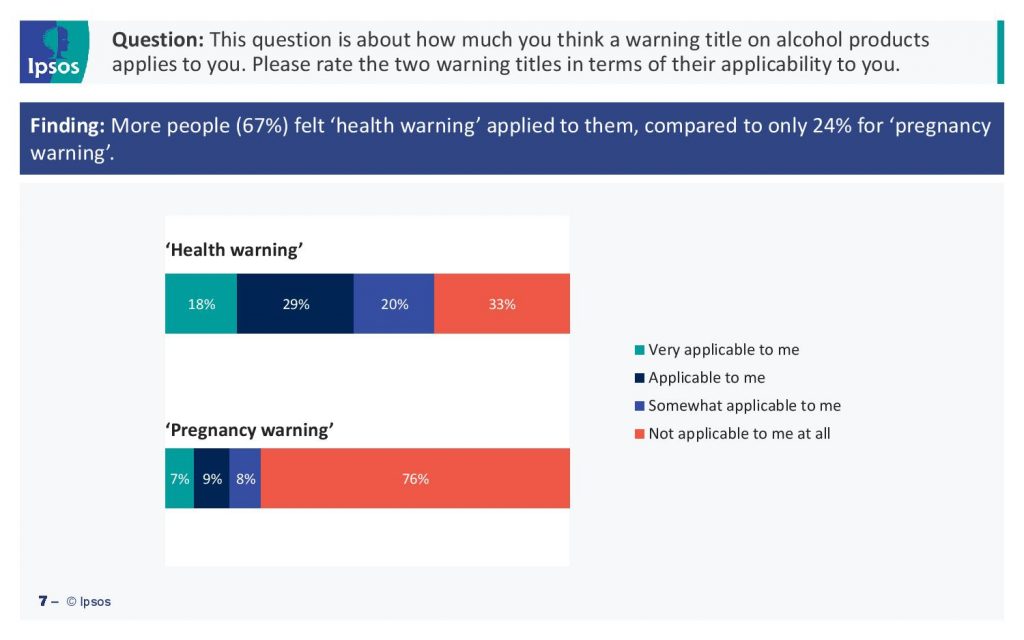
“Messages about alcohol use in pregnancy aren’t just for women who are pregnant, but are relevant and important for the whole community. The consumer testing found that a label with the term ‘pregnancy warning’ is far less relevant to people (24 per cent) than the signal wording ‘health warning’, which was relevant to 67 per cent,” she said.
“The signal wording ‘health warning’ is a critical component of an effective warning because the views of people in a woman’s social network has a bearing on whether or not they drink alcohol before, during and after their pregnancy.”
Giorgi said this latest consumer testing gives Ministers further information to support the red, black and white pregnancy health warning on alcohol products when they meet to vote on the warning on Friday.
AMA President, Dr Tony Bartone, said the AMA is deeply concerned about the serious health consequences, including Fetal Alcohol Spectrum Disorder (FASD), from drinking alcohol during pregnancy.
“Most Australians don’t understand the true extent of this harm. That is why we need a highly visible and clear easy-to-understand warning label for alcohol products,” Dr Bartone said.
“All the research and evidence indicate that red colouring, contrast, and appropriate wording are key to a noticeable warning label. The cost to industry of implementing these features in a label is minimal compared to the benefits a clear warning will have for the health of Australian children and their families.”
Industry Responsibility
NOFASD Australia CEO Louise Gray said the alcohol industry should accept responsibility for its products and provide a clear warning about the risks of alcohol use in pregnancy.
“FASD is caused only by alcohol. It is right that alcohol companies provide an honest health warning label on their products to help reduce the instances of this lifelong condition,” she said.
FSANZ has also suggested the implementation period be extended from two to three years to allow the alcohol industry ample time to factor this one-off update into their label design rotation.
“Alcohol companies constantly change labels to include vintage details or refresh brands, so three years is more than enough time to incorporate the pregnancy health warning,” Gray said.
Alcohol Beverages Australia (ABA) chief executive Andrew Wilsmore has argued that putting what he deems excessive information on a label is risky because: “If there’s too much information, you get this thing called label haze, where nothing gets taken in at all.”
In a recent statement the ABA argued that the signal wording was ‘non-relevant’.
“In March 2020, common sense prevailed and Food Forum Ministers – federal, state and territory – sent the bureaucrats back to the drawing board after rejecting a proposal that mandated colours and a non-relevant signal word,” said Wilsmore.
“Despite the clear direction given by Food Forum Ministers to ditch the colour version, the bureaucrats just can’t let go of their pet design and it is back again. It is extremely concerning that FRSC and FSANZ bureaucrats have totally ignored Ministers’ direction and submissions made to them which outlined where their proposal incurred substantial and ongoing costs.”
ABA calculates the new labels would cost consumers an extra $400 million, with ongoing high costs due to the more expensive label printing costs. “Mandating colours, instead of the existing contrast requirements established under the Food Code, would impose the biggest cost on consumers, without any scientific basis, for no measurable benefit,” claimed Wilsmore.
LUKE STACEY: Health Warning: Alcohol industry can cause lifelong harm to your baby.