“Modern life is leaping on at such a pace we no longer seem to have time to see the simple things of the bush as they are.” – John Blay, in Wild Nature.
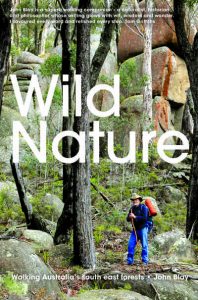
Wild Nature is the third book of John Blay’s trilogy about Australian forests.
In the book, Blay describes his long journey into the forests of south-east Australia. He also covers: the forests’ shared history; their natural history; the forest wars; the establishment of the South East Forests National Park; and the threats that dog their existence, which include bushfires.
Along the way Blay asks the big questions. What do we really know about these wild forests?
How did the forests come to be the way they are? What is the importance of wild nature to our civilisation?
In these contexts the book is both historical and political, and these themes are mapped out across his personal long-term expedition into the wilds. His deep immersion transforms his own consciousness, which in turn suggests a kind of ‘spiritual regeneration’ available to us all.
The book is generally well-written, though it could have gone through another round of revision because there are some passages are hard to read.
Blay vividly describes things (the places he visits, the history of these places, the animals he encounters, etc.) at length. For example:
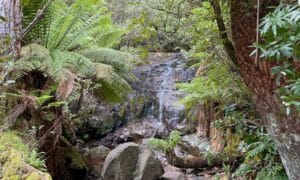
“Pudding stone formations in fantastic shapes abound [in the gorge he is walking through], often topped by moss and rock lilies alternating with streaked rock orchids. Mintbushes in blue and white throw petals at their reflection in the water. Crimson grevilleas and bottlebrush provide contrast. Some sections are of pink granite. There are waterfalls, sculpted pools and cliff overhangs but not any of the rock shelters I’d expected. Some rounded boulders are the size of double-decker buses. Their conglomerate includes rounded stones from streams carved out in the previous aeons, which are again now being ground to sand. Deep pools you can clamber around. Pinkwoods populate some shadier gullies. Tangles of watergum along the water’s edge often make the going more difficult. There are the usual eucalypts, river peppermint and ribbony gum, with some mountain grey gum. The walk is dramatic and charming…”
If you don’t like overly-descriptive passages of prose, Wild Nature probably is not for you. But if you’re an environmentalist, a conservationist, or a bushwalker / hiker, then it is definitely for you.
A person new to this kind of book may find it overloaded with facts and descriptions; however, it fosters an even deeper appreciation of Australian forests in the end.
Tasmania does not feature in Wild Nature, but it will make great preparatory reading if you are a Tasmanian who is thinking about journeying into Australia’s south-east forests at some stage.
In all, Wild Nature is personal, informative, and vividly told. It is due to be released in August this year.
Technical information
Wild Nature, NewSouth Publishing 2020, 336pp, ISBN 9781742236902, paperback with a photograph cover, photograph insert.
About John Blay

John Blay.
Blay is a writer and naturalist who has long-standing connections with Australia’s south-east. He has walked throughout the region, and has written extensively about its nature, its forests, its people, and its history. His work unveiling local landscape has had many consequences including, in 1982, discovering a new species of wattle, Acacia blayana, named in his honour.