In this two-part essay I will endeavour to place the life of the Tasmanian Aboriginal resistance fighter William Lyttleton Quamby into the context of his place and time.
Part 1 described what is known about Quamby’s life; this Part 2 using contemporary nineteenth-century maps of land grants to British settlers will show how the traditional Aboriginal fire-farmed plains on either side of Quamby’s Brook at Westbury were handed over to the settlers by the colonial government over a period of about 10 years from 1824. This was the same decade in which Aboriginal retaliations for loss of their land escalated into the Black Wars.
European settlement of the fire-farmed Aboriginal plains at Quamby’s Brook and the Westbury district before 1835
The current and controversial debate about the location of a new prison in northern Tasmania adjoining the village of Westbury on land which has close links to the long-term occupation of the district by its original Indigenous Tasmanian owners shows little or no understanding or acknowledgement of Tasmanian history.
It is salutary to consider some issues from the past which resonate directly with the present. For it is on the ancient fire-farmed Aboriginal landscapes of Blake’s Plains and Emu Plain divided by Quamby’s Brook that the proposed prison is proposed to be built, a prison that will contain more than twenty per cent by number of Tasmanians of Aboriginal descent.
Aboriginal fire-farmed plains and the nineteenth-century European settler landscape
The extent of European settlement in Van Diemen’s Land by the first half of the 1820s was encapsulated in the map of 1824 compiled by then Deputy-Surveyor George William Evans. In a detail from the map illustrated below, the area at the confluence of the Western (Meander) and South Esk Rivers is shown, indicating that at this date much of this area had not yet been distributed as colonial land grants. By the end of the decade, however, this had changed radically, with most of the accessible, well-watered land of prime agricultural and grazing potential on the fire-farmed Aboriginal plains by then allocated to free settlers with the means to qualify for grants.
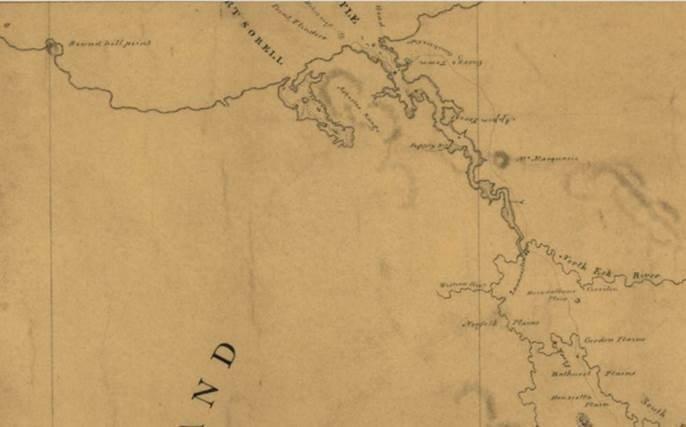
Detail from 1824 map by G.W. Evans showing confluence of the Western (Meander) River with the South Esk at Hadspen. 1
However, the grasslands of Norfolk, Breadalbane, Gordon, Bathurst and Henrietta Plains located beyond rivers which were still without permanent crossings remained mostly unallocated to the settlers. But once the rivers were able to be reliably crossed as at Hadspen and Carrick, the land leading to Westbury was gifted away by government, initially as grazing leases.
The river crossings at Hadspen and Carrick were established by Thomas Reibey who took up the first land grants to the west of the South Esk at Hadspen. The first land grant west of the crossing at Carrick went to Richard Dry, an Irish-born, free-by-servitude political convict who was gifted 200 acres by Governor Lachlan Macquarie at Quamby’s Plains. Ann(e) Maughan, Dry’s wife, who was not a convict, received a grant of 50 acres on the North Esk River from Lieutenant-Governor David Collins on 9 May 1809.
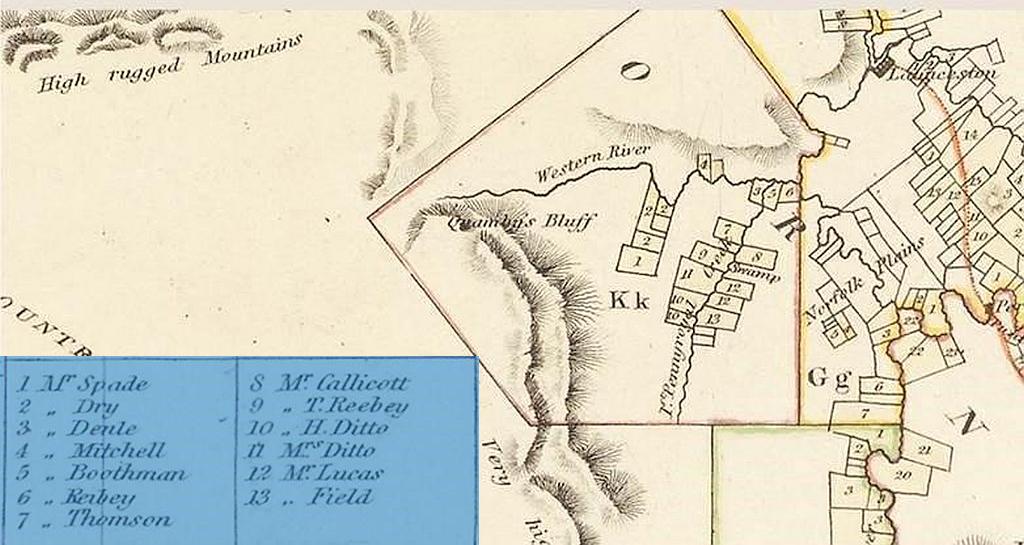
Detail (above) from Thomas Scott’s 1824 survey map 2, showing the land grants on Quamby’s Brook backing onto the Western (Meander) River. Dry’s three grants (no. 2) were the basis of his Quamby estate, originally known as Belle Vue; Thomas Reibey’s grant (no. 6) formed his Entally estate; and William Field’s (no.13) estate Enfield on the Liffey. All three settlers also had grazing rights to run cattle over the Aboriginal fire-farmed plains stretching west as far as Mole Creek.
In 1826 George Arthur, the newly installed Lieutenant-Governor of Van Diemen’s Land and a former British army officer, created seven interlocking police zones to control the convicts on the island, with each zone under the charge of a stipendiary magistrate and a chief constable. This was to be the core of Arthur’s reform of the convict assignment system. He aimed to create a new regime of tight social controls over the assigned convicts by administrative rather than physical means.
In achieving this he harnessed the interests of the free settlers in improving their assets by providing them with convicts, assigned essentially as slaves.
In 1833 Arthur described his system as ‘a natural and unceasing process of classification, the mainspring of which … is the silent yet most efficient principle of self-interest.’ 3
In 1829 surveyor Thomas Scott accompanied Lieutenant-Governor Arthur to the west as far as the Mersey River at Mole Creek and beyond to the massive Van Diemen’s Land Company’s grants of over 200,000 acres, carefully charting the country and the holdings of landowners along their route.
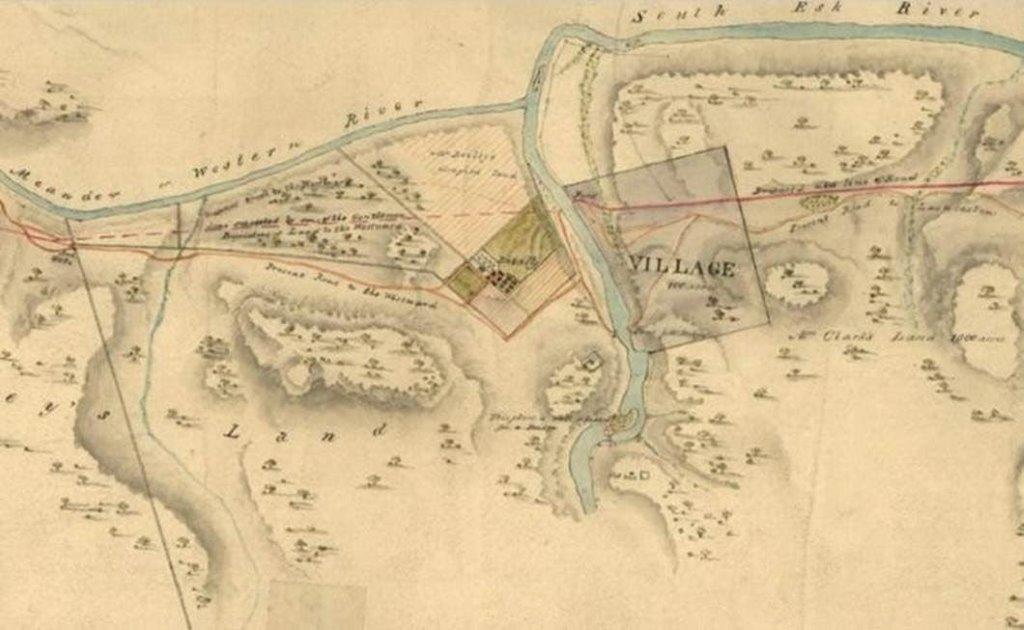
Detail from Mr Scott’s General district plan of Launceston and Meander 4, drawn by Thomas Scott after his trip to the west in 1829 with Lt. Governor Arthur. It shows the river crossing, roads and the ford over the South Esk at Hadspen leading to Entally. The symbols for trees indicate a lightly timbered, mostly as yet uncleared landscape.
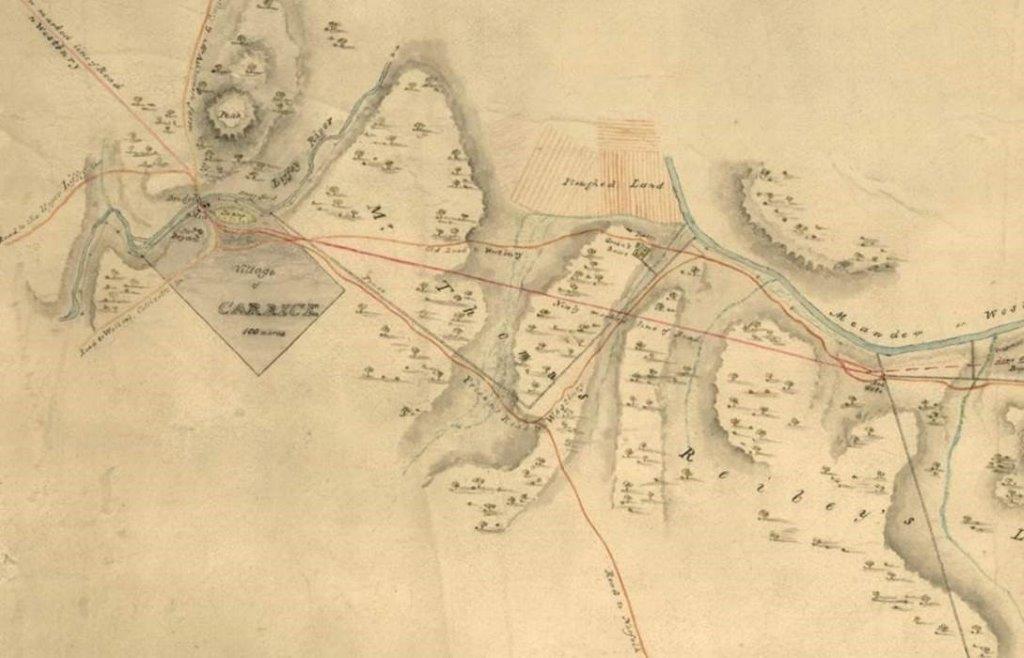
Another detail from this map showing roads and the bridge crossing the Liffey River at Carrick. William Bryan’s mill is shown and a bridge has been built over the Liffey. Both structures with later additions are still extant. The village was marked out at this date; Entally on the western bank was built by Thomas Reibey by 1819.
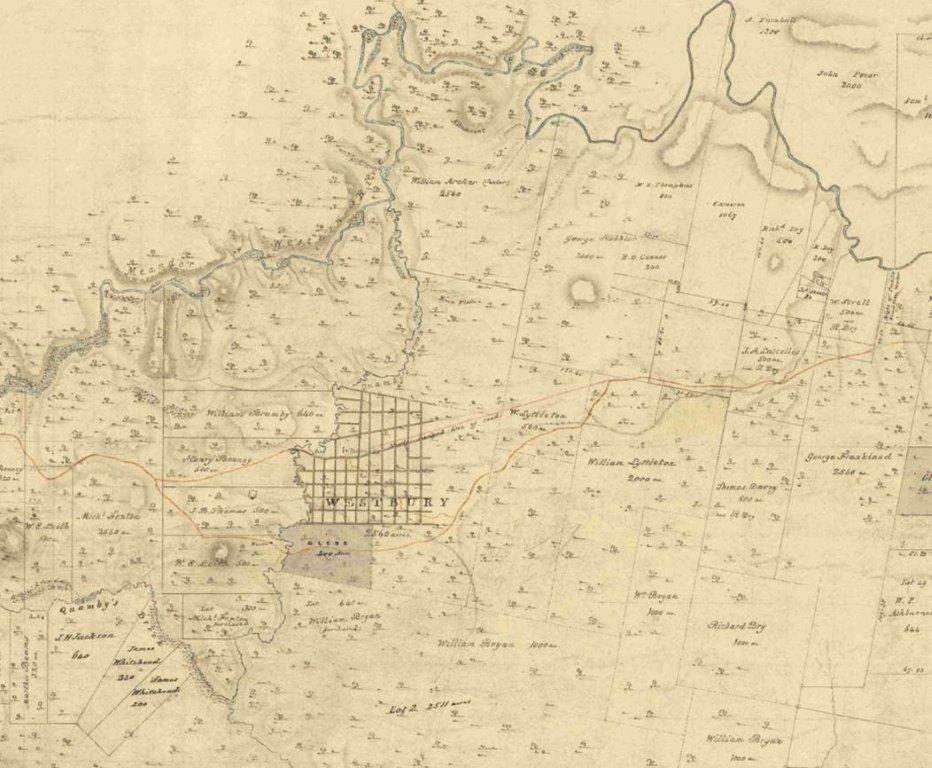
Detail from Mr Scott’s General district plan of Launceston and Meander, drawn in 1829. William Archer Senior’s grant of 2560 acres in the block bounded by the Meander River and Quamby’s Brook is indicated, with Emu Plain and Blake’s Plains not yet allocated.
New settlers were entitled to a land grant based on the assets they brought with them to the colony. As the father of three successful sons already farming in the Longford area, William Archer Senior’s original land grant was substantial and was fronted on three sides by rivers.
The Emu Plain block to the east of Quamby’s Brook had not yet been acquired but was later granted to William Lyttleton, nor had Blake’s Plains to the west been distributed. This later went to William Archer. By 1838 Dry was to purchase George Hobbler’s block and all the land in this vicinity previously owned by William Archer. The blocks owned by Brumby, Bonney and Thomas were amalgamated to form the Westfield estate when purchased by William Field in the name of his wife.
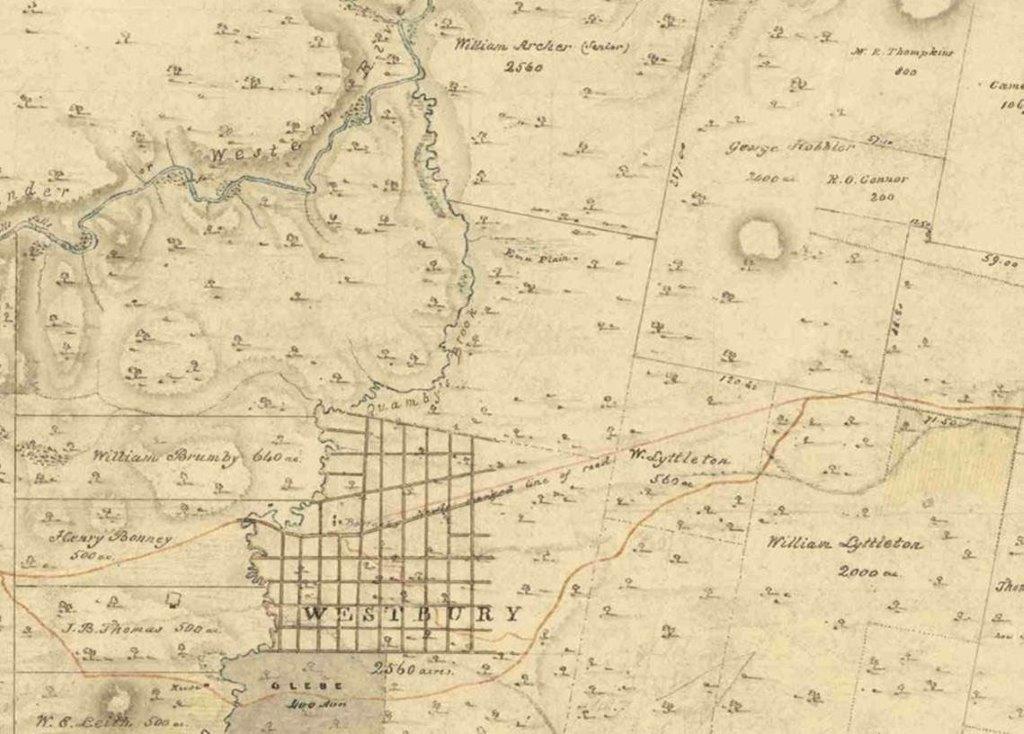
Detail from Mr Scott’s General district plan of Launceston and Meander showing the grid layout for the proposed town of Westbury and the as yet unnamed Lyttleton Street marking the town boundary to the north. William Lyttleton had not yet acquired Emu Plain to the east of Quamby’s Brook.
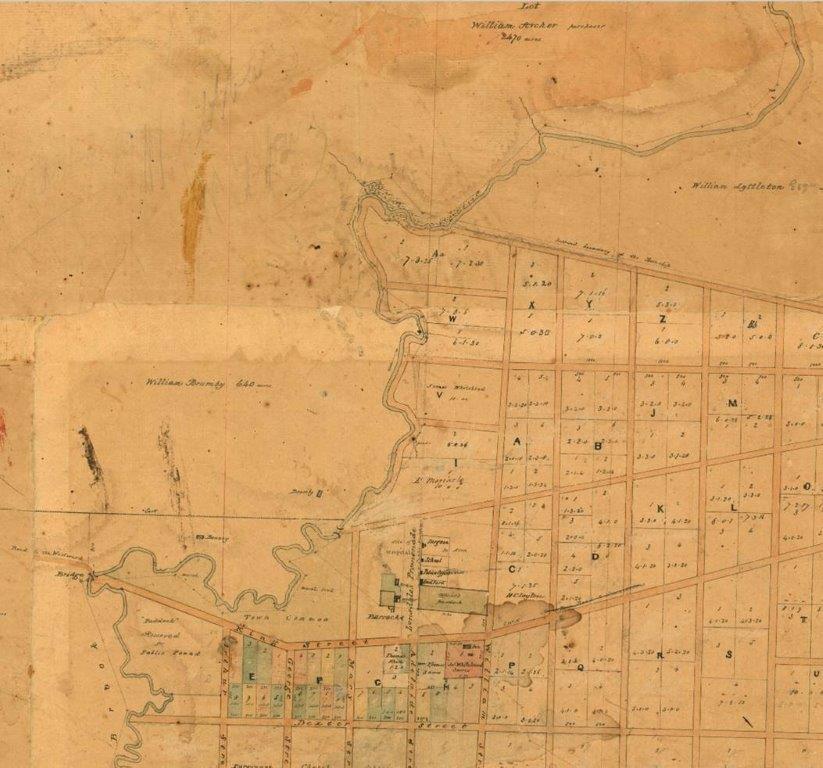
Survey plan of the town of Westbury dated 21 January 1832, draftsman unknown. 5
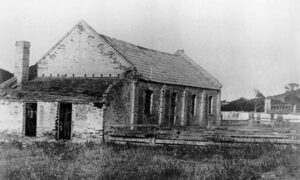
As has been stated, William Archer Senior of Brickendon took up the land to the west of Quamby’s Brook, later acquired from Archer by Richard Dry. William Lyttleton owned the land to the north-east of the town boundary and by this date William Brumby had been granted a block of 640 acres, or one square mile. The river crossing, now on the Meander Valley Highway, was at his southern boundary but progressed no further with the town common to the south. At the end of King Street, a bridge was completed for a road to the ‘Westwards’ with the public pound for stray cattle and sheep surrounding its eastern approaches. The barracks were on what is now the village green.
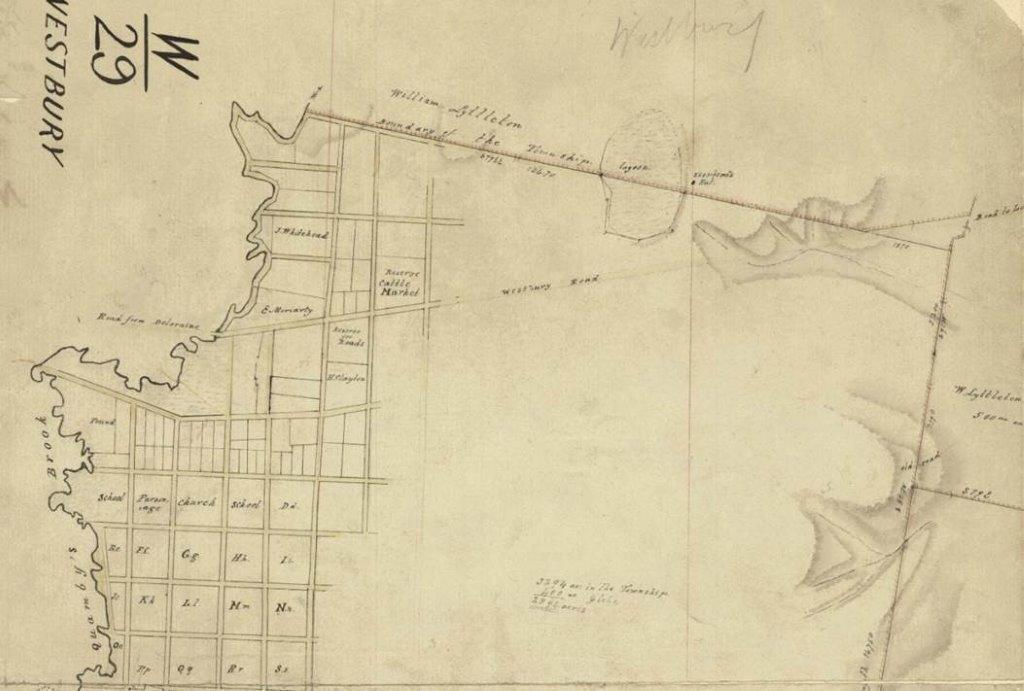
James Scott’s survey of Westbury and surroundings dated August 1837. v The Westbury Road, then as now, is shown as the principal road with the Quamby’s Brook crossing to Deloraine.
Between 1820 and 1835 under the aegis of Richard Dry, many settlers of Irish origins took up grants on the plains to the west of Hadspen stretching as far as Deloraine and on to the Mersey. Principally they were William Bryan, to the south of Westbury; Lieutenant Travers Hartley Vaughan at Native Hut Corner (now Old Wesleydale), Chudleigh; and Lieutenant William Moriarty and family at Dunorlan to the north of the Gog. The main centres for road construction within the district in 1830 were Westbury and Deloraine where military detachments from the 57th Regiment controlled road-making using chain gangs of leg-ironed, mainly Irish convicts many of whom had been transported to the colonies as a result of their political convictions.
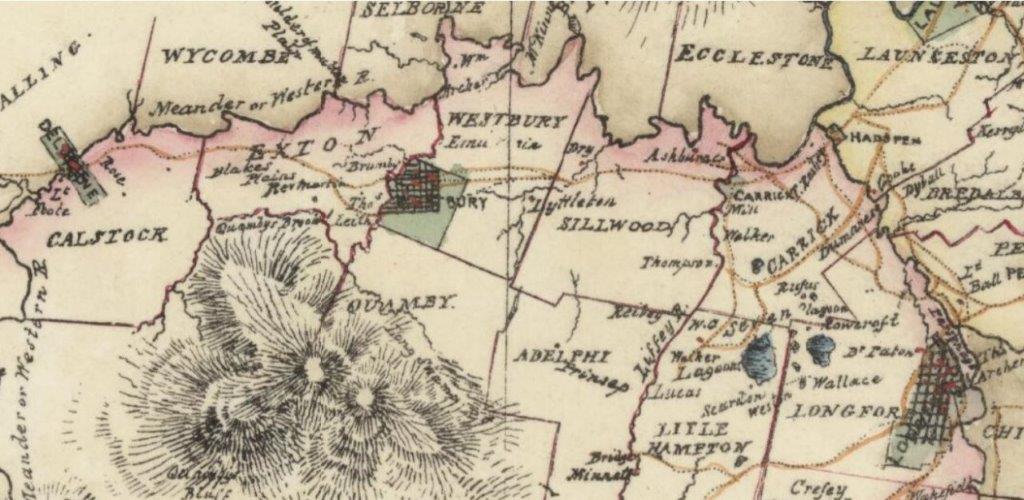
Detail from Surveyor-General George Frankland’s 1837 map, 7 with names and delineation of the Parishes of Westbury (Emu Plain), Quamby (Long Swamp) and Exton (Blake’s Plains) that surround the town of Westbury, all bisected by Quamby’s Brook with Quamby’s Bluff to the south. Ashburner’s property Sillwood east of Westbury divided Dry’s land from Lyttleton’s along the Meander River.
The road to the west from the river crossings at Hadspen and Carrick is marked with a dotted line. Both Emu Plain and Blake’s Plains are designated by the word ‘plain’, that is a treeless landscape, and therefore in this locality an Aboriginal fire-farmed landscape in an otherwise timbered landscape. By 1835 the largest land owner in the district was the Irish patriot Richard Dry, a 1797 Wexford rebel and former political convict, by this time with more than 12,000 acres to his name.
An Irish magistrate such as Bryan was considered by his opponents, particularly the Englishman Lyttleton, to favour people of Irish origins in a system whose fundamental autocratic flaw was that it did not provide for trial by jury.
The resulting tensions this engendered led to increasing dissent with Arthur and his clique, not helped by the governor’s stated religious convictions leading his more militant opponents to accuse him of hypocrisy.
The essence of Arthur’s thinking may be deduced from his Observations on Secondary Punishment (1833), where he writes that convicts came from poor and ignorant backgrounds, victims of circumstance who in Van Diemen’s Land had their first chance of developing honest traits of character.
Arthur’s system of bondage was attacked as ‘unscientific white slavery’. Arthur countered such criticisms by ordering the construction of Port Arthur, a prison of severe secondary punishment to defy any charges of leniency that might be levelled against his system of convict assignment.
The Irish landowners took their fellow Irish compatriots as their assigned convicts. Most of the latter were Catholic although their masters were mainly Anglo-Irish Protestants. They served their sentences in and around Deloraine and Westbury with the most competent and reliable becoming tenant farmers on the Irish-owned estates.
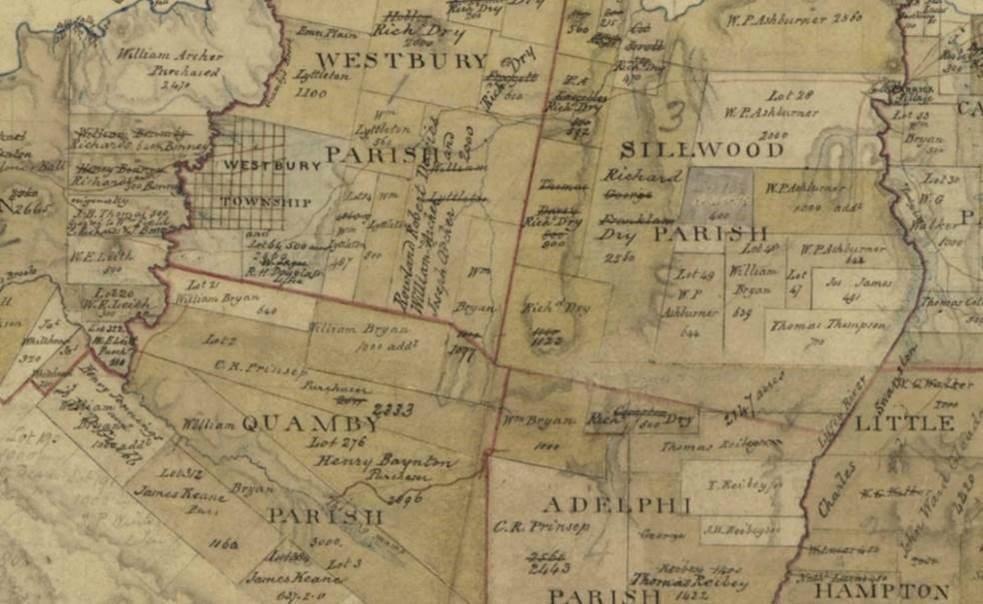
Detail of the land grant survey map of Westmorland by George Frankland, 1837. 8 This is an accurate rendering of existing land grants in the Parish of Westbury at this date with annotations recording changes of ownership.
By 1839 the 2600 acres owned by William Lyttleton were surrounded by land now owned by William Archer, William Bryan and Richard Dry. William Field’s ex-convict widow had gained control of the blocks that comprised Westfield.
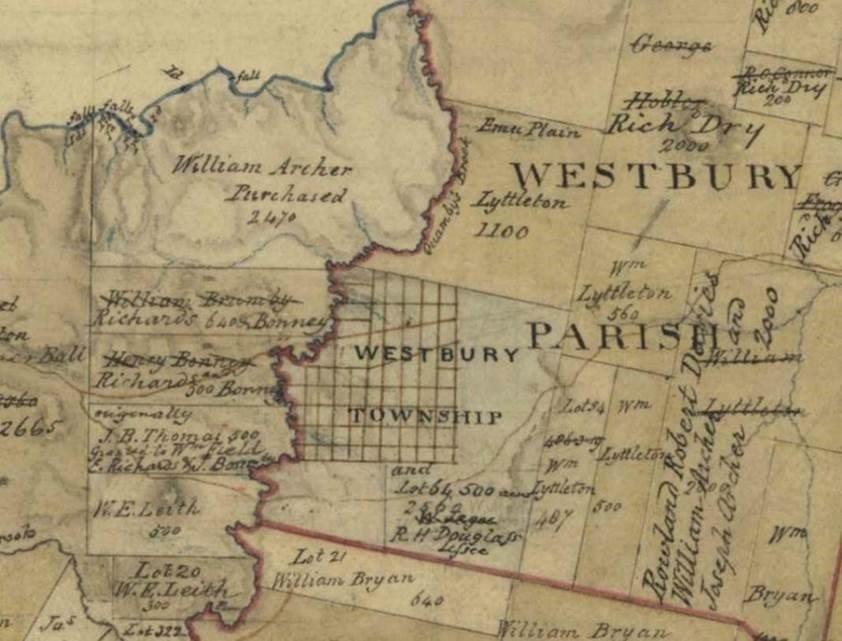
Enlarged detail of the 1837 Frankland map (above) showing the purchase by William Archer Senior of the Blake’s Plains block of 2470 acres. This, together with the block to the north on the other side of Quamby’s Brook, was purchased from the Archer family by Richard Dry in 1837 for £16,000.
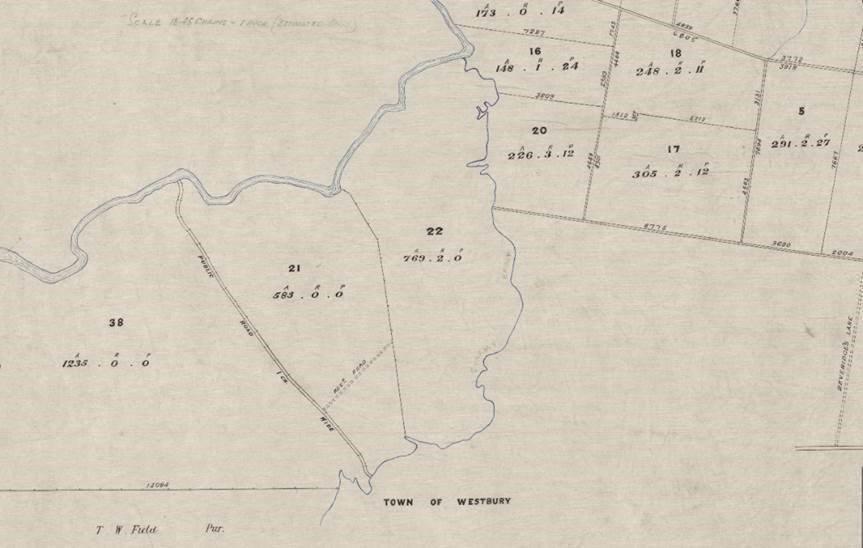
Detail of sale plan of the 1887 land sale of Quamby 9 which outlines the Blake’s Plains land, originally purchased by Richard Dry in 1817. At the time of the sale, this area was divided into three titles: lots 21, 22, 38, with a public road (present-day Birralee Road) from Westbury to the Meander River.
The lots were described as follows in the report on the sale as follows: ‘Lot 21, Mill Run, of 583 acres …; Lot 22, Home Run, of 760 acres 2 roods … ; Lot 23, Foley’s; of 401 acres 2 roods 14 perches …; Lot 38, Roxford Back Run of 1235 acres …’ 10. The naming of the Quamby Estate blocks as ‘runs’, not farms, confirms their past history when they were first used by Richard Dry by virtue of cattle grazing rights over a ‘native plain’.
Meander Valley Central Industrial Precinct and the proposed prison site
Two areas on these blocks are now part of the Meander Valley Central Industrial Precinct:
Part of Lot 38: Roxford Back Run is the site of the proposed prison, formerly on class three or class four land owned in the 20th century by the Field family of Westfield; and part of Lot 21: Mill Run of 583 acres which adjoins Birralee Road to the east and on part of which stands the Tasmanian Alkaloids factory.
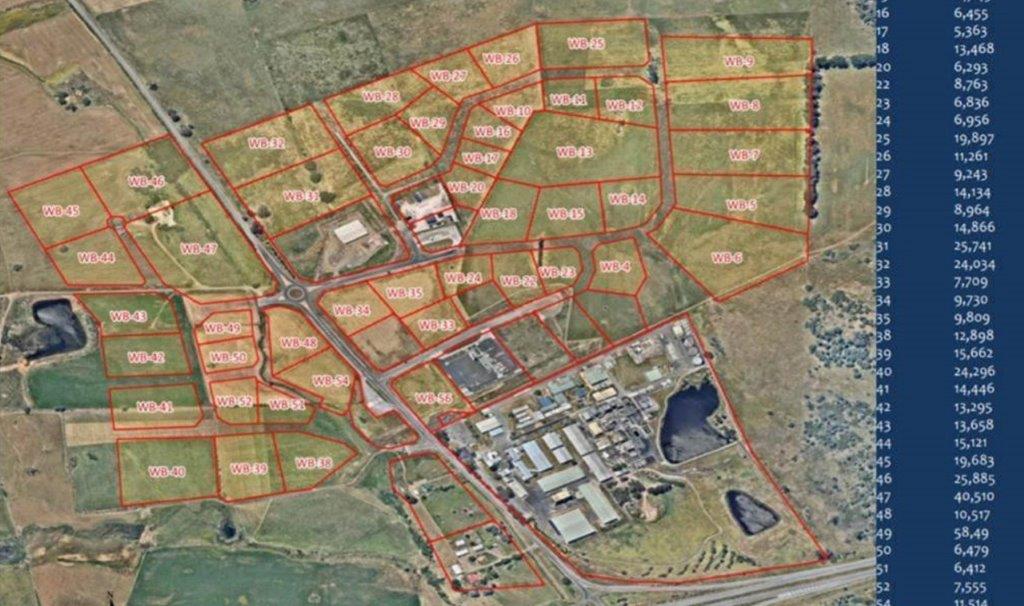
Meander Valley Central Industrial Precinct subdivision
The stated area of the proposed prison by Minister for Corrections, the Hon. Elise Archer MP, is 41.5 hectares. The Valley Central Industrial Precinct covers an area of 69.8 hectares. The prison site is believed to be slated for blocks 44, 45, 46, 47, covering an area of 10.2 hectares to the west of Birralee Road.
Therefore, much of the proposed prison footprint of 31.3 hectares is outside the current Industrial Precinct on farmland to the north which is believed to be in the possession of Glen Avon Farms.
In order to progress the matter, the state government will have to amend the planning scheme to facilitate the proposed new prison on the same owner’s land but outside the current declared Industrial Precinct. Why has the Meander Valley Council not insisted that blocks 38 to 54 on the same side of the road are to be included on the proposed prison site? Their non-inclusion (less 44, 45, 46 and 47) suggests a scheme to maximise the owner’s profit by increasing the size of the Precinct over agricultural land rather than using land within the Precinct in the same ownership.
The state government will apply for the total area to be rezoned to accommodate their proposed custodial facility, increasing the industrial zone over land never designated for this purpose nor agreed by the Meander Valley Council. Under the current planning laws a prison cannot be classified as a utility nor as a prison, it now becomes a ‘custodial facility’.
The proposed prison will therefore require the state government to apply to the Meander Valley Council to rezone all the land in the prison footprint as a Particular Purpose Zone, a land use where either the planner and or the government may write their own rules.
Apart from anything else, a prison adjoining Quamby’s Brook in full view of the Bass Highway and adjoining Westbury is hardly an acceptable site. As a large percentage of its occupants are of Aboriginal descent this may be considered as adding insult to injury.
Summary
In 2020 the forces at work here are essentially no different to those experienced by William Lyttleton Quamby when rebelling on behalf of the Pallittorre people in the late 1820s.
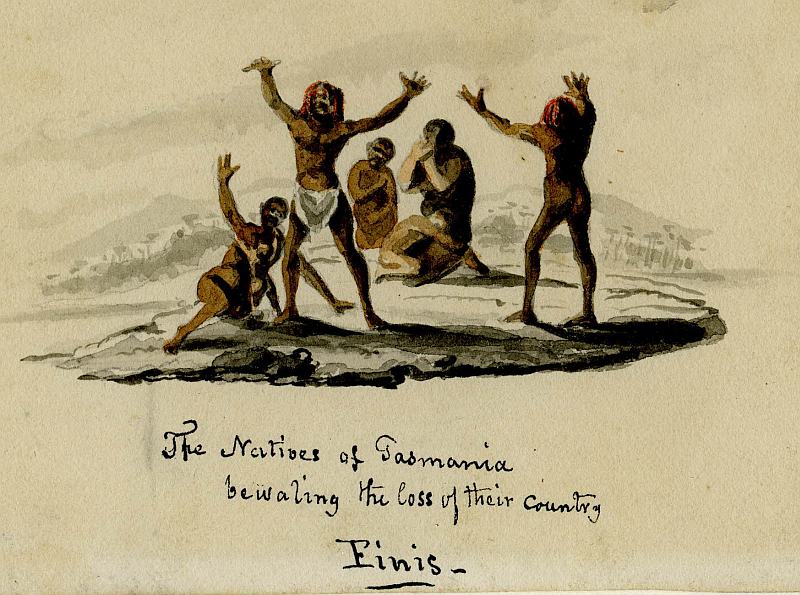
Quamby had been taught English and educated in the ways of white settlement. He rebelled against the government and settlers, becoming a resistance fighter to protect the land his people had fire-farmed for hundreds of generations. Aboriginal protest in this part of Van Diemen’s Land virtually ceased with the shootings of Quamby and his extended family in 1829 and the end of George Augustus Robinson’s ‘Friendly Mission’ to round up surviving members of the indigenous clans by 1834.
The Aboriginal people lost all rights over their fire-farmed plains by government decree after the land was expropriated without consultation, much as the people of Westbury are being made subject to a prison by a Liberal government decree with dubious consultation some two hundred years later.
Tasmania is the only state with no historic landscape protection laws and no cultural landscape legislation on the statute books. This situation could be seen as a conscious omission by successive state Liberal and Labor governments to give the logging industry rights to destroy Tasmania’s historic old-growth native forests for woodchips.
As a result, this intervention by government over planning matters regarding a proposed prison makes it almost impossible for the inhabitants of Westbury to legally protect their multi-layered heritage landscape the evolution of which has been described above.
Aboriginal Tasmanians fought and suffered through Black Wars and the Black Line of the 1820s. Today, with the identification of Quamby as their iconic resistance fighter, they are in a position to honour his legacy by placing a black ban on the development of a prison on land so closely identified with their past.
To them will go the glory of defeating this latest invasion by government on what was once their ancient and traditional landscape.
I have been in discussion with the Tasmanian Aboriginal Community and they do not object to a prison in the north of the island because some twenty per cent of those in prison are of Tasmanian Aboriginal descent and it is too far to travel to the south to visit their relatives and friends. In addition, over sixty per cent of the internees at the Ashley Youth Detention Centre are of Aboriginal descent.
The Aboriginal people are in agreement that the proposed new prison should be sited somewhere north of the Meander River on the Birralee Road in an area of cleared native forest now replaced with plantation timber. To locate a new prison so close to Westbury on Tasmanian Aboriginal traditional land would be an affront to William Lyttleton Quamby.
Tasmania’s First Peoples are already forced to accept a prison at Risdon Vale after the Gaols Department in 1949 obtained by compulsory acquisition a property of 90 acres (36 hectares) not far from Risdon Cove where the initial European settlement of Tasmania occurred and the first of their people were shot.
It is not too late for the Aboriginal Land Council of Tasmania to use their powers under the Aboriginal Lands Act (1995) to investigate black banning the proposed Westbury prison site at Quamby’s Brook, which should be celebrated as the centrepiece of their fire-farmed landscape in whose defence Quamby and his people gave their lives 191 years ago.
John Hawkins has lived in Tasmania for 17 years. He has recreated with his wife Robyn a 19th century landscape over the Bentley Estate at Chudleigh. He is interested in the Tasmanian way of doing business. John was commissioned into the Diehards from Sandhurst in 1962.
1 George William Evans, A new chart of Van Diemens Land … from surveys by G.W. Evans, Deputy Surveyor General … London, J. Souter, 1824.
2 Thomas Scott, Chart of Van Diemen’s Land … by Thomas Scott Assistant Surveyor General, London, 1824.
3 Great Britain, House of Commons, ‘Extract of despatch no.10 from Lieutenant-Governor George Arthur to Viscount Goderich, 27 February 1833’, in Report from the Select Committee on Transportation, London, 1837, p. 55.
4 Thomas Scott, ‘… Mr Scott’s general district plan of Launceston and Meander, 1829’. Manuscript. Tasmanian Archives and Heritage Office, AF396/1/1376.
5 Plan of Westbury, January 21st 1832’. Manuscript. TAHO, AF721/1/766.
6 James Scott, ‘Westbury surveyed by James Scott, 1837’. Manuscript. TAHO, AF721/1773.
7 George Frankland, Map of the colony dedicated to the land-holders of Van Diemen’s Land. Hobarton, April 1837. (Detail). TAHO, AF395/1/5.
8 George Frankland, ‘Westmorland [map no.] 65, 4th May 1837’. Manuscript. (Detail). TAHO AF392/1/1292.
9 A.A. Peart, ‘Westmorland [map no.] 89, Sale plan of Quamby Estate … surveyed by A.A. Peart about 1887’. Manuscript. (Detail). TAHO AF396/1/1316.
10 Launceston Examiner, Tuesday, 26 April 1887, p. 3.