

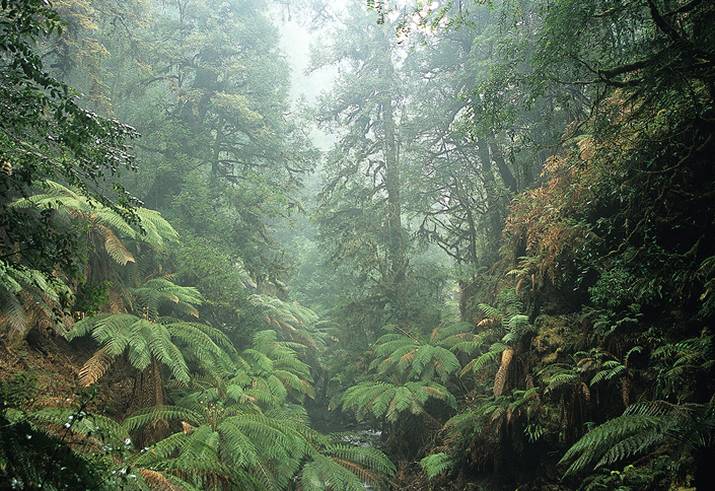
*Pic: Ted Mead … of the Tarkine in the mist …
First published July 9
Introduction
I am restating an argument here that environmentalists could use to support any and all of their campaigns, but which they ignore. This seems disastrous to me, because it might end their interminable conflicts with developers and politicians – and it could do that by showing everyone that they are making much more sense than their opponents.
So why don’t they use it? One reason is that very few are aware of it. But even if they were aware, it may anger them because it contradicts some of their propaganda. Another reason is that, like politicians, environmentalists campaign for the support of the mass public and in order to get that they must tell people what they want to hear and what they already agree with. Environmentalists can’t afford to do too much educating. And there’s the rub, because this argument is not only just a little complicated, it also asks people to prize lasting benefits more than instant gratifications. Worse, it invites them to suffer small costs now to get big benefits later. Perhaps we shouldn’t expect greens to use this argument then, as our democratic politics can’t handle it. But let’s be optimistic and challenge them to try! They might pull it off. And if they did the rewards for everybody would be tremendous.
This argument is basically a simple theory in ecological economics and political science. I first published it in 2009 in the peer-reviewed academic journal Ecological Economics 68 (3), under the title “How economic growth becomes a cost: The scarcity multiplier”. A detailed version is given in my 2016 book Rescuing Democracy, where it is explained in Chapter 5 and applied to Tasmania in the Appendix.
The argument, or “scarcity multiplier” theory, has two conclusions.
The first is that in any relatively well-developed economy, more economic development (even just one new commercial enterprise) does not help to satisfy the public’s wants for more jobs and more income. To the contrary, it increases those wants.
The second conclusion is that this failure to satisfy is purchased at the cost of making natural capital more scarce.
These two results mean that, depending on whether one wants to expose political failure or economic failure, the argument or theory might be presented as “the false promise of economic growth” (political duplicity) or “the scarcity multiplier” (economic stupidity).
In a nutshell
In its briefest form, the argument begins by saying that any economic development in a relatively well developed economy will not satisfy wants for more income and more employment, but will inflame them while making the stock of natural capital more scarce. It then explains that these wants are inflamed because economic development makes the population get bigger while also enlarging each person’s wants for more income and more employment. The argument concludes by reasoning that scarcity increases because this bigger population with bigger personal wants has a much larger aggregate want (compared with the pre-development aggregate want) for the country’s smaller stock of natural capital (smaller, compared with the pre-development stock).
This version is so brief that it is cryptic, but it may be useful for those who want to attract an audience for either of the two more explanatory versions that follow here. Those versions are ‘A brief outline’ and a much longer account that presents the theory as a ‘false promise’ from politicians.
A brief outline of the scarcity multiplier theory …
The scarcity multiplier theory – or if you prefer, the false promise accusation – starts by agreeing with the conventional ‘theory’ or assumption that supplying more jobs and income will actually satisfy – at least to some extent – the wants of citizens for more employment and income. That conventional theory thereby presents more ‘jobs n growth’ as a public good, which makes it an appropriate thing for governments to provide. But that’s as far as conventional thinking goes: The voters say “More ‘jobs n growth’ is great, thank you”, and pretty much stop thinking about it at that point.
The scarcity multiplier theory, however, thinks further by asking what will happen when the government satisfies some of the people’s desires for more ‘jobs n growth’ by expanding the economy? Even just one new development project will make the voters’ state or nation a little bit more attractive as a place in which to earn a living, so out-migration from that region will tend to diminish and in-migration will tend to increase. As such projects are launched, the population therefore gets bigger (than it would have been without them), which increases the public demand (or want) for more ‘jobs n growth’ so that the original want for this tends to be restored. That drives the government to expand the economy again, reproducing the same responses in the population, the economy and the government so that the cycle tends to repeat itself. As this positive feedback progressively expands the economy, it consumes more and more of the state’s (or nation’s) natural capital, making it more and more scarce. This feedback is, therefore, a ‘scarcity multiplier’.
But there is another cycle that supports this multiplier, so that it continues to make natural capital more and more scarce, as long as the government and economy continue to function. This is actually a set of three positive feedbacks that is dubbed ‘affluenza’ (e.g. Hamilton and Denniss 2005, 3; Smith 2016, 215) as it restores and inflames individuals’ wants for more jobs and income. One of its cycles is the adaptation feedback, in which the wants of individuals grow as they get more income, because they adapt to higher levels of consumption and then want even more. This drives politicians to expand the economy, producing more adaptation and so on, ad infinitum. Positional competition such as status rivalry works a similar feedback and sales promotion cultivates both of those feedbacks to create more sales revenue for its own feedback. As the economy grows, its bigger size produces more money for sales promotion.
This combination of population and affluenza feedbacks never ceases, as each of their cycles fuel the next to expand the economy and the population. It’s like a dog chasing its tail. It exhausts both citizens and their natural resources. Wilderness, wild life, fresh water, arable and other types of land – in fact all types of natural capital, including the climate – are inexorably gobbled up by commercial interests, wherever they can make money from it. Many business people love this dynamic, whether they are really aware of it and understand it, or not. It always makes money for them.
To further clarify this scarcity multiplier theory, a longer version is now presented. Its title is the one under which it was originally published, in TNPA News 19 (winter 2014), the newsletter of the Tasmanian National Parks Association (http//:tnpa.org.au). It is reproduced here with a few alterations and additions.
How the false promise of economic growth destroys our environment
On February 16, 2014, one month before the Tasmanian State election of that year, the front page of the Sunday Tasmanian declared: “Voters clear on what politicians must deliver… JOBS, JOBS, JOBS”. It reported a poll of 2912 voters showing that 50.9% of them considered job opportunities and the economy to be the issues that would most influence their votes. In contrast, only 21.3% selected health services, 12.1% education, 11.2% environment and 4.5% crime and safety.
This random sample might be taken to summarize the environmental predicament here. With a 51% preference for economic growth versus 11% for the environment Tasmanians will degrade the environment – including our parks – wherever this seems necessary for further growth. This sense of priorities is shown here to be misguided and a new paradigm of thought offered instead. The current paradigm, that economic growth is desirable – and usually urgently needed – is followed not only by commercial interests but also largely by environmentalists and Green politicians, who although apparently less keen on growth, often advocate it for reducing unemployment with developments in industries such as tourism, the University of Tasmania, scientific research (medicine, Antarctica and the Southern Ocean), wine, horticulture, irrigated crops and renewable energy.
Before reviewing the current paradigm and offering a new one, a few crucial concepts must be sketched. The first is that of public and private goods. Public goods are things that are freely available for citizens to use without direct payment at a point of sale. They can be tangible, such as street signs, or intangible, like a high level of social trust. We need governments to protect and provide public goods that are important to us. The market won’t do this as it focuses on providing private goods. Those goods are in some sense owned by an individual or entity and thus may be used by others only with permission or by paying a price to the owner. These concepts lead to another, that the current paradigm is politically powerful only because it views economic growth as promising public goods. This is the promise that citizens expect from politicians and political candidates. Voters may not countenance them promising private goods, such as offering to make a few entrepreneurs wealthier by approving a new development project. Such promises are legitimate from markets, but not from governments, as the only justification for their existence is that they are needed to provide public goods that would not be provided unless citizens are organized (as by a government) to produce them (e.g. Olson 1965, 15; Taylor 1987, 1). So, in the case of economic growth, its politically legitimate promise is that it will satisfy at least some of citizens’ wants for more employment and income. If such satisfaction is made freely available to citizens in general, it is a public good. In contrast to the current paradigm that economic growth fulfils that promise of satisfaction, the proposed new paradigm is that economic growth not only fails to satisfy citizens’ wants for more employment and income, it exacerbates those wants. If the new paradigm replaced the current one then the political case for further economic growth would be weakened or eliminated and democratic governments would become much more interested in protecting natural values, along with other public goods.
The system analysis diagram on the next page, headed ‘The scarcity multiplier’, traces the consequences of Tasmanians following the current paradigm. These consequences are facilitated by Tasmania’s situation as a relatively developed region in a world of other regions, many of which are less economically and politically developed, with poorer indicators of quality of life such as lower per capita income, greater inequality, more damaged environments and relatively strong crowding effects. Because of this global context, Tasmania’s population has a size and a rate of growth that result not only from its ratio of births to deaths but also its ratio of in-migration to out-migration. The argument that follows applies not only to Tasmania, but also to any other region with a relatively well-developed economy, such as Australia as a whole.
The central box in the diagram represents ‘Political decisions’ on economic growth – in other words, government decisions on applications to allow development projects and also their decisions to seek, promote and even subsidize such projects. As noted in that box, democratic governments have a ‘private goods bias’, which means that they sometimes neglect their mission of providing public goods in order to provide private goods instead. One form of this bias is that they often help citizens to be supplied with private goods instead of disciplining or ignoring their wants for these when that is needed to provide important public goods. In other words, the private goods bias includes a tendency to manage supply rather than want. Democratic governments have this bias because politicians that display it tend to be more successful in elections (Smith 2016, Chapter 2). The ‘private goods bias’ is the core finding of research by economists over the last half-century who work in the field known as ‘public choice’. They recognize it under the more general label of ‘government failure’, but in the case of ‘Political decisions on development proposals’ the failure is a bias for protecting and producing private goods rather than public goods (Smith 2016, 203-206).

From Smith 2016 (Rescuing Democracy)
As indicated by the arrows pointing from ‘Political decisions…’ up to ‘More Development’ the private goods bias means that development projects are usually approved, often despite widely recognized substantial costs for public goods such as the natural environment. The consequent construction and operation of each project increases employment and income, which supports a larger population (arrow P2 to Growth of Population). That growth takes place mostly through migration: More people are attracted by the extra income and employment to live in Tasmania and fewer are compelled to leave in order to find work. As indicated by the two P3 arrows from ‘Growth of Population’ to ‘More Wants’ at the centre bottom, this increase in population means that aggregate wants rise in Tasmania, for both private and public goods. This creates greater pressure to use its limited Natural Capital (upper left box) for both private (marketed at point of sale) and public (free access) goods. The increase in population also re-establishes some of the initial level of wants for More Development because although some of those wants for private goods have been met, there are now more Tasmanians, all wanting private and public goods. The partially re-established wants for private goods tend to renew the pressure on ‘Political decisions on development proposals’ for More Development. That tendency may be strengthened by a high preference in immigrants for private rather than public goods, as many of them will be from less affluent regions. This, at least partially restored, pressure for private goods then assists the private goods bias in ‘Political decisions…’ to again choose More Development (shown as P1). This drives Dpu4 (the conversion of public natural capital into private goods – D meaning depletion or escalation of scarcity) and Dpr4 (depletion of the per capita availability of private natural capital – such as freehold land). More Development again stimulates more Growth of Population and thus More Wants, which tend to lead yet again to More Development and so on.
This repetitive process is a positive feedback, a cycle in which the initial drive (shown in the diagram as ‘Political decisions…’) for more development is restored (at least partially) in each cycle. How far this feedback cycles is open to question, but immigration from other regions with fewer opportunities to exploit natural capital may continue to drive it as long as that difference between Tasmania and other regions lasts. Net migration may therefore overcrowd this State to the extent of overcrowding elsewhere, which would make its natural capital very scarce on a per capita basis. As this feedback progressively heightens that scarcity, it is called the ‘scarcity multiplier’.
As can be seen in the diagram, the scarcity multiplier also has other positive feedbacks. These work in the same direction as the population feedback so they reinforce each other in escalating scarcity. The additional feedbacks form a subsystem identified in the diagram by arrows marked A, A1, A2, As, Ap3 and Aa3, where A denotes ‘affluenza’, or addiction to consumption (e.g. Hamilton and Denniss 2005, 3; Smith 2016, 215). This affluenza subsystem starts with More Development producing more income in Tasmania, which enables its citizens to increase (indicated by A2) their consumption of private goods (the More Consumption box), which in turn produces two psychological responses. The first of these is that citizens then want to consume even more private goods in order to elevate or maintain their social status relative to others. This is status rivalry or ’keeping up with the Joneses’, one of several problems that economists classify as ‘positional competition’. The second psychological response is ‘adaptation’, which is that citizens soon adapt to their level of consumption, no matter how high it is, thinking that it would now be more interesting or convenient to consume even more. Positional Competition and Adaptation therefore create More Wants (Ap3, Aa3). Note however, that these two responses work in private goods only, not public goods (Layard 2005, 7, 44, 49), so they increase the public pressure for political approval of new development projects (the central box) without a countervailing increase in pressure to protect public goods such as the natural environment. More Development and More Consumption follow, producing more Positional Competition and Adaptation and so on. As with Adaptation, Positional Competition drives this feedback indefinitely because consumption by some provokes others to ‘keep up’ or ‘get ahead’ by consuming more, which then provokes retaliatory consumption, counter retaliation and so on. Meanwhile, the managers of commercial enterprises promote their sales with advertising that excites Positional Competition and Adaptation, leading to even More Want for private goods, then More Development and More Consumption. The latter produces More Sales Revenue, which increases the funds for More Sales Promotion, which reinforces More Wants for private goods (via As then Ap3 and Aa3), leading to more political decisions for More Development, resulting in yet More Sales Revenue and so on. Affluenza thus comprises three feedbacks (positional competition, adaptation and sales promotion) that inflate wants, one of which does it by boosting the other two. This system proceeds indefinitely and as it progresses it converts free public natural capital (such as wilderness) into marketed private goods (such as tourist accommodation and guided walks) and increases the prices of private natural capital (such as freehold land), which escalates the prices of private goods.
With both the population growth and affluenza feedbacks operating simultaneously, the force of the multiplier is formidable because their growths of want are multiplied together rather than just added. While population growth increases the number of people, affluenza increases the wants of each one. The chart shows the crux of the multiplier as the central box, where politicians are under increasing pressure to provide private goods rather than public goods such as a generous ratio of natural capital to population. The extent to which the multiplier escalates the scarcity of natural capital depends on the strength of its component feedbacks versus the distress of each citizen over the mounting scarcity, as that could halt the system by influencing ‘Political decisions…’. However this will be slow to happen because if the countervailing distress of citizens is to influence legislation and public policy, it must be transmitted through a dysfunctional democratic system that is structured to pay limited attention to public goods (its private goods bias). Moreover, that distress will fade as time and generations pass – for what is, becomes the norm. In other words, amnesia occurs not only in each citizen but also across successive generations, for when a new one grows up in circumstances that the previous generation recognizes as deficient, the new one considers them normal. It has known nothing better so it unconsciously tolerates its degraded situation, no doubt employing instinctive coping strategies. But as primate psychologist Frans de Waal (1996, 200-201) observes, “coping with stress is not the same as getting rid of it; constant behavioural (and probably also physiological) countermeasures are necessary under crowded conditions.” It seems likely that the growing value of increasingly scarce public natural capital may not be able to halt its elimination wherever this can expand the production of private goods. The scarcity of private natural capital will escalate through a similar process and possibly more rapidly because the political concern that citizens express over scarcities in their public natural capital may not be felt for scarcities in private natural capital, especially as the owners of the latter delight in its escalation of price.
This system analysis shows that the current promise of economic growth is false for Tasmania and other similar regions, such as Australia as a whole, and other parts of the developed world. We need a new paradigm of thought for relatively developed economies: An understanding that economic growth does not satisfy wants for more employment and income, it exacerbates them while making domestic natural capital more scarce. This understanding would allow us to seek ways of assuaging citizens’ wants for more employment and income without forcing a relentless escalation of the scarcity of their natural capital.
Although revolutionary, the new paradigm is shown here as actually agreeing with the current one – as far as the latter goes. All the new one does is accept the current one and then look further ahead, which produces a radically different conclusion. In the diagram, the current paradigm is the popular awareness of the chain of events from ‘Political decisions…’ through More Development to More Consumption. That awareness stops there, forming the horizon for many citizens, but as business operators are more directly concerned with the process they may very clearly see that More Development leads also to Growth of Population and that both this and More Consumption generate More Wants for private goods, escalating popular pressure for yet More Development and so on. So while they may understand the process, business operators have a personal, monetary incentive to see it, not as a ‘scarcity multiplier’, but as a ‘magic pudding’ that grows if they eat it – and at least as fast as they can eat. This emphasizes the need for all of us – as voters – to understand the scarcity multiplier so that we can instruct our politicians to stop it and thereby enable our natural capital to be maintained at a level of per capita abundance that provides the best possible quality of life for us and our descendants.
But that exhortation will go unheeded because most voters are too busy with their lives to indulge in political wishes. The real problem is government failure – the private goods bias at the heart of the multiplier. To protect our quality of life – not only in Tasmania but across the relatively developed world – we must eradicate that bias. How we might accomplish this while keeping government democratic is another story. One of these is offered in my book Rescuing Democracy.
To conclude, I suggest it’s essential that environmentalists in Tasmania and elsewhere get their heads around the scarcity multiplier, not only for current issues like fish farms, tourism (whether in wilderness or not), woodchip exports from Dover, pumped hydroelectric power storage for the mainland and sales of our farms and other real estate to foreigners, but for many future possibilities such as another push in Tasmania for a pulp or paper mill (it’s sure to come, the wood is growing) and perhaps, fresh water for the mainland. Of course, in applying the scarcity multiplier analysis to a commercial proposal we need to be able to reply sensibly to the obvious riposte: What do we do about unemployment? That issue is broached in §4.2.3 of Rescuing Democracy. But as the scarcity multiplier analysis indicates, in devising solutions to such problems we must not create incentives for citizens that they will later have cause to regret.
References …
de Waal, Frans. 1996. Good Natured: The Origins of Right and Wrong in Humans and Other Animals. Cambridge MA: Harvard University Press.
Hamilton, Clive and Richard Denniss. 2005. Affluenza: When Too Much is Never Enough. Sydney: Allen & Unwin.
Layard, Richard. 2005. Happiness: Lessons from a New Science. New York: Penguin.
Olson, Mancur. 1965. The Logic of Collective Action. Cambridge MA: Harvard University Press.
Smith, Paul E. 2009. “How Economic Growth Becomes a Cost: The Scarcity Multiplier.” Ecological Economics 68(3): 710-718.
2016. Rescuing Democracy: How public deliberation can curb government failure. Brooklyn NY: punctum books (see note below).
Taylor, Michael. 1987. The Possibility of Cooperation. Cambridge UK: Cambridge University Press.
Note:
Rescuing Democracy is sold by Amazon and is free as an e-book from the website of the publisher, punctum books. Alternatively, I can email a pdf copy to anybody who wants one, if they let me know their email address.
Download Rescuing Democracy …
http://cdn-src.tasmaniantimes.com.s3.amazonaws.com/files/Smith_Rescuing_Democracy_EBook.pdf
*Paul E. Smith is University Associate, School of Technology, Environments and Design (Discipline of Geography and Spatial Sciences), University of Tasmania, Sandy Bay.










