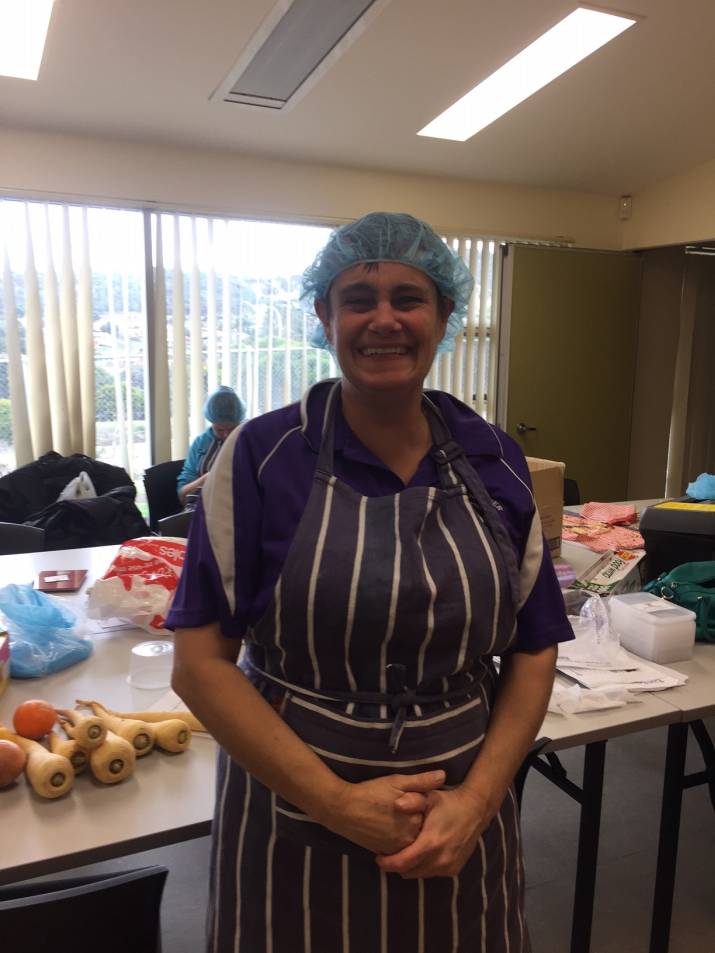
*Pic: Tanya, one of Waterbridge’s dedicated culinary volunteers
We need to grant our neighbourhood houses the status they deserve …
By most measures, Waterbridge, in the south of Tasmania at Gagebrook, is an extremely successful business.
They work to a familiar business model: raw materials come in, a talented team of people adds value through a variety of streams and processes, and the final products are sold to the customer. Following this model, Waterbridge has become extraordinarily popular and their customer base is growing.
Along the way they’ve developed a work culture that is about the best there is. People love working at Waterbridge. Most of them are volunteers. In today’s HR jargon you’d call Waterbridge an ’employer of choice’.
But the thing is, Waterbridge isn’t a business in the conventional sense. They’re just a small enterprise based in a neighbourhood house in a battling suburb. And to complicate things further, the products that this particular enterprise offers for sale are sold with the barest of profit margins, as a favour to their customers. By this measure alone, as a business, Waterbridge is barely hanging in there.
At its heart, Waterbridge is about feeding people. The engine room is the kitchen. When I visited, just as the lunch rush was coming to an end, eight or ten volunteers were tidying up, wiping benchtops and sweeping floors. Everyone was laughing about something or other, the banter flying around just as you’d expect in a room full of close buddies doing something they get a kick out of. Today they’d made a curry, spaghetti Bolognese, a zucchini slice, a couple of dozen jars of fruit chutney, and a few other bits and pieces I didn’t quite catch, but judging by the smells it was pretty good tucker.
Some of it was destined for immediate consumption by drop-in customers looking for a hot feed, some was being packaged into containers ready to be sold. The price they charge for one of these ready-to-eat meals? $3 a pop. A big, healthy, complete meal for less than the cost of a flat-white.
Later, up in the ‘pantry’ – Waterbridge’s shopfront, a converted demountable – I saw a big freezer full of these meals, along with a display of fruit and vegetables that would make an artisan grocer proud. Here they can sell 90 takeaway meals a day, and literally crates worth of their terrific fruit and veg. The stuff they grow at their own community gardens they sell for $1 a kilo.
Customers come from as far away as Oatlands to buy food from the pantry. Busloads of old folk rock up regularly too, as do childcare workers, buying for the kids in their care for the day because it’s cheaper and healthier than literally any other option. Community nurses too, and locals, young and old. Word of a good thing spreads fast.
For a time, one of Waterbridge’s pet projects was boxing up fresh fruit for schools in the area. The kids (and teachers) loved it. A crate of amazing produce would arrive, enabling kids whose eating habits weren’t among the best, and those who, for whatever reason, didn’t bring lunch to school that day, to eat something healthy.
The program was a raging success. One shipment a week became two, and each school would have happily taken three.
Then the funding ran out, and that particular venture had to cease.
‘The funding ran out’ seems to be a recurring theme at Waterbridge. They win a grant of some kind that keeps them afloat for a while longer, but when that money’s gone they’re back to bare bones, with every day a struggle to keep going.
In the world of business, you’d say, well, if you need continual propping up then you ain’t so crash hot. Why should we pour in more money to keep you afloat? Can’t you just run things a bit better, maybe focus a bit more on profit?
And that’s true, for the conventional use of the word ‘business’. A business should at least be self-sustaining, and if it is to grow it should be capable of doing so all by itself.
The difference between Waterbridge and a conventional business is worth exploring a little more thoughtfully.
A conventional business takes raw materials and resources and transforms them into saleable products, just like Waterbridge does. But for this kind of business to be sustainable it must show a healthy bottom line. To take that notion to its logical conclusion, the more money a business makes, the more successful it is. The drive is to scrimp and save wherever you can, with your eyes set firmly on that bottom line.
Economically speaking, this is where the ‘tragedy of the commons’ kicks in. In modern parlance it just means ‘every capitalist for himself’. Even a well-intentioned, ethical business is at the mercy of the tragedy of the commons: the temptation is there to cut costs, reduce staff numbers, scrimp on raw materials, increase markup, and find means to sell more stuff. As a business operator, my own personal interest becomes more important than the ‘common’ interest.
In the worst cases, the tragedy of the commons manifests itself as greed, corruption and immorality. If I dump my toxic waste in the river I can save money, and to hell with everyone else.
In this sense, mercifully, Waterbridge works in direct contravention of the tragedy of the commons. They have the interest of the commons primarily at heart, not the bottom line, and because of it they find themselves swimming hard upstream, against the conventional flow of business.
Our commercial grocer buys in fruit, vegetables, meat and dairy for as low a price as they can negotiate, and then on-sells the very same items at a marked-up price, perhaps applying a little value-add magic along the way. The prices for which their products sell are inextricably linked to the success of the business. You charge as much as you can get away with, and no less.
On the other hand, Waterbridge has a completely different set of products in its repertoire, despite, on the face of it, being just like the grocer.
Their ‘product’ isn’t a row of capsicums on a shelf. It’s much more personal than that.
It’s a burgeoning interest in cooking and food safety, in someone who hasn’t had a job for a while.
It’s the satisfaction that comes with having learned to cater for a group of 15 people, when twelve months ago you couldn’t boil an egg.
It’s learning about stock management and inventory. Ordering from suppliers. Customer service. Running a business.
The ‘product’ of the school fruit box initiative – the one the funding ran out for – wasn’t a nicely packaged crate of bananas and apples. It was kids who gained a new understanding that healthy food is normal, and tastes good too. I was told that up until the first fruit box arrived at his school, one particular kid had never seen a watermelon.
And, most importantly, Waterbridge’s product is the sense of wellbeing and self-worth one gets from taking part in a venture that has a gargantuan effect in a community that’s had more than its share of hard knocks.
Attendance at Waterbridge’s twice-weekly cooking programs is through the roof. The people who come along are not just learning to cook, they’re making new friends, building their social network the old-fashioned way. They’re finding new sources of support, whether that’s someone to help with babysitting, or a lift to town, or a shoulder to lean on. This too is the product, in the literal sense, of Waterbridge’s business.
In fact, at just about every turn of the trade, Waterbridge is value adding. It’s just that they’re adding to the community, not to their bottom line.
Ironically, there is actually a real monetary benefit to having a strong community commons, and it aligns with one of the biggest economic problems we face today: the relatively poor standard of health in our wider Tasmanian community. Indeed, preventative health – in both the physical and mental health spheres – is a highly-charged political discussion topic at the moment. Prevention is better than the cure, and Waterbridge is the ideal model to deliver on that premise.
Another success indicator of a business is staff morale. If you love your job, and the business behind it, you’ll keep coming to work. It’s a testament to Waterbridge that their staff keep turning up despite not being paid. Even those who were originally ‘coerced’ to be there – through a program such as Work for the Dole – are still there, though they met their contractual obligations long ago.
In fact, the only success indicator that Waterbridge doesn’t score well on is the bottom line. Unfortunately, that’s the metric that seems to count most. This is a terrible reflection on our system of accountancy at the community level. By any other measure, Waterbridge would be operating well and truly in the black.
The problem is that the small financial boost they need isn’t coming in, and what does trickle through is unpredictable. Waterbridge is often at the mercy of grants, for which they have to jump through hoops and write endless applications, lately with little success. The admin and paperwork all takes time that could be better spent. It’s as though they continually need to prove that they know what they’re doing, despite their impeccable track record, in order to qualify for another modest handout.
What’s the solution?
That’s easy. Recognise that neighbourhood enterprises like Waterbridge are not a drain on our society, they’re an asset. Communities do better when they have a healthy support hub. The small amount of money they need is returned a thousand fold in better health and wellbeing, and community resilience in general.
Waterbridge doesn’t need much. They need someone to help make deals with local food growers and suppliers, to guarantee a reliable supply chain. They need someone to help with delivering food to those in the community who can’t make it to the pantry. They need to re-establish their school food box program. The need a few reliable hands to cover for the volunteers when they’re called away or can’t make it in today. They need a bigger coolroom for the pantry.
And they need to no longer have to beg for handouts.
Lots of good stuff ‘just happens’ when you build a community hub like Waterbridge. It’s the kind of thing that develops organically, its feelers reaching further and further into the community, its network growing all the time. It’s the ultimate in grass-roots, bottom-up social organisation, and it offers a heck of a return on investment.
*Bruce Ransley is Healthy Food Access Coordinator at the Heart Foundation Tasmania.