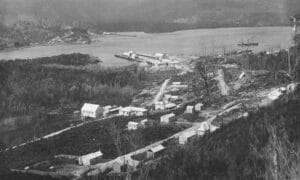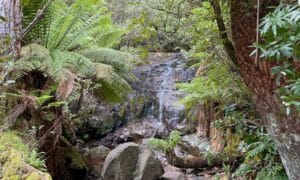

*Pic: Looking across the heavily forested and undulating route that Henry Hellyer traversed in 1829


Negotiating a horizontal forest maze en-route …
It has been claimed that the Tasmanian Aboriginals used a trade route from the Surrey Plains across the Tarkine wilderness to the coastline. But where exactly was this path, how often was it used, and was it maintained?
To date there is no evidence that it ever existed, though conversely there is no reason to think that it wouldn’t have.
The Pebble Track as it was known, was last documented on a 1923 mining map, but was this the route used by Aboriginal people or merely a trans-access track for prospectors?
Around 1800 to 1840 European explorers were encroaching deep into the Tarkine region and conflict with the Aboriginal custodians invariable occurred. By the middle of that century the Tarkiners were almost non-existent in the far west due to the resettlement endeavours of Augustus Robertson.
In the summer of 1827 explorers Jorgen Jorgenson and Clement Lorymer headed south along the northwest coastline then inland from near Sandy Cape around the Norfolk Range until they reached a point east of the Donaldson River on a prominent ridge known today as the Longback. There they were thwarted by bad weather, and with low supplies and difficult scrub confronting them they retreated.
In December 1828 Henry Hellyer took up the challenge and headed west in his goal to find arable country for future settlements. His first journey led him past the Surrey Plains and Waratah to the summit of Mt Cleveland where he discovered no suitable farming land, only horrendous wet scrub, and daunting views west over the expansive rainforest that revealed no coastline in sight.
Hellyer then returned in early 1829 to attempt a traverse to the coast. From Champion Plain west of Waratah he stayed on higher ground and descended to the Whyte River south of Luina through thick broken country to the northern end of the Meredith range. It was a long arduous struggle through the thickly wooded country within the Heazelwood Valley.
Hellyer noted in his journals about the gruelling scrub – “so deep indeed and so difficult to get through that with its gullies it occupied us 4 days and I cannot estimate it at more than 10 miles across in a right line”.
Having crossed the Heazelwood River, Hellyer ascended to Long Plain near where the Savage River township is now located. This was the first time it was relatively easy going, though short lived, as they soon plunged into the steep Savage River valley then up westward to Longback Ridge.
Here was their first sighting of the sea, though it was still many miles away. This was the most eastern point from where Jorgenson and Lorymer had explored from the coast just 2 years prior on the 20th March 1827
Hellyer then dropped into the steep ravine of the Donaldson River and continued west keeping south of the Norfolk Range en-route to the coastline. Hellyer never mentioned anything about recent fire activity across the landscape or any contact with Aboriginal people until he neared the Sandy Cape area.
There was obviously no signs of regular burning west of Waratah to the coastal plains as to keep the country clear for travel; in fact Hellyer described most of the country as hellish and very tiresome to make easy or rapid progress.
In 1864 some 35 years after the Hellyer expedition, Gordon Burgess cut a track from Waratah west to the coast along a similar route just slightly north of Hellyers’ nearer to the Luina area. The track remained virtually unused until James Sprent relocated the cut and blazed route from the west 10 years later, though he found it difficult to follow as most of the scrub sections had already overgrown.
Throughout the nineteenth century mineral exploration was prominent all across the Tarkine as the search for any rich ore bodies prevailed. By the late 1800s some notable ore deposits had already been discovered in places around Waratah, Savage River, Balfour and Corinna.
So where was the mythical Aboriginal track that led from the Surrey Plains to the West coast? The grand expanse of rainforest north of the Savage River road between Waratah and the Western Explorer road has not seen extensive fire for centuries so regular burning – albeit natural or cultural – had not provided an open route across the Tarkine for a seemingly long time.
The Pebble Track, as indicated on the mining map, was much further north from Burgess’s route, leading from Surrey Plains across the upper Arthur River and emerging somewhere in the plains west of the Donaldson River and south of Pyramid Hill.
This route essentially traversed the southern extent of the vast Savage/Donaldson River rainforest-clad wilderness. Illustrated as a straight line on the map, this meant that if a track existed it had been cut through the dense forest, or otherwise it was inaccurate and merely convoluted along a path of least resistance.
There was certainly no means of burning access through this damp complex and entangled country, which raises doubt about the Aboriginal Pebble path taking this route. The use of stone axes to tunnel through kilometres of dense horizontal and mixed scrub seems preposterous.
Nearly 200 years later.
My first expedition into the Tarkine’s rainforest expanse was in the mid 1980s when I walked (mostly crawled) into the upper Savage River and rafted down its magnificent emerald corridor. The entangled horizontal scrub was defiant of fast and easy travel, yet in an unpredictable nature there were occasionally open leads of magnificent cool-temperate rainforest superlative in its representation of Myrtle and Sassafras splendour.
I was soon to realise that a traverse across the Tarkine’s vast rainforest extent would be a dauntingly slow and unpredictable task. But the mystery of the unknown has always lured me, and the search for a feasible walking route ultimately became the challenge.
On route I located no formed track, only some blazes on trees that could have dated back to the great depression era, and some faint, heavily overgrown swathes in the east, which was bulldozing from about 60 years ago.
There are a few possibilities for an east-west traverse, though they would require continual burning or track cutting. The route I chose through the mature rainforest and western heathlands seemed the most pragmatic one.
As for the exact location of the Pebble Route – The mystery lingers on!
*Ted Mead has been exploring Tasmania’s wilderness areas extensively over the past 35 years. Ted claims that his east-west traverse through the Tarkine rainforest, unaided by a GPS, was an inspiring remote country challenge, which ultimately reinforced his commitment to campaign for the wild tracts of this remarkable country.