


Little Penguin dog kill
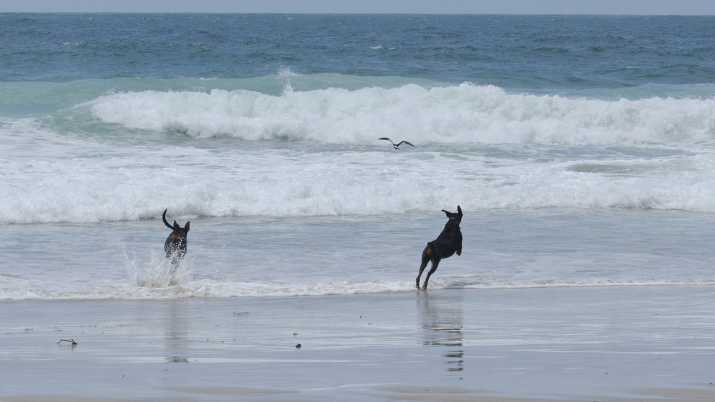
Dogs and a Pied Oystercatcher
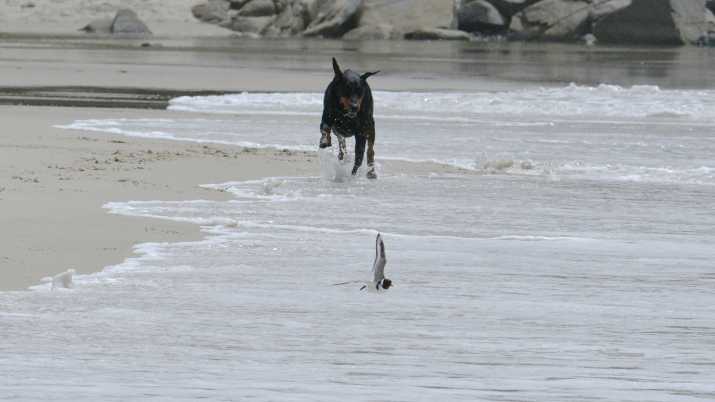
Dog chases Hooded Plover
Another observation of a Little Penguin apparently killed by a dog at Bicheno,
and a disturbing case of abuse of Tasmania’s threatened shorebirds by
roaming dogs starkly highlights the need for owners to restrain their animals
on beaches this summer.
A freshly-killed Little Penguin was observed on the Bicheno foreshore on 3
January during a BirdLife Tasmania survey. A number of deep bites to the
penguin’s head are consistent with a dog attack.
The penguin was found next to its burrow in a Council-declared Dog
Restricted Area where dogs are prohibited at all times during the Summer
months. The presence of penguins along the Bicheno foreshore is one
justification for the restriction on dogs during the penguins’ breeding season.
“Clearly someone was happy to see their dog roam in a prohibited area, with
no regard for the potential threat to nesting penguins”, Dr Woehler said.
“The penguin was located during a brief inspection of the area, and there may
well have been other penguins in the surrounding vegetation that we could
not survey” Dr Woehler noted with concern.
Just a week or so earlier, BirdLife Tasmania convenor Eric Woehler was
surveying beach-nesting shorebirds on Short Beach, at Chain of Lagoons on
the East Coast, when two out-of-control dogs began their chase.
Dr Woehler photographed one dog, first chasing a pair of nesting Hooded
Plovers up and down the beach, and then joined by a second animal, pushing
a Pied Oystercatcher out to sea.
“It was appalling to see how these birds were being treated by dogs that were
allowed to be completely out of control,” Dr Woehler said.
“These are iconic Tasmanian shorebirds. They are in the middle of their
breeding seasons, when they can least afford to suffer this kind of treatment.
Their eggs and chicks are threatened by this sort of behaviour.”
Tasmania is the national stronghold of Hooded Plovers and Pied
Oystercatchers, which nest on the state’s sandy beaches, Dr Woehler said.
Pressed near to local extinction in some mainland states, the eastern
Australian sub-species of the hooded plover is one of 20 birds that the
Federal Government has prioritised for recovery efforts
( http://www.environment.gov.au/cgibin/
sprat/public/publicspecies.pl?taxon_id=66726 )
It’s also the poster-bird for BirdLife Australia’s campaign to protect beachnesting
birds ( http://birdlife.org.au/projects/beach-nesting-birds )
“As Tasmanians head to the beach this summer, many with their dogs, these
unfortunate observations really underscores the need to obey dog
management zones on our foreshores,” he said.
“Stay off ‘no dog’ beaches, particularly in national parks where they are
completely prohibited, and always keep them under real control – even on offleash
beaches.”
BirdLife Tasmania encourages Councils to enforce their dog regulations in
coastal areas this summer.
Dr Woehler also encouraged beach-goers to document any cases of dogs
chasing shorebirds that they see, and to report any other instances of
penguin attacks.
“The phone camera can be a great tool to help authorities track down dogs
allowed to roam unchecked,” he said.
“There is plenty of room for people, and their dogs, to have fun at the beach
in Tasmania without terrorising our penguins and shorebirds.”
BirdLife Tasmania convenor Eric Woehler










