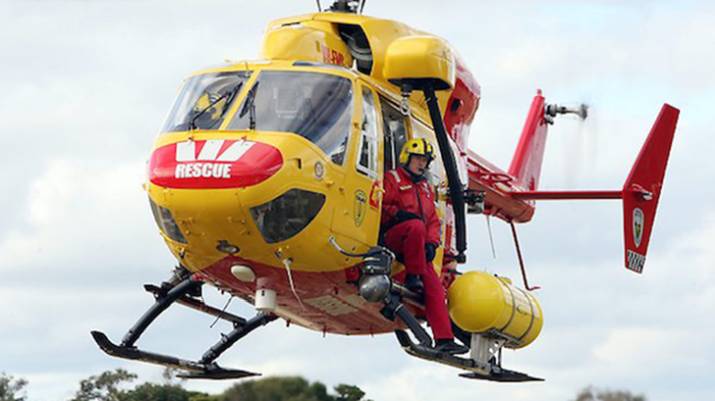

The Silly Season is upon us, and most summers from around Christmas through into the new year the Tasmanian Search and Rescue helicopter is seemingly flying non-stop to rescue bushwalkers, boaters and-off roaders from emergency situations.
It appears that each recreational season there is an increase in rescues, even though the levels of visitation into remote areas is on the decrease.
Accidents do and will always occur, that is the risk of being an adventurer. But are we becoming too dependent on the convenience of receiving rescue when the scenario is not really all that distressing?
Whilst there are many realistic dire rescue scenarios, it also appears that the use of an EPIRB is fast becoming a convenience call for a quick escape by the ‘Big Yellow & Red Taxi’ This poses the questions – Are we becoming complacent? Does having an EPIRB make it more likely to take risks, or more likely to set out without the necessary experience?
When the EPIRB was introduced to our outdoor lifestyles it was designed for use only in Life Threatening Situations. Of course there are always going to be situations that are not life threatening in the immediate moment, though these predicaments may lead to serious scenarios in a short space of time.
This is the grey area for EPIRB rescue, which has always been easier to analyse in retrospect. However most people on land should be conscious that rescue for inclement weather, flooded rivers or low food supplies is just a patience game and part of many unplanned possibilities that can arise through Tasmania’s extreme conditions.
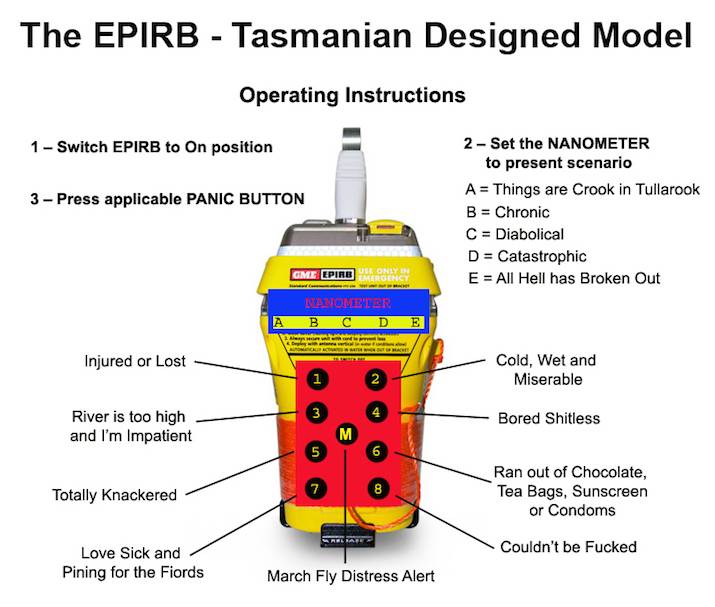
Realistic discretion is required – Just don’t pull the pin because things are looking crook in Tullarook!!!
EPIRB activation is limited to a signal of help only – no other form of communication is available.
A more pragmatic approach is for bushwalkers to carry a satellite text messaging and tracking device such as the Delorme – www.alwaysinreach.com.au. These devices allow you to contact friends, associates or rescue authorities to inform what your scenario and location is.
For an example – an incident may have happened and assistance or rescue is required but is not life threatening. This would assist authorities in their decision if it requires a rapid response rescue. Such a device may also be life saving in the case of a crisis where immediate medical advice is required to assist someone. Time maybe critical, so relying on a paramedic to reach you from the result of an EPIRB distress signal may be the difference between life and death scenario.
What is an EPIRB and how does it work
The EPIRB is an Emergency Position Indicator Radio Beacon, which sends a high frequency signal to rescue authorities.
Most serious outdoor adventurers now carry a 400Mhz (marine) or 406Mhz (land) beacon that indicates your general position to a few kilometres. Some models even come with a GPS indicator to enable your exact positioning to within 50 metres. Other models have a secondary 121.5Mhz signal that is used as a homing device.
When the EPIRB is activated a coded message is sent on the distress signal via satellite to the earth stations, which then forwards it onto the nearest coordination centre. This centre then immediately notifies the rescue authorities such as the Tasmanian Polices Search and Rescue unit.
The Tasmanian Police SAR unit is a highly trained and professional outfit. The rescue helicopter, which is always available for quick response, is totally geared-up for all scenarios, and is even fitted out with a State of the Art infrared night vision system.
Without doubt – if you find yourself in a dire predicament then Tasmania is one of the most reassuring places to be.
*Ted Mead began carrying a compact EPIRB into the bush when they became available decades ago, and fortunately after 5000 nights in the wilds has never had to activate it. Ted believes it is an obligation to oneself and others carry some form of emergency communication device, and that the use of them is responsible.