If you are concerned about global renewable energy being hamstrung by the new wave of conservative politics, then forget about the American election outcome as Asia has foreseen the future, and it all looks inspiring in that part of the world.
Recently a collaboration of Asian countries have shown that the world’s energy issues are resolvable through renewables, and have laid plans to construct a Super-Grid that will facilitate energy needs to a united band of forward thinking nations!
Asia has seen the light at the end of the tunnel, whilst conservative politicians in Australia and the US haven’t even seen the tunnel yet. As a result nations like us will inevitably be trailing in the wake of the world’s leading countries that are stimulating their economy, whilst concurrently transitioning out of the fossil fuel industry.
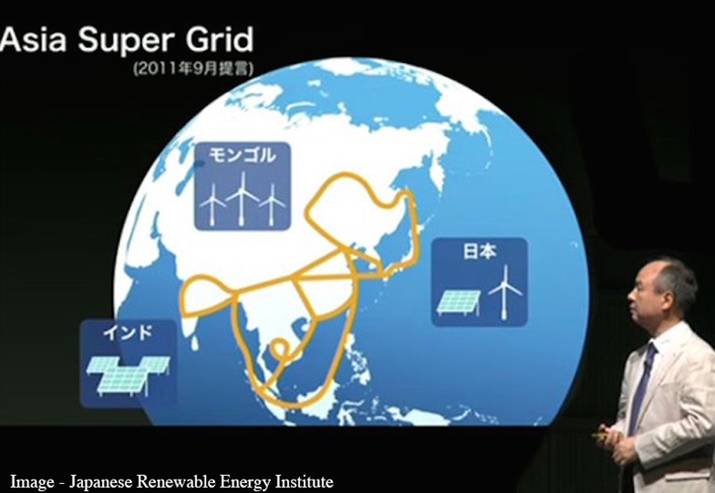
The Super-Grid idea came from Masayoshi Son, the founder of the Japanese Renewable Energy Institute, who recognised that a solution to Asia’s present reliance on coal and nuclear energy was urgently needed after the Fukushima nuclear fallout in 2011.
His idea was to harness the massive amount of available wind and solar possibilities that could come from the Gobi Desert region in China, which is said to be equivalent to thousands of nuclear reactors.
Entrepreneurs from Russia, China, Japan and South Korea met in September in Tokyo to sign a Memorandum of Understanding that seeks to create the Asian Super-Grid. The grid will consist of wind and solar technologies, and is designed to distribute clean energy throughout the world.
The concept is dependent on development of an ultra-high voltage grid operating at over 1,000 kilovolts AC across thousands of kilometers. It envisions interconnecting grids across regions, nations, and even continents with a capacity of over 10 gigawatts.
This process has seen the establishment of the nonprofit Global Energy Interconnection Development and Cooperation Organization in Beijing – GEIDCO, which is led by Liu Zhenya, former chairman of China’s State Grid. Members include the four Asia Super- Grid signatories, as well as utilities, universities, and equipment manufacturers from 14 countries.
The project is underway and GEIDCO anticipates other concepts like this will develop everywhere across the world as the anticipated price efficiency of solar will seemingly outweigh fossil fuel base-load energy costs by 2025.
Perhaps this new Asian Super Grid will not only be a technological example, but a political example that nations can unite in peace and for the common good of the planet. The political dispute between China and Japan is a classic example to how this project is being seen as a means to transform a new era of peace and prosperity throughout the Eastern hemisphere of our world.
An alternative Super-grid within Australia is easily within our grasp as we are one of the most suitable countries in the world for renewable energy. What we lack here is political momentum, because our puppet-strung politicians will never sever themselves from their close association to the current energy and resource extractive industry magnates.
Its up to the Australian private business sector to take the initiative, and that move, due to the projected long-term economic investments of renewables, is already in transit. One compelling example of this is that the former CEO of ENGIE (now doomed Hazelwood power station in VIC) Tony Concannon has already made the journey from coal to solar with an application for development approval of a 300MW single axis tracking solar PV power plant – The Bungala Solar Project – Port Augusta.
And so the revolution has begun!
*Ted Mead has been an advocate and user of photo-voltaics for over 30 years. Whilst Ted believes that renewable energy micro-grids are the best option for the planet’s environment, he acknowledges that Super-grid systems will assist many countries that don’t have the resources or land space to be self sufficient in alternative power generation.