

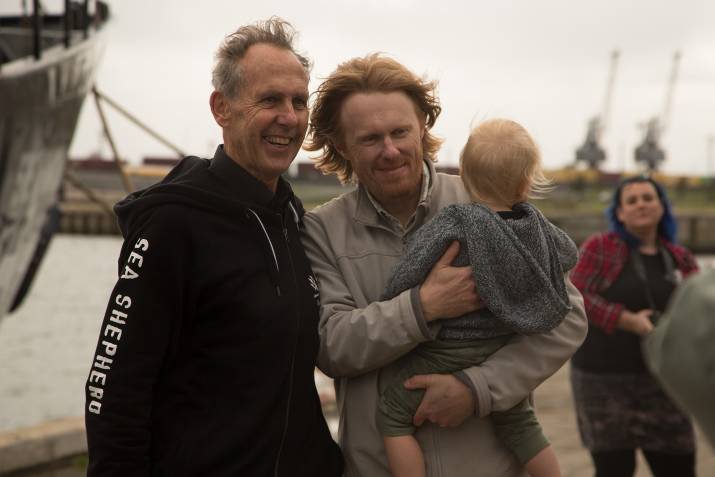
Australian Environmentalist of the Year Peter Owen with his son and Bob Brown after touring the Great Australian Bight on Sea Shepherd’s MY Steve Irwin. Photo: Tim Watters.
… says Australian Environmentalist of the Year Peter Owen
• Great Barrier Reef & Great Australian Bight threatened by fossil fuels and climate change
• The expansion of the fossil fuel industry must stop immediately
• We have enough fossil fuel reserves to take us past 2 oC of global warming
The 2016 Australian Environmentalist of the Year, Peter Owen, says the greatest threat to nature is the fossil fuel industry and climate change on receiving the award in Hobart this morning.
“Australia’s greatest natural assets, including the Great Barrier Reef and the Great Australian Bight, are threatened by fossil fuels and the climate change they cause,” said Mr Owen, the Wilderness Society South Australia Director who helped protect vast areas of the Great Australian Bight that are now threatened by BP’s plans to drill in its pristine waters.
“When is the fossil fuel industry going to realise we must act on climate change? We have more than enough coal, gas and oil reserves to burn that will take us past 2 degrees Centigrade of warming, let alone the 1.5 oC target the Paris climate agreement set out to achieve.
“We have a responsibility to provide a liveable climate for our children into the future. I feel this stronger than ever after having children recently.
“The expansion of the fossil fuel industry must stop immediately, but the industry continues to try to open up new operations such as Queensland’s Carmichael coal mine, which threatens the Great Barrier Reef, and push into pristine natural environments, such as BP’s plans to drill for oil in the Great Australian Bight.
“In the past month I have had the great opportunity of visiting both the Great Australian Bight and the Great Barrier Reef, travelling through the Bight with Sea Shepherd then realising a long-held dream to visit the reef with my father.
“However, the dying coral of the Great Barrier Reef is truly shocking and the last thing I would want to see is the Great Australian Bight suffer similar fate like the devastation of an oil spill.
“Australian governments must do more to act on climate change, starting with stopping the expansion of the fossil fuel industry immediately, including suspending oil and gas exploration permits in the Great Australian Bight.
“BP’s own oil spill modelling shows an uncontrolled well blowout would be guaranteed to impact South Australia and could reach as far as Western Australia, Tasmania, Victoria and NSW.*
“A spill is now a real threat as bolts are failing on subsea oil drilling safety equipment. The US offshore oil and gas regulator, the Bureau of Safety and Environmental Enforcement, says subsea bolt failures could cause a repeat of BP’s Gulf of Mexico disaster.
“BP was responsible for the world’s biggest oil spill, the Deepwater Horizon tragedy in 2010, when 11 oil rig workers were killed and 800 million litres of oil spewed into the Gulf of Mexico for 87 days, devastating the waters, fisheries, marine life, coastal communities and livelihoods.
”The spill and cleanup killed millions of fish and seabirds, 800,000 coastal birds and an estimated 75,000 dolphins and whales.
“The Bight’s pristine waters are home to 36 species of whales and dolphins, including the world’s most important southern right whale nursery, as well as many humpback, sperm, blue and beak whales. The Bight also supports sea lions, seals, great white sharks, orcas, giant cuttlefish, some of Australia’s most important fisheries and migratory seabirds such as such as the albatross and the white-bellied sea eagle that Australia has international obligations to protect.”
Peter Owen has been the director of the Wilderness Society South Australia for 11 years after having worked as a lawyer and an ecologist.
Mr Owen has been instrumental in the protection of vast areas of land and seascape including the Nullarbor Plain, South Australia’s offshore islands, the Arkaroola Mountains, the Mawson Plateau and the declaration of the state’s 19 marine parks – Australia’s first representative marine park network outside of the Great Barrier Reef.
In 2013 he started work on the campaign to stop BP and other big oil companies pushing to expand the fossil fuel industry into the Great Australian Bight, putting at risk one of the planet’s most significant marine wilderness areas and a liveable climate.
In January 2016 the Great Australian Bight Alliance was launched to create a platform for people, groups and organisations to stand together to stop oil exploration in the Bight. The alliance is growing quickly and now includes the Wilderness Society, Sea Shepherd, the Bob Brown Foundation, representative of the Mirning Traditional Owners of the Great Australian Bight and many others.
* The NSW coast has a 41 per cent chance of getting hit by a spill if it occurred in winter*, while Apollo Bay and Wilsons Promontory in Victoria would have a 91 per cent chance of being hit by a spill occurring in April-May. BP’s spill modelling shows:
• 97% chance of spill hitting Adelaide in April-May, 86% chance in winter, 58% in summer
• 100% chance of hitting Port Lincoln in April-May, 98% chance in winter, 91% in summer
• 100% chance of hitting Kangaroo Island in April-May, 95% chance in summer, 94% winter
• 97% of chance whales getting hit in Great Australian Bight Marine National Park in winter
• Apollo Bay and Wilsons Promontory (Vic) have a 91% chance of being hit by spill in April-May
• NSW coast has 41% chance of being impacted in winter
• Esperance (WA) has 64% chance of being hit in winter
• Tasmania has a 66% chance of being hit in April-May
* The percentage chance of moderate (sub-lethal) impacts on the Australian coast are listed in the table from BP’s oil spill modelling summary (attached). BP defined summer as October to March, winter as June-September and called April-May the transitional period.
Vica Bayley Tasmanian Campaign Manager The Wilderness Society (Tasmania) Inc.










