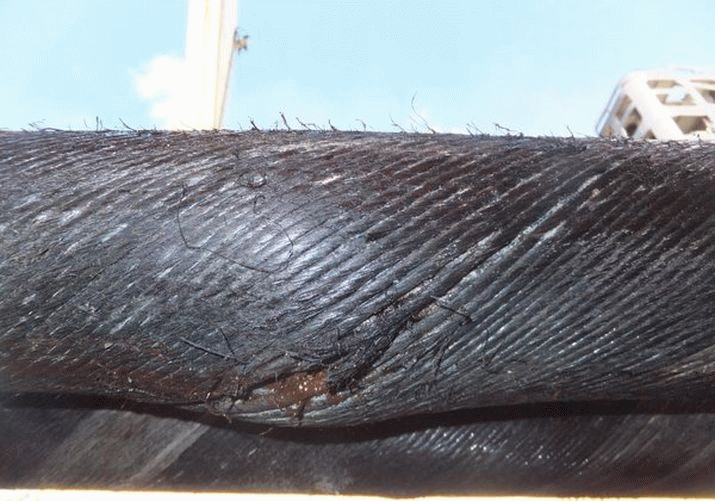
*Pic: Source of the first drama: the damaged Basslink cable …
The Tasmanian Minerals and Energy Council (TMEC), in their submission, questions the 33% rise in electricity prices since the Energy Strategy was released in May 2015; and has set out a comprehensive list of questions in regard to Hydro Tasmania’s and Tas Network’s cash flows, revenues, costs and debts, as well as energy security.
Download and read the submission … HERE
The TMEC questions are astounding. In effect, they list the numerous gaps in Tasmania’s Energy Strategy and effectively demonstrate the poor capacity for strategic planning by the current Tasmanian Government.
In summary, TMEC states:
“The industries and employers who are represented under the Tasmanian Minerals and Energy Council are highly dependent upon the performance of the State’s energy businesses. As such, the absence of a clear set of strategic plans which moves Tasmania from the current situation of high debt and high charges to one of sustainable debt and internationally competitive delivered contestable loads remains a priority of TMEC as it should be a priority for the State Government.”
Perhaps #24 comment in BASSLINK: Sunny Groom’s holiday … was too hopeful (and was ‘dreamin’) …
I’m looking forward to this. Hopefully the full story will be revealed and subsequent changes made to future-proof the Tasmanian energy supply and maximise renewable energy. (Or am I just dreamin’?).
ABC news online outlines what’s expected in the inquiry which begins tomorrow (June 19):
“Tasmania’s three state-owned energy businesses will front a parliamentary inquiry on Monday examining the causes and responses to the energy crisis.
Hydro Tasmania, TasNetworks and Aurora Energy have been called to give evidence at the first hearing of the powerful Public Accounts Committee. …
Hydro senior executives are expected to be grilled about their strategy to export heavily during the two years the carbon tax was in place to maximise profits, as well as the cost of the crisis.
In its submission to the inquiry, Hydro insisted it was in a “sound financial position” with net debt of $826 million at the end of March, less than the figure for the previous five financial years.
“While the reduction in generation to rebuild storages will, in isolation, have a downwards influence on the valuation of the assets, the business has a strong net asset position,” the submission stated. …
The inquiry will also investigate the decision-making process that led to the major turbine of the Tamar Valley Power Station being put up for sale last year, rather than fired up during dry conditions last year.
In its submission, Hydro Tasmania revealed it did extensive modelling that concluded that the state’s electricity demand could be met in extreme scenarios of a 12-month Basslink outage combined with a drought.
Hydro estimated the closure and sale of the combined cycle generation turbine would reduce fixed costs by $7.5 million a year.
The gas-fired power station was eventually fired up in January, after Basslink failed in December, and the Government has now withdrawn approval to sell the turbine.”
http://www.abc.net.au/news/2016-06-19/parliamentary-inquiry-into-tasmania27s-energy-crisis-to-begin/7522626
Meanwhile here are extracts from Hydro Tasmania’s latest statement:
“Financial impact on Hydro Tasmania of response to energy supply challenge
20 June 2016
Hydro Tasmania today outlined the financial impact on the business of record low inflows from September 2015 to April 2016, combined with the six-month Basslink outage, in evidence to the Public Accounts Committee of the Tasmanian Parliament.
Chairman Grant Every-Burns told today’s hearing most of the impact of responding to the energy supply challenge would occur in the current financial year, with some cost carried over to 2016/17.
“The period in question was very dry by any reckoning, containing a number of sequences each representing the driest in 100 years,” Mr Every-Burns said.
“Within that same period the Basslink cable failed. The consequences of this failure were magnified by a repair time amounting to 176 days against our prior expectation of 60 days.
“As a result, this year’s profit will be eliminated and a loss of $90 million is expected (loss before tax and fair-value adjustments. Non-audited accounts). In the year ahead Hydro Tasmania intends to build storages and target a break-even or small positive financial result for 2016/17.
“In my 45 years’ experience in the power industry as a power engineer, senior executive and board Director I have rarely seen a situation more difficult than that recently faced by Tasmania and I have never seen a response so effectively executed,” he said.
…
Prior to the heavy rainfalls in May and early June, Hydro Tasmania calculated that the extended dry would result in a shortfall of approximately 2025 gigawatt hours (GWh) compared to normal yield.
Replacement generation comprised 900 GWh of Basslink imports, 745 GWh of gas generation, 325 GWh of load reduction and 55 GWh of diesel generation.
Hydro Tasmania estimates that the net cost of responding to the energy supply challenge is between $140 million and $180 million, including an offsetting reduction in Basslink costs. This takes into account that Basslink has been back in service since 13 June, and assumes a return to normal inflows going forward. The net cost includes:
• Gas-fired generation – approximately $47 million.
• Diesel generation – approximately $64 million.
• Net reduction in the value of LGCs produced – approximately $15 million.
The remainder is related to the cost of imported energy over Basslink, a variety of contractual arrangements, and the cost of managing the situation.
The full impact of the Basslink outage is not yet known, as the cause of the outage, and its contractual impact, has not yet been determined.
…
As at 31 May 2016, Hydro Tasmania’s net debt stood at $849.6 million. Despite the challenges it has faced, Hydro Tasmania’s debt is forecast to peak at approximately $940 million in late 2016. This is well within Hydro Tasmania’s current borrowing limit – supported by the letter of comfort from the Treasurer to TASCORP – of $1085 million.”
http://www.hydro.com.au/about-us/news/2016-06/financial-impact-hydro-tasmania-response-energy-supply-challenge
• All of the submissions to the inquiry are found on this page, but you need to scroll down to see the list: Inquiry into the financial position and performance of Government owned energy entities:
http://www.parliament.tas.gov.au/ctee/Joint/pacc.htm
*Lindsay Tuffin has been a journo since 1969, mainly in Tassie … This article was put together with the help of Lyndall Rowley …
• Gordon Bradbury in Comments: Wow! The TMEC submission pulls no punches. Four pages of very succinct text that rips the current State Government to shreds! And not a word from mainstream media … Very entertaining and enlightening reading.
• Luigi in Comments: Hydro Chairman Grant Every-Burns: “In my 45 years’ experience in the power industry as a power engineer, senior executive and board Director I have rarely seen a situation more difficult than that recently faced by Tasmania and I have never seen a response so effectively executed,” he said. What he neglects to mention is that the crisis was caused by the Hydro selling our water energy in the teeth of an exceptional dry period throughout 2015. With water energy levels at 25% in December, they were still exporting when BassLink fried. And they’re exporting again now with water energy levels at 27%. And running the Gordon Power Station to do it when its level is under 15%. Sack the lot of them.
• Lyndall Rowley in Comments: There seems to be a fairly uniform pattern of expert negative assessment flowing towards the government in its parliamentary inquiry. I was shocked enough to read the Tasmanian Energy and Minerals Council submission which clearly criticises the Tasmanian Government’s Energy Strategy and management. But the submission from the Launceston Flood Authority provides an equally eye-opening account of poor management from a slightly different perspective. It’s a passionate and convincing but damning plea for the return of full flows to the South Esk River and Cataract Gorge through the closure of the Trevallyn Power Station …
• Mark Temby in Comments: … I hope I’m misinterpreting the thrust of this article but it appears someone didn’t do their job properly in 2015 and the buck stops with the Minister just like Gutwein with councils or Hidding with road safety. …
• Lyndall Rowley in Comments: I’ve just finished reading the entire ‘Mervin C Reed FAICD FChFP AAFA JP, Chartered Financial Adviser’, submission to the parliamentary accounts committee re government owned energy entities. Wow, what an entertaining read! Trouble is, if taken as gospel, it’s a damning (even frightening) indictment of the management of Tasmania’s energy system by the three ‘energy entities’. There are too many gems to repeat here. But just to give you a sample of the tone and content …
• Jack J in Comments: #20 Lyndall. I can only second William’s recommendation. The amount of well digested detail and excellent analysis you have provided for the fire management debate was impressive enough. This post is on par. First rate. We’ve got the famous 4F’s in Tasmania. Fire, Foxes, Forests and Flood. Add to that this damning analysis of how our water and energy have been mismanaged and can one ignore what seems to be the bleeding obvious any longer? Because we seem to have a systemic failure of governance in Tasmania. Reform is needed at a fundamental level concerning how we do business. I don’t believe that party politics are the answer, in fact, it may well be the problem. Nothing really changes concerning the QUALITY of the outcome irrespective of what party has power and what luminary sits on a board of directors.