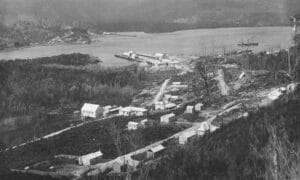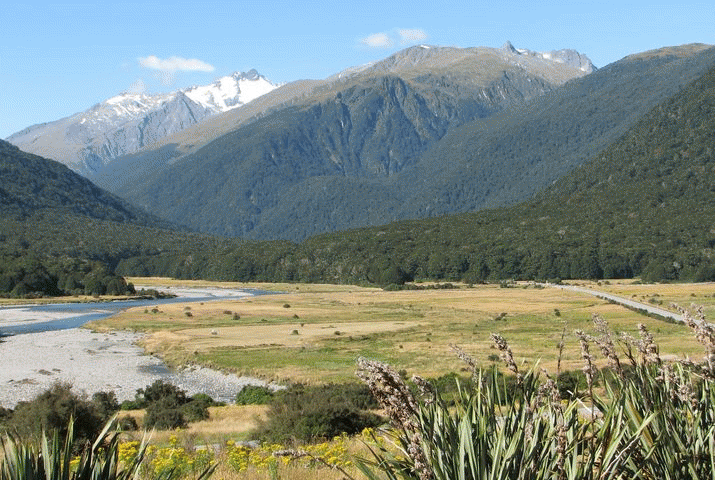
Photo of Makarora
Penelope Marshall who lives in southern Tasmania is deeply concerned about 1080 poison, used in Tasmania to kill foxes ( TT HERE ) and to guard forestry [‘There’s too many of them (‘pests’): John Gay]. But in New Zealand its use is massive … blanket-coverage of NZ’s wild areas in much greater strength and quantity. Carol Sawyer lives in Wanaka NZ (bio below). Here is her story …
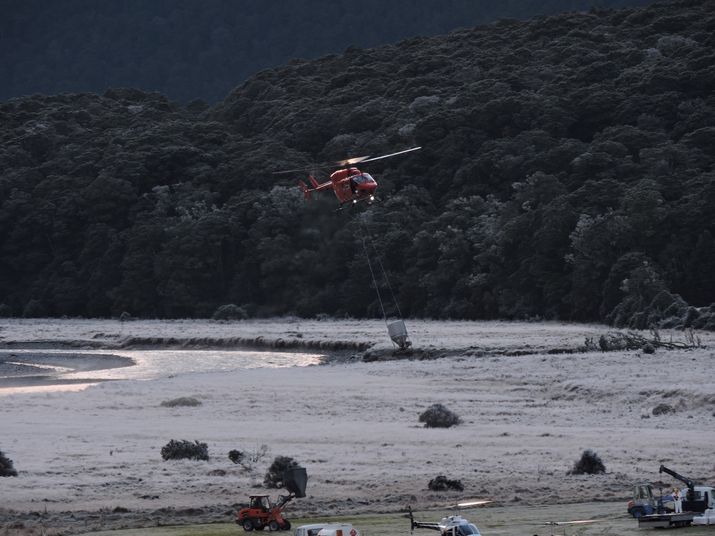
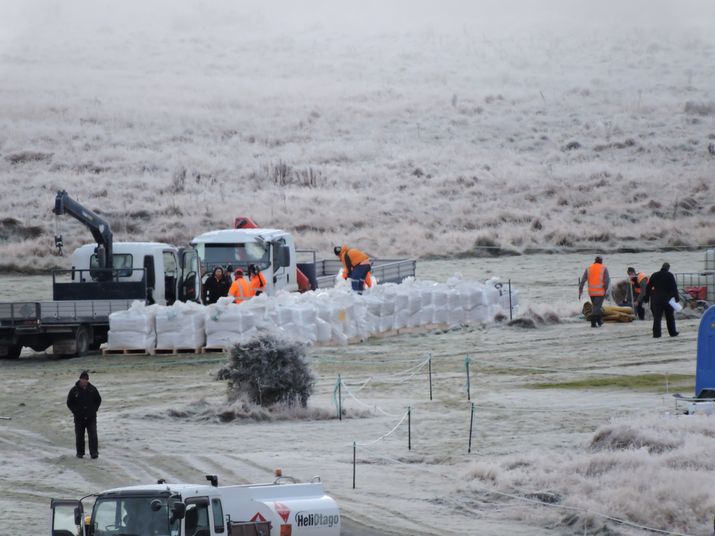
*Pics: A sunny view of the drop zone in summer, and then the frosty dawn of the May pre-feed drop. Note the proximity to SH 6 and the Makarora River – the mown patch is the loading zone! All pics: Carol Sawyer
The aborted 1080 poison drop at Makarora, at the head of Lake Wanaka, has to be one of the more expensive cock-ups for the Dept of Conservation in 2015.
As part of its Battle for the Birds programme, 33,000 ha in the Makarora area ( Cameron Valley, Young-Blue Valleys, Makarora Valley, Siberia Valley, Wilkin Valley), were scheduled to have 33 tonnes of pre-feed cereal baits and 66 tonnes of 1080 poison baits showered on them from the sky at the first weather opportunity after November 1, 2014.
This 100 tonnes of prefeed and poison baits ( 33 tonnes of prefeed and 66 tonnes of poison ) had arrived in the Wanaka region from the government-owned factory in Whanganui, North Island, in early Spring, 2014, ( along with the prefeed and poison designated for the Matukituki Valley, Wanaka, which was actually dropped on December 2, 2014 ). I am told it was stored nearby at a cost of $4000 per month.
This poison and prefeed has a shelf life of three months maximum. NZ’s “Aerial 1080 Control Guidelines” booklet, put out by “National Pest Control Agencies”, list ‘Standard Operating Procedures for Regional Government’.
The ones that apply here state that “The prefeed shall be applied 2 – 4 weeks prior to the toxic bait application. Prefeed effect is known to last at least 6 – 8 weeks ( and probably longer )”.
As well as this, it is stated that “the following standards should be met”, which include “Bait stored for minimal time and not longer than three months”. Cereal goes rancid over time, among other things.
Otago Daily Times, 3 July, 2015 – Wanaka conservation manager Chris Sydney was reported as saying : “The palatability and toxicity of the pellets starts to ‘measurably decline’ three months after manufacture”
By January, 2015, the operation at Makarora had still not happened.
In January 2015 DoC Wanaka spokeswoman, Annette Grieve, announced ( The News, January 15 ) that the prefeed and poison drops would start “after January 26″ over 33,000 ha.
By February, 2015, the drop area had been reduced to 23,000 ha. I understand this was to avoid the areas above the bushline, as a result of losses of Rock Wren in the 1080 poison operation in Kahurangi National Park, October 2014. In an updated Federated Farmers/ Forest and Bird website on 1080, it is stated : “With no clear picture to why the rock wren are missing, DOC has excluded alpine zones with rock wren populations from future 1080 drops until they know more.” ( 3 radio-tagged Kea died in that 1080 drop, as well ).
Finally, at dawn on 20 February, 2015, 60 staff were in place at Makarora, brought from all around the South Island. 23 tonnes of pre-feed cereal baits ( 1 kg per ha ) had been unloaded beside the Makarora River at Cameron Flat. However, also at dawn Helicopters Otago cancelled the drop because the flight pattern was unsafe.
Who exactly is to blame for this ? Helicopters Otago presumably design their own flight charts ! However it may not be that simple. I am informed that DoC Wanaka were changing the flight areas constantly with regard to roads and waterways, etc. right up to days before the drop.
So, on this day, Helicopters Otago pulled the pin and everybody packed up and went home and the 23 tonnes of prefeed was loaded back onto the trucks and was seen to head back in the Wanaka direction around noon.
The helicopters did not return again to Makarora until the end of May, 2015 !
…
On May 27, 2015, starting at first light in a very frosty dawn, 23 tonnes of prefeed cereal baits were dropped on the Makarora area.
Winter comes early in these mountain valleys. It was almost too late to do the prefeed drop, so of course it became too late to do the 1080 poison drop. The snow had arrived.
DoC Wanaka’s Chris Sydney said at the time that the operation would be rescheduled for Spring or early Summer, later in 2015, and that the prefeed drop would not have to be repeated because its effects “will last sufficiently until Spring” ( Otago Daily Times, 19 February, 2016 ). The prefeed and poison baits would be over a year old by then, and nine months past their use-by date !
DoC Wanaka spokeswoman, Annette Grieve, speaking of Makarora, said “rodent populations are likely to have crashed naturally through winter” so the aerial 1080 operation would be targeting primarily possums at Makarora next Spring.
( Otago Daily Times, 2 July, 2015 )
The Makarora poisoning was meant to be part of the “Battle for the Birds” operation targeting rats and mice – not possums ! And if the rats “crashed naturally through winter” why was a 1080 poison drop necessary in the first place?
Anyway, Spring 2015 came and went.
Summer 2015-16 came and went.
Autumn, 2016 arrived and the DoC pesticide summary for March to June, 2016 did not show any proposed prefeed or poison drops at Makarora. “The Otago Daily Times was unable to obtain comment from DoC” on the reason the Makarora operation was not included in the 2016 pesticide summary. ( ODT 19 February, 2016)
As at May, 2016, the DoC poisoners have not returned. It is now over a year and six months since the drops were scheduled and the poison pellets arrived in the area.
What did all this actually cost ? DoC Wanaka admits to a total wasted cost of $182,795. But of course it is a lot worse than this, because it wasn’t just a wasted cost; it was money spent on feeding RATS !
And it must have been a LOT more than $182,795 ( detailed down to the last $5 ?! ) I spent a lot of time trying to work out the actual cost, transport ( truck and ferry ), storage, staff involved in both operations, six helicopters, security , wages and accommodation for up to 60 people on both occasions, signage, resource consents, planning time, loaders, etc. The figures are obviously an estimate, DoC shrouding itself in secrecy, but I enlisted the help of many people, including everyone from truckdrivers to long-time anti-1080 campaigners with information files full to bursting.
And the cost seemed to me to be closer to $1 million.
And…. where did the 66 tonnes of hugely past its use-by date 1080 poison scheduled for Makarora go?
Does the fault lie solely with the Department of Conservation or are Helicopters Otago to some extent liable ?
Where is the accountability in all of this ?
$1 million spent to fatten rat tummies for the winter and a large amount of very nasty poison contained in 66 tonnes of unuseable cereal baits presumably buried somewhere and leaching into the ground poses some questions doesn’t it ?
…
Estimate of expenditure of taxpayer money on proposed 1080 poison drop at Makarora, ( the last drop of DoC’s ‘Battle for the Birds’ programme ) :
Two attempts at dropping prefeed baits at Makarora. Poison drop not now happening so poison past its use-by date – Apparently the baits can only be stored for up to six months in cool, dry conditions ( Henderson et al, 1998 ) :
1) First, unsuccessful attempt to drop cereal prefeed baits, March 20, 2015. Baits delivered and unloaded. Approx 40 DoC staff, plus extras. Accommodation overnight. Some staff flown to the huts the day before. Drop aborted. Prefeed loaded up again and transported in the direction of Wanaka – then where ?
2) Second, successful attempt, May 27, 2015. This time, 23 tonnes of prefeed, six helicopters, 43 DoC staff, 15 sundry staff. Accommodation for at least one night. Some DoC workers choppered to huts the day before.
Total cost of helicopter hire – based on figures per hour of helicopter time provided by the Animal Health Board for the Hokonui 1080 drop, 2004, and allowing for inflation = $13 per ha x 23,000 ha. Allow eight hours for prefeed drop plus helihire the previous day for ferrying DoC workers to huts. $299,000 + $20,000 = $319,000
Cost of wages at average $200 per day, x 2 days, for 43 DoC workers and 16 sundry workers = $24,000
Cost of accommodation and food x 3 days for DoC staff brought in from around the country, plus 16 others, x 2 = $30,000
Cereal prefeed baits :
( Estimated using Hokonui 1080 drop (2004) figures plus inflation ) @ $2 per kg. Original amount brought in and paid for was 33,000 kgs, although only 23,000 kgs dropped eventually = $66,000
Cost of truck transport ( 2 trucks ) @ $ 15 per km, from Whanganui to Makarora return, ( 1100 kms ) = $66,000
Cost of returning prefeed to storage after aborted drop, unloading, reloading, and bringing back again = $3,500
Truckies wages, accomm., and food, over 4 days x 2 = $3,000
Cost of two trucks on ferry, going from Haast empty, and coming back full = $2,852
Cost of storage for at least one year at $4,000 per month = $48,000
Signage ?
Admin ( resource consent, flight paths, typing, etc. ) ?
Advertising ?
2 x Front-end loaders @ $120 per hour x 4 ( loading and unloading twice ) = $3,840
1080 Poison baits :
Cost of bringing 4 truckloads of 66,000 kgs of 1080 poison baits from Whanganui to Makarora = $112,000
Cost of 4 trucks on ferry, going empty and returning full = $5,700
Truckies ‘wages, food and accommodation, over 4 days, x 4 = $6,000
Cost of 66,000 kgs of poison pellets ( prefeed is $2 per kg so I have estimated poison at $3 per kg, but it is probably more ) = $198,000
Cost of disposal of 1080 poison pellets, including transport to unknown disposal site = ?
TOTAL COST OF RAT FEAST = $887,892 plus unknowns as listed, must bring the cost to at least $1 million of taxpayers’ money wasted by the supposedly cash-strapped Dept of Conservation. Well done DoC Wanaka !
*Carol Sawyer lives in the little lakeside town of Wanaka in the South Island of New Zealand. She has a longstanding love of birds and wildlife, and has been campaigning against New Zealand’s 1080 poisoning regime since 2014, when the Dept of Conservation announced they were going to drop 1080 poison on the beautiful Matukituki Valley near her home town.