They too used to diagnose
They too used to suggest
Eat healthy
Exercise
The only difference
There are more cars
Leading to pollution
This too is accordingly
The ‘old public health’ took into consideration the role of socio-economic factors that influence diseases and illnesses. For example, low income is the cause of poor nutrition. Low income is the cause of living in poor housing conditions in huts and shanties with open drainage around, mosquitoes, smelly, inadequate water supply, no electricity, alcoholism, and crime, which cause everyday life stress.
The basic cause of disease is the environment, in which we live, poor nutrition, poor housing, poor sanitation, poor water supply, and daily life stresses are causes of illness, and, the public health of olden times had health policies based on factors that led to poor health, which the new public health suggests.
For instance, in Australia, various health acts contain provisions to promote Public health in Australia. These acts were, and, are being modified when required according to changed socio-economic and health conditions. These Acts reflect dedication among Parliamentary members to conduct health services in a most disciplined, written, and accountable way.
The New Public Health presents things differently – old wine in the new bottle. The New Public Health suggests having effective policies to overcome inequalities of income and wealth to facilitate better health. It still includes the basic life factors of low income, low nutrition, improper housing conditions, sanitation, and water supply, electricity, and cleanliness.
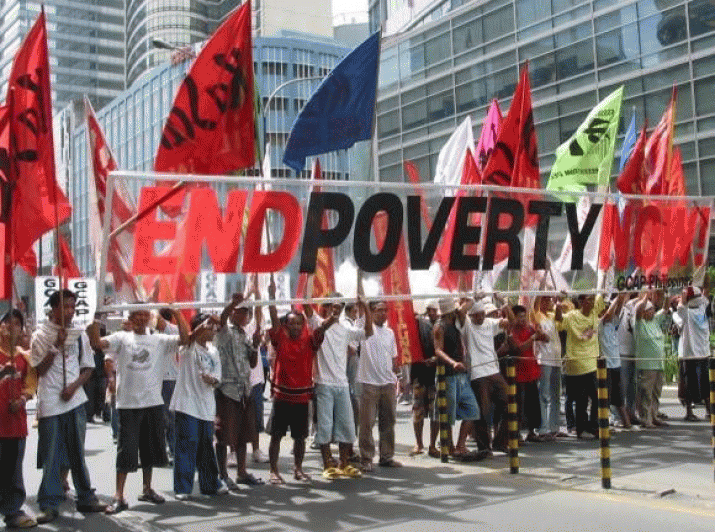
Therefore, the old public health model still occupies a prime position in explaining the causes of diseases. The New Public Health suggests how to improve our lifestyle to overcome diseases and illness, although the cause of malnutrition is still low income. People were poor in olden days too, and, they too must have asked the government of that time to improve their lot. People of England too lived in poverty in olden times. Are some people living in England today poor?
The World Bank suggests, in 2012, that 896 million people lived on less than $1.90 a day in developing countries. Globally, more than 162 million children remain undernourished (The Millennium Development Report 2014). On what criteria do we set the income of the poor workers so that they could have a sufficient amount of money income to buy a meal for themselves and their family members, it is a question, which required answer also in olden times.
Where the Government raises money from to raise the income of the poor is a big question to answer. One way is to give less money to those paid more than what is required. This extra money can be used to raise the wages of the low-paid workers. The other way, is for all countries to print more paper notes to pay more to low-paid workers. It is much easier to print more notes than to grow fruit and vegetables. If we cannot justify paying more to low-paid workers because they have limited education and training, printing notes and giving them to them to let them buy fruit and vegetables, education and medication is another way. This way, they will not suffer from malnutrition.
The New Public Health suggests doing exercise to prevent obesity, thereby preventing many diseases – hypertension, cholesterol, heart disease and breathing problems, diabetes, and many more. The agents of the health care system in olden times would have suggested to their patients to do exercise, or eat early to avoid indigestion or drink milk and eat fruit and vegetables, and do not smoke and drink alcohol.
The factors governing individual’s health has taken a new form: ‘ecological public health’. Earlier, those individuals who used to smoke had difficulties in breathing, but today, due to change in the mode of traffic and production activities, humans are facing new triggers of bad health. This is ecological public health. Apart from considering the old health model and new health model, it emphasizes sustaining the environment in which we live – to control air, water, and noise pollution to promote better health.
Millions of automobiles in highly-populated countries make people less able to breathe; also, factory pollution and noise pollution affects our health. In highly polluted and traffic-congested cities, people cannot inhale oxygen when they do breathing exercises. They inhale smog. Therefore, all governments are taking initiatives to overcome transport congestion, which is quite impossible to do in large metropolitan cities, including Australia.
One car means one level of pollution, a million cars means, millions more in the level of pollution, including noise pollution. We might like to measure the amount of pollution on Saturdays and Sundays to state the role of traffic emission in pollution.
Why do people cover their face while riding their motorbikes? It is due to environmental pollution. Why is Dengue fever still prevalent in countries like India? It is due to lack of cleanliness, where water is stagnant; mosquitoes that cause Dengue are born.
Why do people in many developing countries not drink the municipality water; instead buy water in bottles? Until today, the cause of poor nutrition is low income of the family.