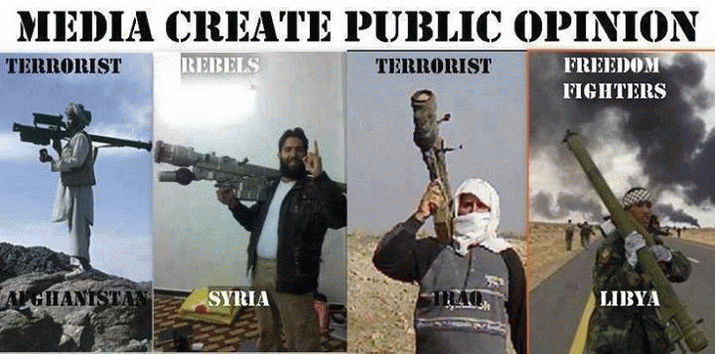
*Pic: Image from HERE
Amid the cleanup of the Belgian terror attacks, some questions are being asked that were softly spoken after Paris, and even whispered after New York’s 9/11. In essence – with our media’s focus on the dramatic, the visual, and the violent, are we abetting terror. Are we ourselves the means which small groups use to make big impacts – to frighten millions and more importantly, influence the direction of world events to damage all our lives.
The now familiar saturation coverage of every detail, the grainy action shots run over and over, the dramatization of the hunt for those responsible, the victim details, the memorials, and our social media participation, have become phenomena in themselves. What would happen if instead, we simply and minimally reported the facts, focused on analysis of the trends, and left it at that?
To gain perspective, let me point out something very important. Every day on this planet, about 30,000 children die from causes associated with poverty. This is an unspeakable horror that we have just learned to live with. We’ve made massive progress with this, in my lifetime that figure has reduced from a peak that was three times higher. But hold that figure in mind. Thirty thousand is ten equivalents of the September 11 bombings, every day that you or I have been alive. But it doesn’t make the news.
If we had proportionate, accurate newscasting, the daily news would just display that figure against a montage of images, in respectful silence, for thirty minutes. In comparison, nothing else really matters. Train crashes, murders, road accidents barely deserve a mention. But we prefer drama, and that’s how we get suckered every time. With earth changing consequence – pointless, economy-breaking wars are fought, politicians are elected of a calibre that we would normally find laughable. Armaments sales blossom while health and education expenditures plummet. And the bombers of our grandchildren’s generation are nurtured into existence in the ruins. By this means, hate-filled men hidden deep in the backwaters of the Middle East have us in their hands.
The psychology of terrorism is now well understood. On an individual level, the motive for young men, and occasionally women, lies essentially in self-importance. In achieving significance and glory, imagined or real, living or posthumous. This appeal, which has to overcome compassion for others, any shred of empathy, and any instinct for self preservation, can only gain traction in those who have wandered a landscape of insignificance and marginalization all their lives. Most young people feel they matter enough – to their parents and relatives, their friends, their communities, to society itself, to simply not feel any such need. Its a pre-existing pathology which provides a huge recruitment ground.
The most promising work in terror prevention is in youthwork, community building, family relationship strengthening, and educational help and acceleration so that we do not see refugee or war-born generations loosened out of the social weave, so they come to hate what they cannot be part of.
The politics is a different matter entirely. The key lies in its power to cause fear through randomness. Just as a lottery provides the illusion of hope to millions, the highly unlikely, but still imagineable outcome that it could be you next, getting shredded to pieces in a crowded place, in an ordinary city, makes terrorist bombings and shootings into political dynamite. Its so cost-effective – a mere handful of young men can intimidate a whole nation. Not surprisingly its a method that has been used across history by the underdogs, from the campaign for the state of Israel, all the way back to the the tactics of Boudicca against Rome.
But the actual vehicle of terrorism is the newscast. The television focus, for hour after hour, on the death, the drama, the blurry replaying of explosions, the second hand vicarious grief, the details and stories of survivors.
So the proposition must be considered, lest we face hundreds more versions of Paris, or Madrid, or Brussels, or Istanbul, every year, an unending, monotonous drone of spectacular carnage. Our media is collaborating in the terrorists’ work. It’s television gold, tabloid salvation. How can we stop that? Will sheer boredom do the job for us? Or is a new global media ethos needed? That the simple reporting of figures, general details, without drama, without repetition, should become the norm, and then get onto news that is actually important.
Terror kills a tiny fraction of the number that hunger, disease, poor sanitation, and now of course, climate change, does. The self-importance of the suicide bombers, the manipulation of their puppeteers, the welcoming arms of the world’s defence industry and the third rate politicians who get a free ride on the fears of the ill-informed.
These are all in our power to take away.
Only in wartime, do democratic countries suppress or restrict the news – and have popular support to do so. But I wonder if we will reach some hybrid of that – an agreement to not do the terrorists work for them, and hose down the drama and hysteria. And get on with the real work of making a just world.
Steve Biddulph
Adjunct Prof. of Psychology,
Author – Raising Boys, Raising Girls, and The New Manhood
Visit our Facebook page!
https://www.facebook.com/stevebiddulphraisinggirls
• Bob Hawkins in Comments: The Australian public should acknowledge that the flow of boat people to Australia was never more than a trickle, especially if compared with what’s been going on in the Mediterranean and across the borders of southern Europe. The media, especially Murdoch’s, must take a lot of blame for this. Voters should be reminded that, whichever big party they choose to run their country, it will be led by a state-sanctioned child abuser; and he will appoint an immigration minister, who, by taking the job, will be indicating his willingness also to be a child abuser. We, as a nation, should be a lot better than that.