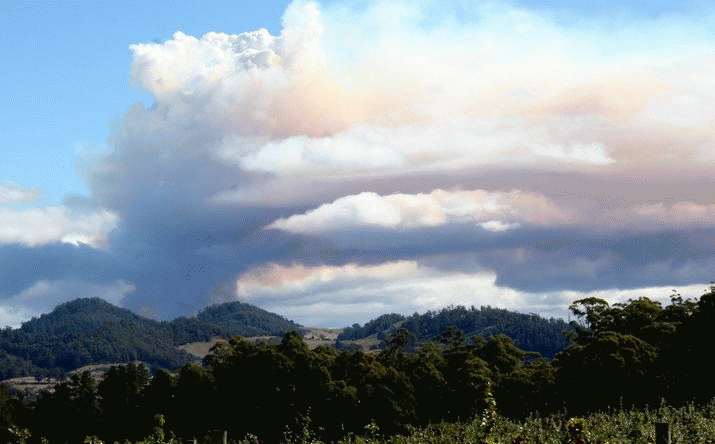
*Pics: Southern forests burning. Taken this afternoon (Monday) from near Cygnet by Pat Synge.

Southern Forests from David Nuttall … from the top of Sunday Hill (Monday)

Forestry Tasmania regeneration burn in the Plenty Valley (inside the 572 000ha identified for protection). 4 April 2012. Photo by Rob Blakers, http://www.robblakers.com/
Dear XXX,
Forestry Tasmania would like to advise you that its annual program of planned burns is likely to commence soon in mid to late March. Planned burns are conducted to regenerate forests after harvest and to contribute to the statewide fire management effort through fuel reduction burns.
Around 150 regeneration burns are planned for this year in coupes across the Permanent Timber Production Zone ranging in size from a couple of hectares up to approximately 100 hectares. In addition, Forestry Tasmania will be involved with fuel reduction burns across the state as part of the coordinated fuel reduction program.
WHY WE DO IT
Regeneration burning is undertaken in Autumn – starting in March and extending to May in some areas. Autumn is the best time to undertake this work because it is the safest time of year to burn; the fuels are dry which creates less smoke than damp fuels; the extreme conditions of summer have passed reducing the chance of the fire escaping boundaries; it is an ideal time for germination of eucalypt seedlings given warm temperatures and the onset of regular rainfall.
Fuel reduction burning is undertaken in Autumn and Spring and, like regeneration burning, is conducted when fuel and weather conditions are suitable.
HOW WE DO IT
Our aim is to minimise impact on neighbours and local communities. Every burn is carefully planned for safety, smoke dispersal, protection of assets, infrastructure, special values, and threatened and endangered species. These factors are documented in a burn plan that is reviewed, audited and approved along with a risk assessment.
We burn only when weather conditions are suitable for managing and containing the fire to the boundaries we have prepared and allow for favourable smoke dispersal as specified in each plan.
On poor smoke dispersal days, burning is voluntarily cancelled until suitable conditions prevail.
Our burns are also coordinated with other agencies and forestry businesses to control smoke levels within the Environment Protection Authority’s standards for each airshed area.
On-site preparation is undertaken where needed, for example fire breaks may be established to create a fuel free buffer on a dry boundary or near a special value or asset, and tracks are constructed to provide access for any suppression activities that may be required.
HOW WE LET PEOPLE KNOW
Notification of and engagement with immediate neighbours and other directly stakeholders at the planning stage.
Publication of the planned burn program on our Interactive Map Viewer
Through agreed protocols with tourism and wine industries
Public notices in daily and local newspapers
Notification of immediate neighbours and other stakeholders who have registered with us, of our intention to burn on the planned day.
Twice daily media and website reports during the burning season
Daily information uploads to www.plannedburnstas.com.au
MORE INFORMATION
You can find out more about Forestry Tasmania’s planned burns program by visiting www.forestrytas.com.au/planned-burns and www.plannedburnstas.com.au or by listening to ABC local radio during the burn season.
If you have questions or would like daily notifications of planned burns in your region then please contact:
XXX XXX
Stakeholder Engagement Coordinator
• ABC: Tasmania abandons World Heritage Area logging plans on UNESCO advice
• Ted Mead in Comments: In an understatement, we are governed by pathetic, troglodytic, pyromanical morons at the highest level in Tasmania. I just looked at the TFS 2016 fuel reduction program and I can’t believe that – directly after a massive fire in the Tarkine this summer they are about to torch some of the remaining unburnt country there. These areas include the Mt Lily, Edith and Holloway, which they attempted to incinerate last year but botched it up as those fires either didn’t ignite properly at some sites, or burnt further west towards the coast than they intended. And in the process they almost charred a bushwalker in their haste and incompetence.
• ABC: Tasmania’s Tarkine emerges as forest conflict hotspot over speciality timber access The Tarkine is shaping up as the new battleground in the reignited conflict over forestry, as the Tasmanian Government looks for sources of specialty timber outside the World Heritage Area. The Government is abiding by UNESCO’s World Heritage Committee’s ruling against selective logging in the Tasmanian Wilderness World Heritage Area (TWWHA). Forestry Minister Peter Gutwein said the decision was disappointing, but work was underway to assess the availability of special species, such as myrtle and celery top pine, in other reserves and conservation areas. “I’m going to be looking at all of the land outside the TWWHA,” he said. … In 2014, the Government ripped up the Tasmanian Forest Agreement and reclassified about 400,000 hectares from future reserves to future potential production forest, making it available for selective logging in late 2017. The Government is also considering specialty species logging in about one million hectares of reserves and conservation areas, including rainforests in the Tarkine. The Wilderness Society’s Vica Bailey said logging those areas, such as the pipeline corridor in the Tarkine protected under former prime minister John Howard in 2005, was equally unacceptable.
• Nicholas Gilbert in Comments: … The study is based on data from Mountain Ash forests burnt in the Black Saturday fires and clearly shows a direct link between tree age and fire severity, especially the propensity of fires to crown. The fires of most severity and rapid spread were from clear fell regrowth forests 15-30 years of age which carry maximum fuel load due to self-thinning after the initial clearfell. Fire intensity diminishes as forests age because crowns are higher and fuel is diminished. They conclude that logging practices need to change especially in a drying and heating climate.
• Gordon Bradbury in Comments: Personally I think it is time to threaten a consumer boycott of all Tasmanian timber. That’s right! ALL TASMANIAN TIMBER! The entire forest industry needs to take responsibility for the ongoing political madness they have helped create. Both Labor and Liberal parties need to abandon the public native forest special timbers industry. Otherwise this madness will drag on for many more years.