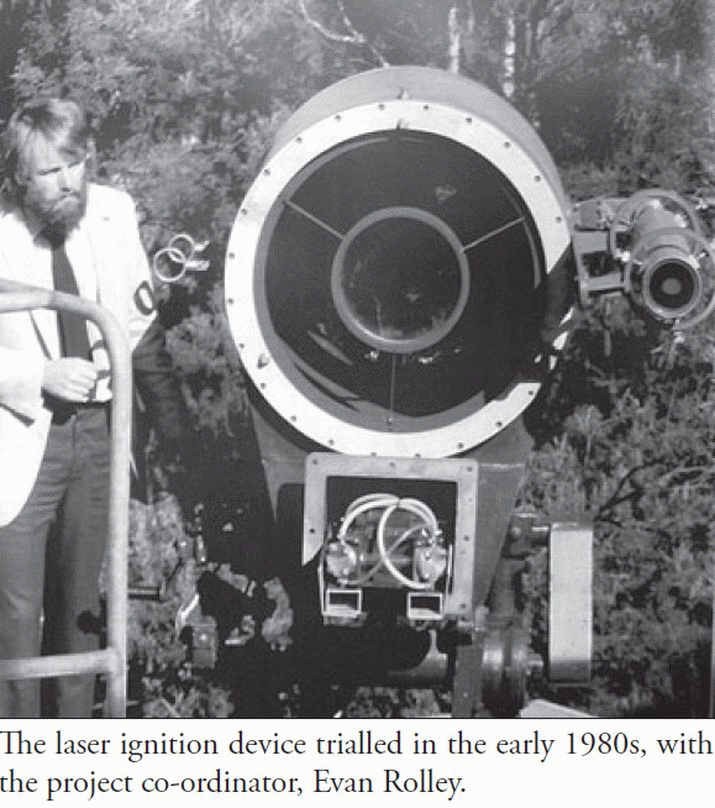
*Pic: The Laser Ignition Cannon … and Evan Rolley in younger days …
In January 2016 Tasmania was experiencing unprecedented climatic change and ecological breakdown in the form of drought, bushfires, water shortages and energy shortages. Many of the drivers of this calamity were external to Tasmania but some were domestic. As one of the world’s largest coal exporters and one of the world’s largest deforesters, Australia has a pathetic ecological record.
Has Tasmania been intelligently managing it’s evolved ecology? No.
Tasmania’s largest land ‘manager’ Forestry Tasmania spent decades perfecting ‘high intensity burns’ as a method of increasing forest yields by allegedly speeding-up harvest time by 5 years. You could say Forestry Tasmania was a government agency obsessed with fire.
By the 1970’s the importance of burning ‘slash’ (slash and burn) had turned into an almost military campaign for the Forestry Commission.
In 1975 Forestry and the UTAS Physics Department began work on a ‘laser ignition device’. By 1977, Evan Rolley had taken over from Phil Gourlay as chief coordinator of RandD on the ‘laser ignition device’. It consisted of laser elements mounted on a Bofors gun. A Bofors gun is a 40mm anti-aircraft gun that Forestry had obtained from the navy. Inspired by US weapons research, Forestry wanted to ignite harvesting slash from 4 to 5 km away.
Lasers in the device were focused with gold-plated mirrors which had to be expertly polished and mounted. However, by 1982 field trials showed the laser ignition device could not ignite eucalyptus leaves further than 750m away.
In 1983 the project was finally abandoned as too costly and unworkable. Forestry had wasted 8 years on the laser ignition cannon.
Aerial Incendiary Bombing
It took the Forestry Commission some decades to perfect aerial fire-lighting. Initially they experimented with giant matches, or DAIDs (Delayed Action Incendiary Devices). These were dropped from a helicopter on to targets. Forestry almost took-out a chopper when the head flew off a lighted DAID and into an open box of DAIDs inside the aircraft. The chopper was so full of smoke it was forced to land.
Fortunately no lives were lost. This method was abandoned when 3 people were killed in Victoria after a helicopter crashed while deploying DAIDS. From there Forestry moved-on to the ‘ping pong ball technique’.
Initially, 25mm plastic-cased balls containing 20g of potassium permanganate were injected by hand on an aircraft with 3ml of glycol and then thrown from the plane. The balls ignited after they hit the ground and stayed alight for 3 seconds. Forestry perfected an Aerial Incendiary Machine or ‘AIM’ which automated the priming and launched of the balls and spacing the spot fires more accurately. When the helitorch came on stream, it was used for regeneration burning and the AIM was used only for lighting fuel reduction burns.
The Helitorch
Developed in 1987 the device is best described by Forestry themselves: “The helitorch consists of a 200 litre container of jellied petrol carried as a sling load beneath a helicopter. The operation is controlled by a bombardier sitting beside and directing the pilot. The helitorch has revolutionised high-intensity burning in Tasmania. The speed, safety and enhanced control of the process compared with ground-based methods allow up to about 40 coupes to be burnt in one day”.
From Wet Sclerophyll to Dry Sclerophyll Forests
Since Forestry Tasmania has been bombing forests the island’s ecology has changed significantly. It may have been policy to convert wet or rainforests to dry forests for economic reasons. Forestry used buttongrass moorlands as “a priority target for systematic research on fuel reduction burning because of their flammability”. “The Forestry Commission began fuel reduction burning in buttongrass in 1939 using ground-based lighting and started aerial ignition in 1969, with an annual program reaching 10,000ha by 1975”.
At the same time Forestry were exporting massive amounts of ‘resource’ from the island’s limited forests. This peaked in the late 1990’s and 2000’s. Overall, it would be impossible to conclude that the activities of the Forestry Commission-Forestry Tasmania did not significantly alter the ecology, landscape and climate of Tasmania for ever.
West Tamar Talk would like to thank Evan Rolley for encouraging the documentation of the history of Research and Development at Forestry Tasmania. The result was “A History of Innovation Eighty-five Years of Research and Development at Forestry Tasmania” available HERE: http://www.forestrytas.com.au/uploads/File/pdf/pdf2009/innovation_web.pdf
First published on the Karl Stevens’ blogspot HERE
• Sign this PETITION for the Right to peaceful protest in Tasmania
• Blair Richards, Mercury: Forestry’s $480,000 consultants’ splurge FORESTRY Tasmania has spent almost half a million dollars on consultants, much of it on reports informing the State Government’s efforts to restructure the forest industry. Labor is calling for the release of reports to allow Tasmanians to get the full picture on Forestry Tasmania’s viability and the state of the forest industry. However, Resources Minister Paul Harriss says the reports are either Cabinet or commercial in confidence. Documents released after a Right to Information request from Labor show that between December 2014 and July last year Forestry Tasmania spent $481,779 on external consultants. The spending included …