Revealed! NZ’s Vegetation Browsing Evolution
New Zealand’s half a century of anti-wild animal campaigns and associated hired deer killers and aerial bombardment of forests with 1080 poison for possums may have been a total waste of public money as well as ecologically damaging to the country’s wilderness areas with use of poisons. That is one conclusion to be drawn from recent findings by Canterbury Museum work using “state of art 3D modelling”.
The work had given greater insight into New Zealand’s vegetation prior to humans migrating here and how the vegetation had evolved.
Canterbury Museum curator Professor Paul Scofield said the giant moa had a very strong bill (with) the ability to bite through thick twigs and sticks, but some small moas probably were grazing very much like sheep.”
The nine species of moa utilised the vegetation and had a considerable browsing impact. Moas became extinct 500 years ago due to hunting by Maori and fire destruction of their habitat by Maori and natural causes.
“They probably created much more open forest, eating under-storey, biting through thick sticks. We strongly suspect that what we called pristine forest is nothing like the pristine forest prior to human arrival,” said Professor Scofield.
“It has implications for conservation efforts going forward,” he added.
New Zeaand’s Sporting Hunters Outdoor Trust spokesman Laurie Collins, said government departments, mainly the Forest Service and its successor the Department of Conservation, has propounded that New Zealand’s vegetation had “evolved in the absence of browsing animals”. Laurie Collins said the Canterbury University work had blown the myth away.
“Whether animals or birds, matters little. Browsing was commonplace for millions of years,” he said. “Much of New Zealand’s so-called conservation efforts of the last 80 or so years, have therefore been mistakenly directed at getting rid of ‘pests,’ a tag applied by departments and the vocal Forest and Bird Society, to mammals such as deer and possums. Even schoolchildren in the class-room have erroneously been taught such flawed doctrines.”
Laurie Collins said credible scientists had spoken of New Zealand’s vegetation’s evolution under a strong browsing regime but had been ignored by departments pursuing their own agendas. He cited world-eminent New Zealand ecologist the late Dr Graeme Caughley who was rated a world leader in the field of vertebrate ecology. Dr Caughley who was senior principal research scientist at Australia’s CSIRO, told a 1988 New Zealand seminar that New Zealand’s plant-herbivore systems underwent three ecological stages.
He said “New Zealand has seen three browsing regimes over the last 1000 years:- the period of moa browsing up to 1400, the interregnum of little browsing 1400-1850 and the period of mammalian browsing (e.g. deer) since 1850.”
Laurie Collins said overseas scientists visiting New Zealand were critical of New Zealand’s anti-wild animal policies.
Late in the 1950s, Dr William Graf, a Californian Professor of Zoology, came to New Zealand to study the wild deer situation as Hawaii was considering introducing deer for sport.
Following the visit, Dr Graf reported there existed in New Zealand an “anti-exotic animal phobia, to an extent that much of the public as well as many government officials do not and cannot view the situation in an objective perspective.”
The bureaucracies were incensed and criticised Dr Graf with personality attacks.
The demise of the moa due to hunting by Maori and habitat destruction and the cessation of browsing, resulted in New Zealand’s vegetation entering an “unnatural” state.
The vegetation as early European settlers saw it in the 19th century, was not natural or original, because the browsing component had been largely removed with the extinction of the moa.
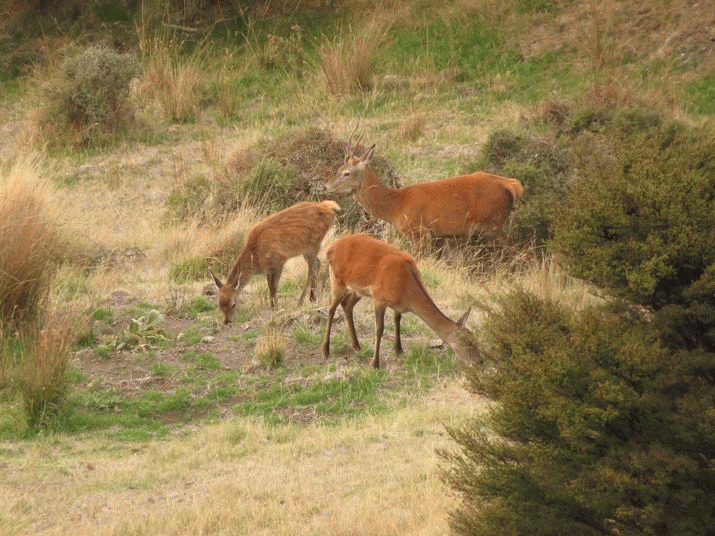
Once deer – and other wild animals – were established, the vegetation-and bush-became more like its original state of the moa era, because browsing was restored into the ecosystem said Laurie Collins.
Possums, like deer, had been vilified by departments and “extreme green groups” said Laurie Collins. He pointed to a Landcare Research scientist telling the Department of Conservation the possum was “not a rapacious consumer” of foliage and that they browsed only as small part of forest’s foliage production.
“Yet the New Zealand misconception of wild animal pests has resulted in costly “conservation efforts” that have involved hired deer killers, uncontrolled helicopter-based commercial deer slaughter and the use of ecologically damaging poisons such as 1080,” he said.
The findings and revelations of the Canterbury Museum work had very big “implications for conservation efforts going forward,” as Professor Scofield put it.
New Zealand’s vegetation by its evolution over countless millions of years from eras of herbivore dinosaurs to herbivore moas and now herbivore game animals needed browsing vital to the ecosystem’s functioning, said Laurie Collins. He refuted claims that hunters were selfish in not wanting deer killed.
“Hunters don’t want large numbers of deer beyond the habitat’s carrying capacity. They merely want common-sense management policies compatible with reality and the health of vegetation – and an end to damaging ecosystem poisons like 1080,” he said.
*Tony Orman (MNZIS) is a former town planner, conservationist (‘wise use of resources’), journalist and author of 24 books.